Summit County amends penalty after retailer submits late training proof in underage tobacco case
June 05, 2023 | Summit County Health Department, Summit County Commission and Boards, Summit County, Utah
This article was created by AI summarizing key points discussed. AI makes mistakes, so for full details and context, please refer to the video of the full meeting. Please report any errors so we can fix them. Report an error »
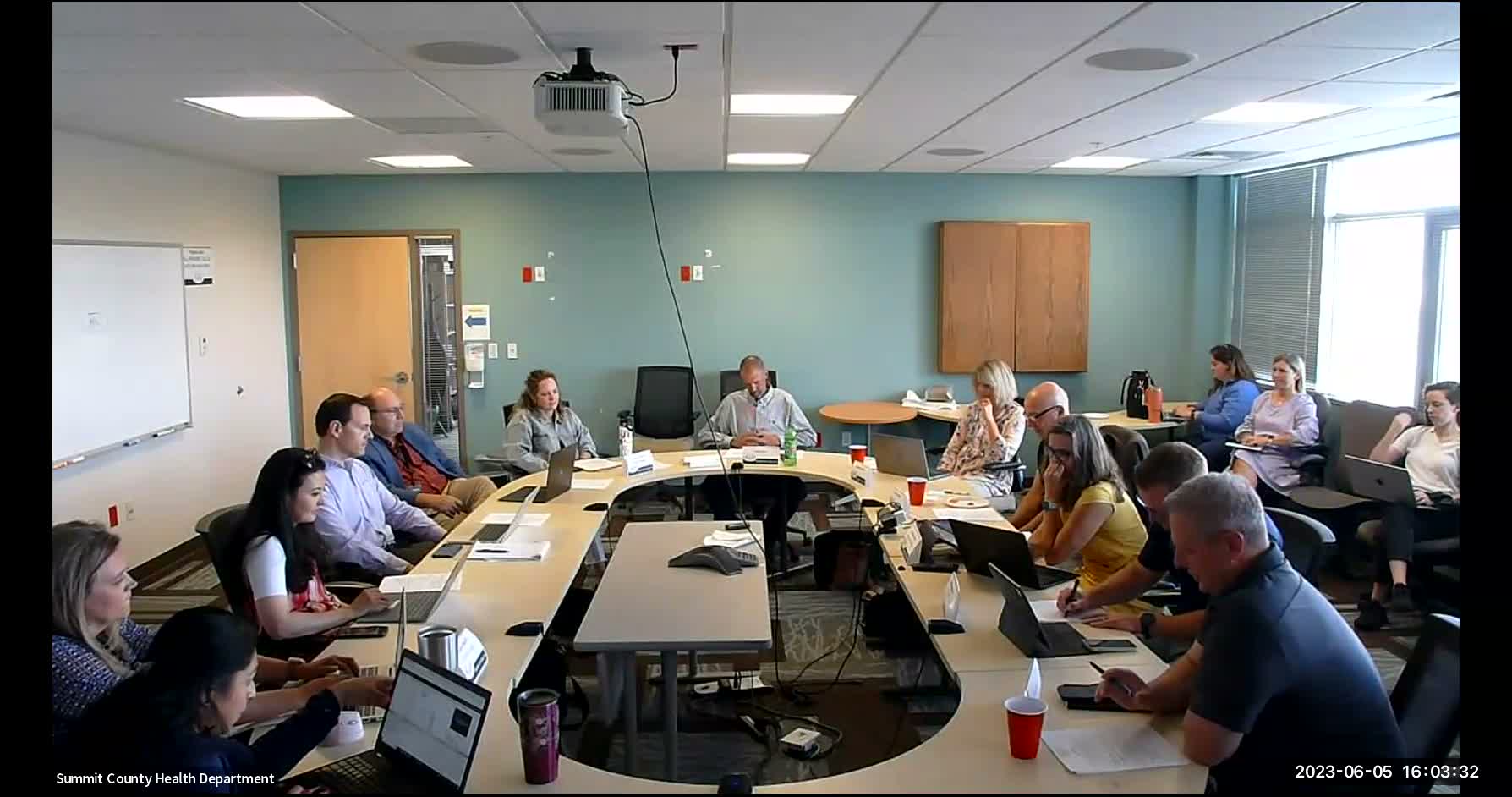
Chair Chris Cherniak opened discussion of an appeal over civil penalties assessed after two December underage tobacco-sales at retail locations owned by the same company. County counsel and health department staff told the board that the department had initially determined the retailers were not eligible for a statutory 50% reduction but later received documentation the department judged sufficient.
Ryan Stack of the Summit County Attorney’s Office and Dave Thomas reviewed the statutory framework in Utah Code §26‑7‑519, which provides two paths for reduction: a mandatory 50% reduction if employees completed an approved training within 30 days of commencing duties that include tobacco sales, or a discretionary suspension if the retailer agrees to implement training within 30 days of a hearing-officer determination. As Stack put it during the meeting, “the hearing officer shall reduce the penalty by at least 50%” when the first path’s conditions are met.
Olivia Gunnerson, the county’s tobacco-enforcement official, said staff initially granted the retailer 30 days to provide proof of training, extended that period while coordinating training options, and later reviewed the records the retailer supplied. Staff and county counsel concluded the submitted documentation was not facially inadequate and therefore met the statutory requirements for the reduction.
Based on that review, the hearing officer amended his earlier March determination and reduced the civil penalty to $500 per violation (half of the $1,000 assessed per violation). County staff said the retailer submitted a check for the reduced amount and the department considers the matter resolved for now. Dave Thomas noted the amended outcome will be recorded as a first violation at each location; the county tracks violations on a calendar-year basis and penalties increase for subsequent violations within the same year.
Board members asked procedural questions about the evidence and compliance checks; staff explained the county conducts underage-buyer operations twice a year in partnership with the Summit County Sheriff’s Office and that criminal penalties for employees are handled by law enforcement rather than the health department. No board vote was required at the meeting, and legal staff emphasized the separation of roles between the county attorney’s office staff who represent the health department and other counsel assigned to the board for appeals.
The department said it will bring proposed health-code updates to the board in August that include changes to the underage-tobacco-sale process intended to close gaps identified during this case. The board did not take additional action at the meeting.
Ryan Stack of the Summit County Attorney’s Office and Dave Thomas reviewed the statutory framework in Utah Code §26‑7‑519, which provides two paths for reduction: a mandatory 50% reduction if employees completed an approved training within 30 days of commencing duties that include tobacco sales, or a discretionary suspension if the retailer agrees to implement training within 30 days of a hearing-officer determination. As Stack put it during the meeting, “the hearing officer shall reduce the penalty by at least 50%” when the first path’s conditions are met.
Olivia Gunnerson, the county’s tobacco-enforcement official, said staff initially granted the retailer 30 days to provide proof of training, extended that period while coordinating training options, and later reviewed the records the retailer supplied. Staff and county counsel concluded the submitted documentation was not facially inadequate and therefore met the statutory requirements for the reduction.
Based on that review, the hearing officer amended his earlier March determination and reduced the civil penalty to $500 per violation (half of the $1,000 assessed per violation). County staff said the retailer submitted a check for the reduced amount and the department considers the matter resolved for now. Dave Thomas noted the amended outcome will be recorded as a first violation at each location; the county tracks violations on a calendar-year basis and penalties increase for subsequent violations within the same year.
Board members asked procedural questions about the evidence and compliance checks; staff explained the county conducts underage-buyer operations twice a year in partnership with the Summit County Sheriff’s Office and that criminal penalties for employees are handled by law enforcement rather than the health department. No board vote was required at the meeting, and legal staff emphasized the separation of roles between the county attorney’s office staff who represent the health department and other counsel assigned to the board for appeals.
The department said it will bring proposed health-code updates to the board in August that include changes to the underage-tobacco-sale process intended to close gaps identified during this case. The board did not take additional action at the meeting.
Don't Miss a Word: See the Full Meeting!
Go beyond summaries. Unlock every video, transcript, and key insight with a Founder Membership.
✓
Get instant access to full meeting videos
✓
Search and clip any phrase from complete transcripts
✓
Receive AI-powered summaries & custom alerts
✓
Enjoy lifetime, unrestricted access to government data
30-day money-back guarantee
