Park City group urges Summit County municipalities to sign 0 Food Waste Compact; program offers startup subsidies
May 21, 2024 | Summit County Council of Governments, Summit County Commission and Boards, Summit County, Utah
This article was created by AI summarizing key points discussed. AI makes mistakes, so for full details and context, please refer to the video of the full meeting. Please report any errors so we can fix them. Report an error »
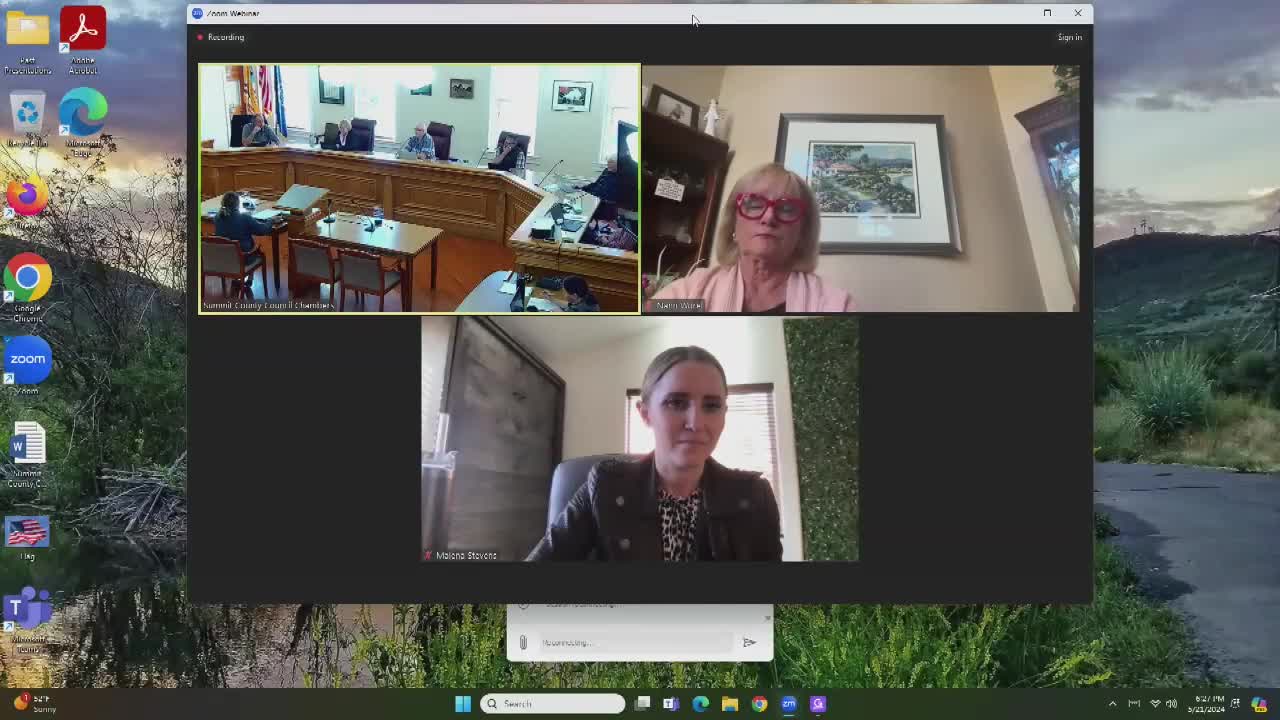
Andy Hecht, manager of the Climate Fund at the Park City Community Foundation, asked Summit County municipal representatives to endorse a voluntary 0 Food Waste Compact that aims to divert food waste from landfills through coordinated local actions and partnerships. He said the compact is meant to be collaborative — bringing together local governments, businesses, nonprofits and residents — and is not a request for funding from municipalities.
Hecht outlined a pilot residential curbside opt‑in collection program. The pilot offers startup fee waivers and a first month of service paid by the foundation to reduce barriers to enrollment. He identified Momentum as the contracted hauler for residential pickups and said collected material is being diverted to Wasatch Resource Recovery (an anaerobic digestion facility in North Salt Lake). Hecht said initial service targets concentrated ZIP codes and that the program aims to enroll 1,000 households this year as a critical mass for sustainability.
Hecht and other speakers argued the program could reduce landfill pressure and deliver a sizable cost‑avoidance. Hecht presented a figure of about $1,470,000 per year as the value of landfill 'airspace' preserved by diverting food waste; a county solid‑waste official present (Speaker 4) said an engineering audit found about 26% of landfill tonnage is food waste and described the savings as cost avoidance rather than direct cash to reallocate.
During Q&A, council members raised operational questions: where diverted food would be processed, the structure of fees for households ($19/month for a 5‑gallon bucket and $27/month for a 16‑gallon tote, according to the presenter), potential future movement to an opt‑out model, and where the program will be available first. Speakers also discussed how current recycling programs compare (one official described current residential diversion as roughly 2,600 tons) and how tourism increases per‑resident waste in the county.
Presenters said the compact will launch publicly on June 4 and requested municipalities consider signing by May 31 (presentation request). Andy Hecht offered to meet with individual councils to explain details and coordinate local rollouts.
The presentation left questions council members flagged for follow up — notably longer‑term cost comparisons, the proposed timeline to transition to any opt‑out model, and how the county’s existing recycling and transfer systems would integrate with a scaled food‑waste program.
Hecht outlined a pilot residential curbside opt‑in collection program. The pilot offers startup fee waivers and a first month of service paid by the foundation to reduce barriers to enrollment. He identified Momentum as the contracted hauler for residential pickups and said collected material is being diverted to Wasatch Resource Recovery (an anaerobic digestion facility in North Salt Lake). Hecht said initial service targets concentrated ZIP codes and that the program aims to enroll 1,000 households this year as a critical mass for sustainability.
Hecht and other speakers argued the program could reduce landfill pressure and deliver a sizable cost‑avoidance. Hecht presented a figure of about $1,470,000 per year as the value of landfill 'airspace' preserved by diverting food waste; a county solid‑waste official present (Speaker 4) said an engineering audit found about 26% of landfill tonnage is food waste and described the savings as cost avoidance rather than direct cash to reallocate.
During Q&A, council members raised operational questions: where diverted food would be processed, the structure of fees for households ($19/month for a 5‑gallon bucket and $27/month for a 16‑gallon tote, according to the presenter), potential future movement to an opt‑out model, and where the program will be available first. Speakers also discussed how current recycling programs compare (one official described current residential diversion as roughly 2,600 tons) and how tourism increases per‑resident waste in the county.
Presenters said the compact will launch publicly on June 4 and requested municipalities consider signing by May 31 (presentation request). Andy Hecht offered to meet with individual councils to explain details and coordinate local rollouts.
The presentation left questions council members flagged for follow up — notably longer‑term cost comparisons, the proposed timeline to transition to any opt‑out model, and how the county’s existing recycling and transfer systems would integrate with a scaled food‑waste program.
Don't Miss a Word: See the Full Meeting!
Go beyond summaries. Unlock every video, transcript, and key insight with a Founder Membership.
✓
Get instant access to full meeting videos
✓
Search and clip any phrase from complete transcripts
✓
Receive AI-powered summaries & custom alerts
✓
Enjoy lifetime, unrestricted access to government data
30-day money-back guarantee
