Summit County readies revenue, coalition strategy after 2024 Utah legislative session
March 27, 2024 | Summit County Council, Summit County Commission and Boards, Summit County, Utah
This article was created by AI summarizing key points discussed. AI makes mistakes, so for full details and context, please refer to the video of the full meeting. Please report any errors so we can fix them. Report an error »
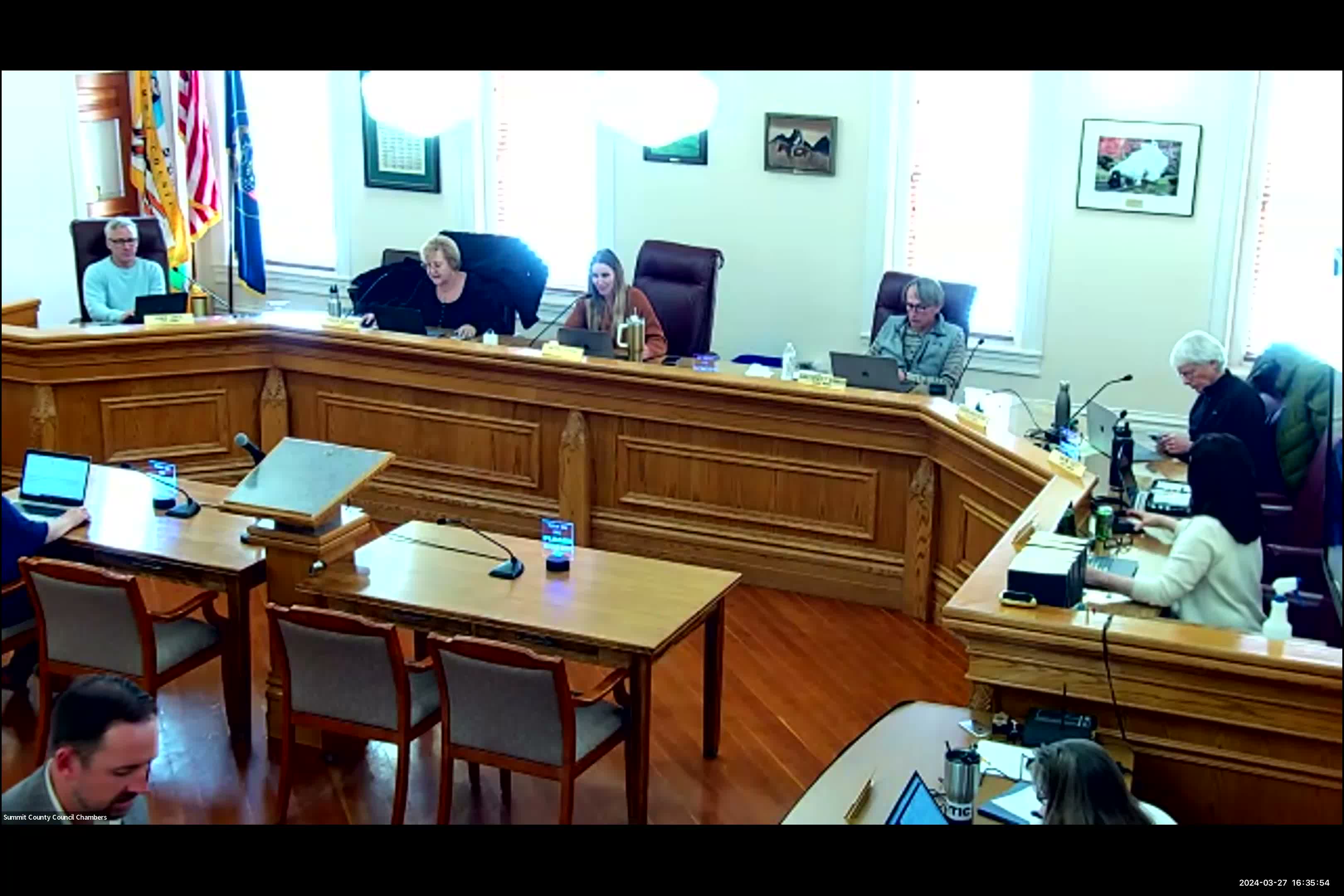
Summit County leaders on March 20 heard from the county's lobbying team and staff about the 2024 Utah legislative session and began planning next steps to address tourism-driven service costs and key infrastructure needs.
Renee Cowley, who co-led the county’s session briefing, told the council the county did not face punitive legislation this year and that relationships with House leadership have strengthened: "We didn't receive any punitive legislation aimed specifically at Summit County," she said, and the county had new legislative champions. Lobbyist Frank Pignanelli added perspective on the session's scale, noting the legislature passed 591 bills.
Why it matters: county officials said they need to convert legislative goodwill into actionable interim work. Council members flagged three near-term priorities: (1) options to fund emergency medical services and other tourism impacts, (2) guidance and coalition-building around housing tools such as housing and transit reinvestment zones (HTRZ), and (3) planning for transportation improvements tied to longer-term Olympic planning.
Revenue option on the table: HB236 (rural hospital tax)
Staff and finance presented House Bill 236 — a new optional sales-tax increment available to eligible counties — as the most promising immediate tool. Finance presenter Matt Levitt summarized preliminary local modeling: county staff estimate a modest implementation (roughly a 0.4% increment) could generate on the order of $12 million annually; model inputs include that roughly half of sales-tax revenue in the county is paid by nonresidents. Levitt said such a tax could reduce pressure on the county general fund and could offset multiple services, estimating the measure might reduce about $2.2–3 million of EMS-related general-fund spending depending on final allocations and voter approval.
Board and council members asked procedural and timing questions. Staff said the usual path would be a council resolution to place the question on the November ballot; if approved, the tax could be assessable in 2025. Councilmember Chris asked that staff and elected leaders quickly form a subcommittee to define how revenues would be allocated among eligible uses (EMS, search-and-rescue, solid waste, law enforcement, avalanche forecasting and related impacts).
TRT and EMS: shaping the narrative
The council also debated flexibility in the transient room tax (TRT) and the narrative used at the legislature. Council members said an omnibus, data-driven approach is needed so the county's request is understood as mitigating tourism impacts (for example, EMS calls generated by nonresident recreation) rather than as a general revenue grab. Several members pointed to analyses previously prepared showing 40–50% of certain seasonal demand (for example EMS and search-and-rescue) is driven by visitors.
Housing and HTRZ
Staff flagged SB208, which sets a new 10-acre minimum for housing and transit reinvestment zones (HTRZ). Summit County currently has a pending 2.5-acre HTRZ application; staff said it remains unclear how the state's new language will affect that in-process application and are awaiting state guidance.
Olympics planning
Lobbyists and council members emphasized the county's strategic position if Utah hosts future Olympics and urged early coalition-building so infrastructure asks are framed around resident needs first. Steve Styler said early planning must identify projects that benefit residents long-term — for example, the Kimball Junction interchange — rather than present Olympic-only justifications.
Next steps and council direction
Council members asked staff and the lobbying team to develop a short-term action plan for the interim: (1) form a small council subcommittee and stakeholder group to refine revenue ask language and allocation options; (2) prepare data briefs showing resident vs. visitor demand for EMS and other services; and (3) begin outreach to similarly situated counties, UAC and tourism partners to build coalitions and identify legislative champions.
The lobbying team stressed the timing: most bills take effect May 1 and funding items July 1, so interim work and coalition-building are needed now to influence the next session or potential special-session priorities.
Renee Cowley, who co-led the county’s session briefing, told the council the county did not face punitive legislation this year and that relationships with House leadership have strengthened: "We didn't receive any punitive legislation aimed specifically at Summit County," she said, and the county had new legislative champions. Lobbyist Frank Pignanelli added perspective on the session's scale, noting the legislature passed 591 bills.
Why it matters: county officials said they need to convert legislative goodwill into actionable interim work. Council members flagged three near-term priorities: (1) options to fund emergency medical services and other tourism impacts, (2) guidance and coalition-building around housing tools such as housing and transit reinvestment zones (HTRZ), and (3) planning for transportation improvements tied to longer-term Olympic planning.
Revenue option on the table: HB236 (rural hospital tax)
Staff and finance presented House Bill 236 — a new optional sales-tax increment available to eligible counties — as the most promising immediate tool. Finance presenter Matt Levitt summarized preliminary local modeling: county staff estimate a modest implementation (roughly a 0.4% increment) could generate on the order of $12 million annually; model inputs include that roughly half of sales-tax revenue in the county is paid by nonresidents. Levitt said such a tax could reduce pressure on the county general fund and could offset multiple services, estimating the measure might reduce about $2.2–3 million of EMS-related general-fund spending depending on final allocations and voter approval.
Board and council members asked procedural and timing questions. Staff said the usual path would be a council resolution to place the question on the November ballot; if approved, the tax could be assessable in 2025. Councilmember Chris asked that staff and elected leaders quickly form a subcommittee to define how revenues would be allocated among eligible uses (EMS, search-and-rescue, solid waste, law enforcement, avalanche forecasting and related impacts).
TRT and EMS: shaping the narrative
The council also debated flexibility in the transient room tax (TRT) and the narrative used at the legislature. Council members said an omnibus, data-driven approach is needed so the county's request is understood as mitigating tourism impacts (for example, EMS calls generated by nonresident recreation) rather than as a general revenue grab. Several members pointed to analyses previously prepared showing 40–50% of certain seasonal demand (for example EMS and search-and-rescue) is driven by visitors.
Housing and HTRZ
Staff flagged SB208, which sets a new 10-acre minimum for housing and transit reinvestment zones (HTRZ). Summit County currently has a pending 2.5-acre HTRZ application; staff said it remains unclear how the state's new language will affect that in-process application and are awaiting state guidance.
Olympics planning
Lobbyists and council members emphasized the county's strategic position if Utah hosts future Olympics and urged early coalition-building so infrastructure asks are framed around resident needs first. Steve Styler said early planning must identify projects that benefit residents long-term — for example, the Kimball Junction interchange — rather than present Olympic-only justifications.
Next steps and council direction
Council members asked staff and the lobbying team to develop a short-term action plan for the interim: (1) form a small council subcommittee and stakeholder group to refine revenue ask language and allocation options; (2) prepare data briefs showing resident vs. visitor demand for EMS and other services; and (3) begin outreach to similarly situated counties, UAC and tourism partners to build coalitions and identify legislative champions.
The lobbying team stressed the timing: most bills take effect May 1 and funding items July 1, so interim work and coalition-building are needed now to influence the next session or potential special-session priorities.
Don't Miss a Word: See the Full Meeting!
Go beyond summaries. Unlock every video, transcript, and key insight with a Founder Membership.
✓
Get instant access to full meeting videos
✓
Search and clip any phrase from complete transcripts
✓
Receive AI-powered summaries & custom alerts
✓
Enjoy lifetime, unrestricted access to government data
30-day money-back guarantee
