Council staff flags multiple Utah bills with county impacts, from data privacy to stadium financing
February 21, 2024 | Summit County Council, Summit County Commission and Boards, Summit County, Utah
This article was created by AI summarizing key points discussed. AI makes mistakes, so for full details and context, please refer to the video of the full meeting. Please report any errors so we can fix them. Report an error »
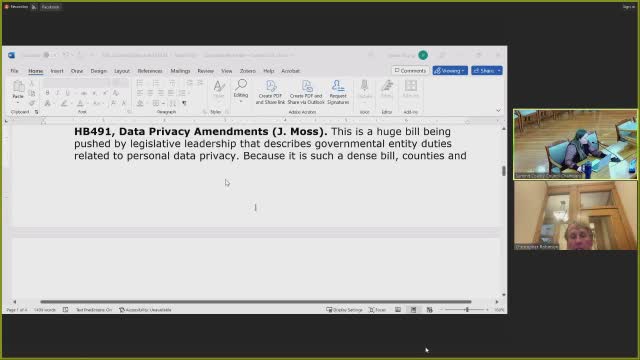
Council staff spent the first part of the meeting reviewing several bills at the Utah State Legislature that could affect county operations and budgets. Staff described HB491 as a “very dense bill” that establishes a state-level privacy board without local-government representation and said information-technology directors across counties are anxious about how to implement the changes. “It does establish a privacy board at the state level, yet there's no representation on that board from local government,” staff said.
Stormwater and construction provisions in HB507 drew specific concern from the county’s stormwater enforcement team. Staff said the bill could affect every construction site in the state and the state’s MS4 programs, and carries a fiscal note of about $11,000,000 — a heavy burden in a year with no projected surplus. The county’s stormwater team warned the provisions could expose counties to EPA direct enforcement.
On local revenue tools, staff reiterated support for HB558, a bill to give third-class counties (including Summit County) more flexibility in transient room tax (TRT) uses to help pay for services generated by visitors — such as solid-waste collection, emergency medical services and search-and-rescue. “These services are being used by nonresidents,” staff said, noting the county has pushed for TRT flexibility for multiple sessions.
Members also heard about HB562, a Fair Park investment bill tied to an effort to fund a proposed Major League Baseball stadium through a statewide TRT/franchise mechanism. Staff described a complex structure with gubernatorial and legislative appointees to a board and estimated revenues of $50–60 million annually, but also significant public costs. Council members and staff asked what happens if a franchise agreement fails and who would be left “holding the bag,” calling the proposal risky.
Other bills raised in the briefing included HB527 (limits on disciplining public employees for use of gender-specific language), HB532/HB534 (streamlining state boards and commissions), SB204 (changes affecting homeowners associations) and SB91 (expanded definition of county officers that could require public hearings for salary changes). For each item staff recommended continued monitoring and follow-up through the Utah Association of Counties where appropriate.
Stormwater and construction provisions in HB507 drew specific concern from the county’s stormwater enforcement team. Staff said the bill could affect every construction site in the state and the state’s MS4 programs, and carries a fiscal note of about $11,000,000 — a heavy burden in a year with no projected surplus. The county’s stormwater team warned the provisions could expose counties to EPA direct enforcement.
On local revenue tools, staff reiterated support for HB558, a bill to give third-class counties (including Summit County) more flexibility in transient room tax (TRT) uses to help pay for services generated by visitors — such as solid-waste collection, emergency medical services and search-and-rescue. “These services are being used by nonresidents,” staff said, noting the county has pushed for TRT flexibility for multiple sessions.
Members also heard about HB562, a Fair Park investment bill tied to an effort to fund a proposed Major League Baseball stadium through a statewide TRT/franchise mechanism. Staff described a complex structure with gubernatorial and legislative appointees to a board and estimated revenues of $50–60 million annually, but also significant public costs. Council members and staff asked what happens if a franchise agreement fails and who would be left “holding the bag,” calling the proposal risky.
Other bills raised in the briefing included HB527 (limits on disciplining public employees for use of gender-specific language), HB532/HB534 (streamlining state boards and commissions), SB204 (changes affecting homeowners associations) and SB91 (expanded definition of county officers that could require public hearings for salary changes). For each item staff recommended continued monitoring and follow-up through the Utah Association of Counties where appropriate.
Don't Miss a Word: See the Full Meeting!
Go beyond summaries. Unlock every video, transcript, and key insight with a Founder Membership.
✓
Get instant access to full meeting videos
✓
Search and clip any phrase from complete transcripts
✓
Receive AI-powered summaries & custom alerts
✓
Enjoy lifetime, unrestricted access to government data
30-day money-back guarantee
