County staff flags bills on infrastructure financing, housing penalties, AI disclosure and mining limits
February 14, 2024 | Summit County Council, Summit County Commission and Boards, Summit County, Utah
This article was created by AI summarizing key points discussed. AI makes mistakes, so for full details and context, please refer to the video of the full meeting. Please report any errors so we can fix them. Report an error »
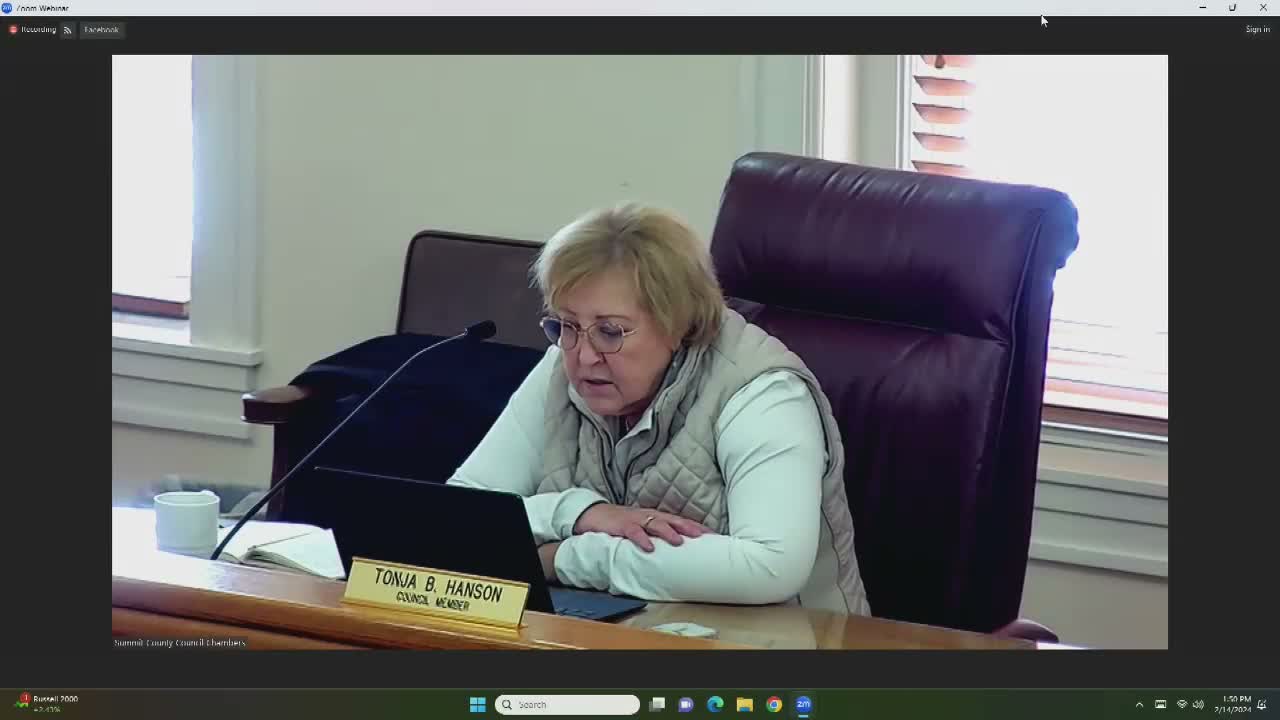
County legislative staff delivered a multi-item update on state legislation the county is monitoring, emphasizing how bills could affect local planning, funding and regulatory authority.
Jana Young summarized HB 13, which would establish infrastructure-financing districts that allow developers access to the municipal bond market to fund infrastructure within a district. "It truly is just a mechanism to have access to this other bond market," Young said, noting the district would not change local land-use authority but could be useful in financing large development infrastructure costs.
On HB 329, staff asked the council to follow a package of bills that would require disclosure when political advertising is substantially generated by artificial intelligence. Eve (staff) said the bills would mandate labeling of AI-generated audio, visual or text campaign communications and make use of AI an aggravating factor in crimes committed using the technology.
Several bills touching water and land use were raised. One measure would create irrigation rules for counties with headwaters that drain to the Great Salt Lake and impose fines for violations; the Utah Association of Counties took an opposed position and Summit County has been engaged because the county is named in the bill. Another proposal (cited as HB 502 in staff remarks) would constrain local land-use authority by requiring counties and cities to allow certain critical-infrastructure materials and mining operations as permitted or conditional uses in many zones, with only narrow exceptions.
Staff also noted HB 465 (housing-affordability revisions) as a concern because it adds new penalties for failing to meet targeted moderate-income housing reporting and creates a targeted housing definition at 120% of area median income.
Young advised continued monitoring and staff coordination with the Utah Association of Counties and legislative sponsors as the session progresses. Several council members asked staff to investigate funding-match details for housing-related programs and to track whether existing appeal and cure processes remain available under amended law.
Jana Young summarized HB 13, which would establish infrastructure-financing districts that allow developers access to the municipal bond market to fund infrastructure within a district. "It truly is just a mechanism to have access to this other bond market," Young said, noting the district would not change local land-use authority but could be useful in financing large development infrastructure costs.
On HB 329, staff asked the council to follow a package of bills that would require disclosure when political advertising is substantially generated by artificial intelligence. Eve (staff) said the bills would mandate labeling of AI-generated audio, visual or text campaign communications and make use of AI an aggravating factor in crimes committed using the technology.
Several bills touching water and land use were raised. One measure would create irrigation rules for counties with headwaters that drain to the Great Salt Lake and impose fines for violations; the Utah Association of Counties took an opposed position and Summit County has been engaged because the county is named in the bill. Another proposal (cited as HB 502 in staff remarks) would constrain local land-use authority by requiring counties and cities to allow certain critical-infrastructure materials and mining operations as permitted or conditional uses in many zones, with only narrow exceptions.
Staff also noted HB 465 (housing-affordability revisions) as a concern because it adds new penalties for failing to meet targeted moderate-income housing reporting and creates a targeted housing definition at 120% of area median income.
Young advised continued monitoring and staff coordination with the Utah Association of Counties and legislative sponsors as the session progresses. Several council members asked staff to investigate funding-match details for housing-related programs and to track whether existing appeal and cure processes remain available under amended law.
View the Full Meeting & All Its Details
This article offers just a summary. Unlock complete video, transcripts, and insights as a Founder Member.
✓
Watch full, unedited meeting videos
✓
Search every word spoken in unlimited transcripts
✓
AI summaries & real-time alerts (all government levels)
✓
Permanent access to expanding government content
30-day money-back guarantee
