Summit County Council presses UDOT on SR‑224 options as Dakota Pacific review continues
January 23, 2024 | Summit County Council, Summit County Commission and Boards, Summit County, Utah
This article was created by AI summarizing key points discussed. AI makes mistakes, so for full details and context, please refer to the video of the full meeting. Please report any errors so we can fix them. Report an error »
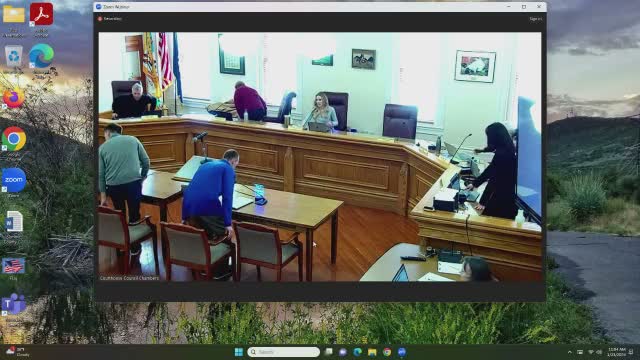
The Summit County Council spent a work session focused on traffic implications of the Dakota Pacific proposal, pressing staff and UDOT consultants for more detail on three alternatives for SR‑224 that range widely in cost and community impact.
The council heard that the county‑commissioned peer review generally agreed with Fair and Peers’ original traffic impact study but noted remaining questions about mitigation, safety, phasing and who would pay for measures such as a proposed northbound lane. “It does assume that the bus rapid transit on 224 is operational,” a county presenter said when summarizing the studies and assumptions behind the traffic model.
Why it matters: SR‑224 at Kimball Junction already carries heavy seasonal and year‑round demand, and council members said a piecemeal fix risks shifting congestion onto neighboring intersections. The three UDOT alternatives discussed are: A, a split‑diamond that redirects local trips to Landmark Drive; B, a trench/fly‑under intended to get through traffic off SR‑224 and reconnect east and west neighborhoods; and C, a conventional widening with pedestrian underpasses.
What staff told the council: County presenters and peer reviewers said the studies used sound methods and that observed April counts were scaled using UDOT recorder data to model average winter and annual conditions. On effectiveness, staff offered a preliminary performance estimate, saying Alternative B produced the best throughput in early metrics — roughly “30 to 35% better” on travel‑time and queuing measures compared with alternatives A and C — but cautioned the number is a ballpark and that final engineering could change results.
Costs and tradeoffs: Staff reported preliminary, non‑final level‑4 cost figures: Alternative A roughly $85–90 million, Alternative B around $150–160 million, and Alternative C about $35 million. Council members pressed for clarity that those are preliminary estimates, and noted Alternative B’s superior throughput could come with a much wider roadway footprint, higher property‑acquisition costs and a different pedestrian experience.
Transit, capture parking and funding: Several council members urged modelling that pairs roadway changes with a dedicated transit center and structured parking at the Richlands parcel to see whether a multimodal package would change rankings. Staff noted funding is typically a partnership — state STIP programming, federal grants (including FHWA’s Reconnecting Communities), possible Olympic‑era funds and local contributions were all identified as potential sources — but that none of those sources are guaranteed.
Requested follow‑ups: Council members asked staff to return with clearer metrics showing how the performance gap was measured, scenario modelling that includes a new transit center and structured parking, and refreshed cost assumptions. Staff agreed to bring updated analyses to the next meeting and to re‑examine prior structured‑parking concepts for the Richlands site.
Public process and schedule: Staff announced a public hearing on the traffic analysis and related topics is scheduled for Feb. 15 at 6 p.m. at Ecker Middle School, with a decision meeting set for Feb. 20 at 6 p.m. The council asked communications staff to publish weekly updates on upcoming topics.
What happened next: Council member Chris moved to adjourn; Roger seconded, and the council adjourned. The meeting was set to continue the discussion at a follow‑up work session later in the week.
The council heard that the county‑commissioned peer review generally agreed with Fair and Peers’ original traffic impact study but noted remaining questions about mitigation, safety, phasing and who would pay for measures such as a proposed northbound lane. “It does assume that the bus rapid transit on 224 is operational,” a county presenter said when summarizing the studies and assumptions behind the traffic model.
Why it matters: SR‑224 at Kimball Junction already carries heavy seasonal and year‑round demand, and council members said a piecemeal fix risks shifting congestion onto neighboring intersections. The three UDOT alternatives discussed are: A, a split‑diamond that redirects local trips to Landmark Drive; B, a trench/fly‑under intended to get through traffic off SR‑224 and reconnect east and west neighborhoods; and C, a conventional widening with pedestrian underpasses.
What staff told the council: County presenters and peer reviewers said the studies used sound methods and that observed April counts were scaled using UDOT recorder data to model average winter and annual conditions. On effectiveness, staff offered a preliminary performance estimate, saying Alternative B produced the best throughput in early metrics — roughly “30 to 35% better” on travel‑time and queuing measures compared with alternatives A and C — but cautioned the number is a ballpark and that final engineering could change results.
Costs and tradeoffs: Staff reported preliminary, non‑final level‑4 cost figures: Alternative A roughly $85–90 million, Alternative B around $150–160 million, and Alternative C about $35 million. Council members pressed for clarity that those are preliminary estimates, and noted Alternative B’s superior throughput could come with a much wider roadway footprint, higher property‑acquisition costs and a different pedestrian experience.
Transit, capture parking and funding: Several council members urged modelling that pairs roadway changes with a dedicated transit center and structured parking at the Richlands parcel to see whether a multimodal package would change rankings. Staff noted funding is typically a partnership — state STIP programming, federal grants (including FHWA’s Reconnecting Communities), possible Olympic‑era funds and local contributions were all identified as potential sources — but that none of those sources are guaranteed.
Requested follow‑ups: Council members asked staff to return with clearer metrics showing how the performance gap was measured, scenario modelling that includes a new transit center and structured parking, and refreshed cost assumptions. Staff agreed to bring updated analyses to the next meeting and to re‑examine prior structured‑parking concepts for the Richlands site.
Public process and schedule: Staff announced a public hearing on the traffic analysis and related topics is scheduled for Feb. 15 at 6 p.m. at Ecker Middle School, with a decision meeting set for Feb. 20 at 6 p.m. The council asked communications staff to publish weekly updates on upcoming topics.
What happened next: Council member Chris moved to adjourn; Roger seconded, and the council adjourned. The meeting was set to continue the discussion at a follow‑up work session later in the week.
Don't Miss a Word: See the Full Meeting!
Go beyond summaries. Unlock every video, transcript, and key insight with a Founder Membership.
✓
Get instant access to full meeting videos
✓
Search and clip any phrase from complete transcripts
✓
Receive AI-powered summaries & custom alerts
✓
Enjoy lifetime, unrestricted access to government data
30-day money-back guarantee
