Summit County Council hears Dakota Pacific�s revised development-agreement proposal: 600 units, PPP land trade and UDOT coordination
April 04, 2024 | Summit County Council, Summit County Commission and Boards, Summit County, Utah
This article was created by AI summarizing key points discussed. AI makes mistakes, so for full details and context, please refer to the video of the full meeting. Please report any errors so we can fix them. Report an error »
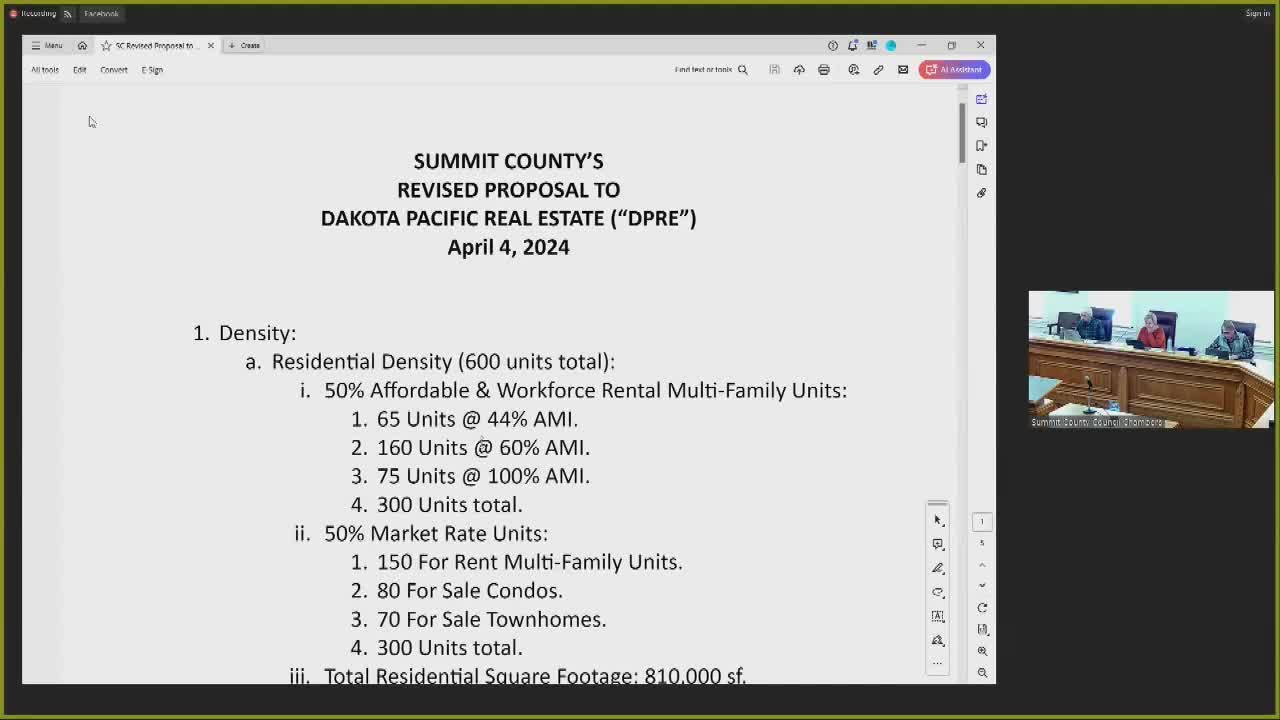
A developer representative on Thursday presented Summit County Council with a revised plan to alter a development agreement for the Kimmell Junction area that would authorize 600 residential units, expanded commercial space and a public-private partnership to fund transit and parking improvements.
Chris Robinson, the presenter identified in the meeting as the representative for DPRE, told council members the residential program would be split roughly half affordable/workforce (300 units) and half market-rate (300 units). He said the affordable component would include 65 units at 44 percent of area median income (AMI) intended for 9 percent tax-credit financing, 60 units at 60 percent AMI and an additional 75 units described as "attainable" at an AMI level the presenter did not specify.
Robinson said existing commercial space near the Skullcandy and Visitor Center buildings totals about 75,000 square feet and that the revised plan contemplates roughly 300,000 square feet of additional commercial development. He described a long list of permitted commercial uses that would allow technology, research, health and senior care, higher education, finance, energy and performing-arts uses while excluding general office.
A central element of the proposal is a proposed public-private partnership (PPP) in which the county would exchange the Richlands Building and Transit Center parcel (described in the presentation as about 6.14 acres) to DPRE in return for a roughly similar tract west of the Skullcandy building (presenter said the available parcel appeared to be about 4.69 acres). Robinson said the Richlands parcel would be folded into the PPP and redeveloped with structured parking (an estimated 1,500 to 2,000 stalls), an updated transit center and a civic plaza with ground-floor retail and a pedestrian connection to the east side of SR-224; he also mentioned the possibility of a future gondola.
On financing, the presenter suggested a mix of county funding, state and federal grants and legislative changes to allow the county to use transient-room-tax revenue in new ways. "These resources would be to get for the county in the unincorporated Bridal Basin Resort Communities Tax to modify the transient room tax," he said, later adding that state law would need to be changed to make some uses acceptable.
Transportation improvements were another focus. Robinson urged coordination with the Utah Department of Transportation on the SR-224 (Kimball Junction) environmental impact statement and said the developer prefers an overpass or "pedestrian promenade" rather than a pedestrian underpass. He said the preferred UDOT alternative may be placed on the Statewide Transportation Improvement Program (STIP) for design funding but cautioned STIP funding currently covers the EIS work, not construction.
Robinson proposed phasing releases of additional project density in 25 percent increments tied to milestones: the PPP public improvements being permitted, funded and under construction; UDOTs completion of final preferred-alternative design; and commencement of UDOT construction on intersections. "When we say 25% of your density, thats excluding what you put on if you master plan whatever on the PPP parcel," he said.
Council members pressed on feasibility and trade-offs. One councilmember, Roger (first name given during the meeting), said the package represented a "substantial" change and raised concerns that deed restrictions on affordable units would reduce property value and hamper marketability. He asked for clarification on commercial-square-foot numbers, AMI levels and where the proposed loss or gain of market-rate units would fall in prior plans. "It's hard to see ... where the thresholds are for economic feasibility," he said.
Other council members and the presenter discussed parking typologies and cost. One attendee cited a per-stall estimate that would make structured parking expensive; the developer said parking could be bonded against tax revenues and that typologies such as tiered or tuck-under parking might reduce costs.
Council members also discussed public benefits listed by the presenter: a childcare facility space for up to 100 children offered at below-market rent (operator not specified) and a possible continuing-care retirement community to use commercial space if feasible. The presenter said the PPP would aim to capture multimodal benefits, including transit and a pedestrian connection across SR-224.
Regarding timeline and public input, council members noted a placeholder public hearing on April 22 but many said they needed more time to digest the new proposal and expected to reconvene for further discussion before asking the public for comment. The chair indicated the April 22 date was flexible and that the council would likely set a hearing after members had time to evaluate the package.
The meeting ended without a decision on the development agreement; council members moved to adjourn after agreeing to reconvene and continue review.
Chris Robinson, the presenter identified in the meeting as the representative for DPRE, told council members the residential program would be split roughly half affordable/workforce (300 units) and half market-rate (300 units). He said the affordable component would include 65 units at 44 percent of area median income (AMI) intended for 9 percent tax-credit financing, 60 units at 60 percent AMI and an additional 75 units described as "attainable" at an AMI level the presenter did not specify.
Robinson said existing commercial space near the Skullcandy and Visitor Center buildings totals about 75,000 square feet and that the revised plan contemplates roughly 300,000 square feet of additional commercial development. He described a long list of permitted commercial uses that would allow technology, research, health and senior care, higher education, finance, energy and performing-arts uses while excluding general office.
A central element of the proposal is a proposed public-private partnership (PPP) in which the county would exchange the Richlands Building and Transit Center parcel (described in the presentation as about 6.14 acres) to DPRE in return for a roughly similar tract west of the Skullcandy building (presenter said the available parcel appeared to be about 4.69 acres). Robinson said the Richlands parcel would be folded into the PPP and redeveloped with structured parking (an estimated 1,500 to 2,000 stalls), an updated transit center and a civic plaza with ground-floor retail and a pedestrian connection to the east side of SR-224; he also mentioned the possibility of a future gondola.
On financing, the presenter suggested a mix of county funding, state and federal grants and legislative changes to allow the county to use transient-room-tax revenue in new ways. "These resources would be to get for the county in the unincorporated Bridal Basin Resort Communities Tax to modify the transient room tax," he said, later adding that state law would need to be changed to make some uses acceptable.
Transportation improvements were another focus. Robinson urged coordination with the Utah Department of Transportation on the SR-224 (Kimball Junction) environmental impact statement and said the developer prefers an overpass or "pedestrian promenade" rather than a pedestrian underpass. He said the preferred UDOT alternative may be placed on the Statewide Transportation Improvement Program (STIP) for design funding but cautioned STIP funding currently covers the EIS work, not construction.
Robinson proposed phasing releases of additional project density in 25 percent increments tied to milestones: the PPP public improvements being permitted, funded and under construction; UDOTs completion of final preferred-alternative design; and commencement of UDOT construction on intersections. "When we say 25% of your density, thats excluding what you put on if you master plan whatever on the PPP parcel," he said.
Council members pressed on feasibility and trade-offs. One councilmember, Roger (first name given during the meeting), said the package represented a "substantial" change and raised concerns that deed restrictions on affordable units would reduce property value and hamper marketability. He asked for clarification on commercial-square-foot numbers, AMI levels and where the proposed loss or gain of market-rate units would fall in prior plans. "It's hard to see ... where the thresholds are for economic feasibility," he said.
Other council members and the presenter discussed parking typologies and cost. One attendee cited a per-stall estimate that would make structured parking expensive; the developer said parking could be bonded against tax revenues and that typologies such as tiered or tuck-under parking might reduce costs.
Council members also discussed public benefits listed by the presenter: a childcare facility space for up to 100 children offered at below-market rent (operator not specified) and a possible continuing-care retirement community to use commercial space if feasible. The presenter said the PPP would aim to capture multimodal benefits, including transit and a pedestrian connection across SR-224.
Regarding timeline and public input, council members noted a placeholder public hearing on April 22 but many said they needed more time to digest the new proposal and expected to reconvene for further discussion before asking the public for comment. The chair indicated the April 22 date was flexible and that the council would likely set a hearing after members had time to evaluate the package.
The meeting ended without a decision on the development agreement; council members moved to adjourn after agreeing to reconvene and continue review.
View the Full Meeting & All Its Details
This article offers just a summary. Unlock complete video, transcripts, and insights as a Founder Member.
✓
Watch full, unedited meeting videos
✓
Search every word spoken in unlimited transcripts
✓
AI summaries & real-time alerts (all government levels)
✓
Permanent access to expanding government content
30-day money-back guarantee
