Council debates EMS funding and broader county budget choices as staff balance one‑time vs ongoing costs
November 01, 2023 | Summit County Council, Summit County Commission and Boards, Summit County, Utah
This article was created by AI summarizing key points discussed. AI makes mistakes, so for full details and context, please refer to the video of the full meeting. Please report any errors so we can fix them. Report an error »
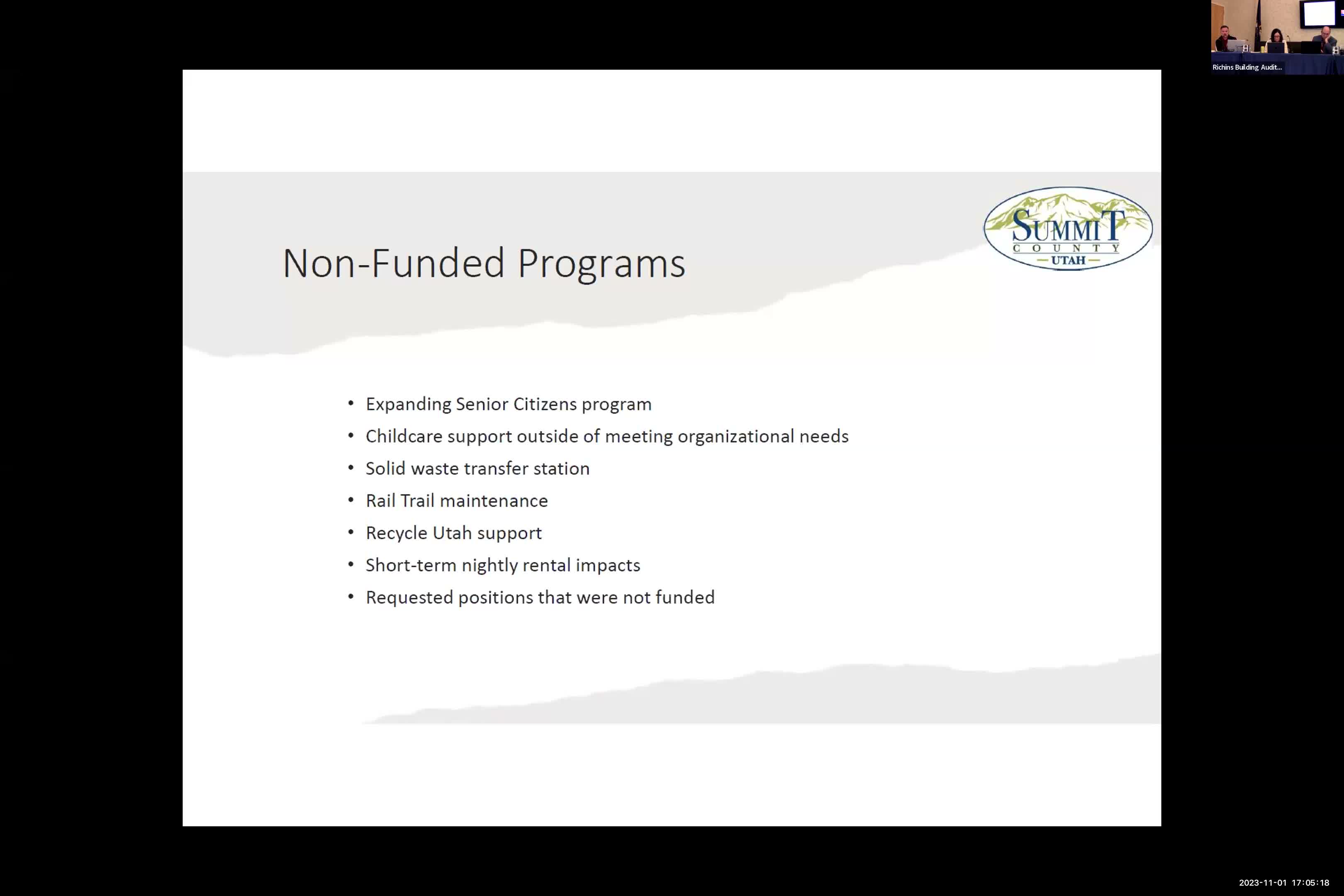
Summit County staff presented a manager’s proposed budget that the county manager described as largely balanced but that includes a set of new or expanded programs and significant cost drivers. Highlights included a proposed EMS expansion (driving multi‑million-dollar ongoing costs), a potential new lands & natural resources staff, an increase in legal services budgets to cover land‑use litigation, and transportation/studies funded by increased transportation support.
Key fiscal choices discussed: Council and staff discussed three options to relieve property‑tax pressure while funding EMS and public-safety increases: (1) a targeted local EMS tax, (2) seeking enabling state statute changes to allow Transient Room Tax (TRT) revenues to offset EMS costs for counties like Summit (currently restricted to higher‑class counties), and (3) a rural hospital sales/food/tourism tax option being pursued in other counties. Staff warned any statutory change would require legislative time and is unlikely to deliver 2024 revenue; council asked staff to refine options for 2025 planning.
One‑time vs ongoing: Staff identified roughly $7M of mostly one‑time costs that council could fund from reserves and another $4.6M of recurring costs (depending on whether the council wants to increase taxes). Council members discussed whether to accept one‑time use of fund balance for capital items (e.g., landfill closure) versus raising new recurring revenue through truth‑in‑taxation measures.
Why it mattered: EMS was repeatedly flagged as the largest driver of new ongoing cost in the county budget. The conversation framed several policy choices with distributional implications: whether to ask taxpayers for recurring increases now, use reserves for one‑time items, or pursue state policy changes that shift costs to visitors/tourists.
Ending: Staff will return with more detailed options and analyses before the truth‑in‑taxation hearing, including modeling of tax increases, potential TRT or hospital‑tax pathways, and the likely timetable to implement state‑law changes if the council chooses to pursue them.
Key fiscal choices discussed: Council and staff discussed three options to relieve property‑tax pressure while funding EMS and public-safety increases: (1) a targeted local EMS tax, (2) seeking enabling state statute changes to allow Transient Room Tax (TRT) revenues to offset EMS costs for counties like Summit (currently restricted to higher‑class counties), and (3) a rural hospital sales/food/tourism tax option being pursued in other counties. Staff warned any statutory change would require legislative time and is unlikely to deliver 2024 revenue; council asked staff to refine options for 2025 planning.
One‑time vs ongoing: Staff identified roughly $7M of mostly one‑time costs that council could fund from reserves and another $4.6M of recurring costs (depending on whether the council wants to increase taxes). Council members discussed whether to accept one‑time use of fund balance for capital items (e.g., landfill closure) versus raising new recurring revenue through truth‑in‑taxation measures.
Why it mattered: EMS was repeatedly flagged as the largest driver of new ongoing cost in the county budget. The conversation framed several policy choices with distributional implications: whether to ask taxpayers for recurring increases now, use reserves for one‑time items, or pursue state policy changes that shift costs to visitors/tourists.
Ending: Staff will return with more detailed options and analyses before the truth‑in‑taxation hearing, including modeling of tax increases, potential TRT or hospital‑tax pathways, and the likely timetable to implement state‑law changes if the council chooses to pursue them.
View the Full Meeting & All Its Details
This article offers just a summary. Unlock complete video, transcripts, and insights as a Founder Member.
✓
Watch full, unedited meeting videos
✓
Search every word spoken in unlimited transcripts
✓
AI summaries & real-time alerts (all government levels)
✓
Permanent access to expanding government content
30-day money-back guarantee
