Summit County adopts ordinance establishing recorder appeal authority, council to refine language
June 21, 2023 | Summit County Council, Summit County Commission and Boards, Summit County, Utah
This article was created by AI summarizing key points discussed. AI makes mistakes, so for full details and context, please refer to the video of the full meeting. Please report any errors so we can fix them. Report an error »
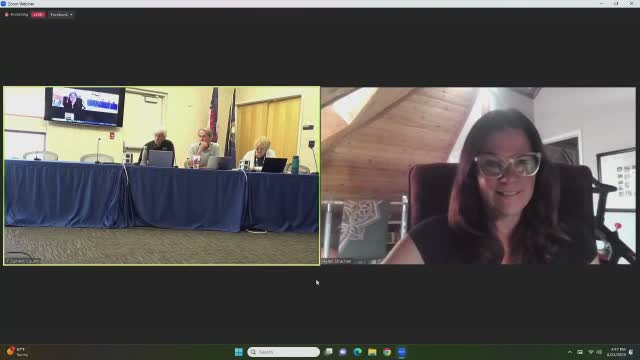
Summit County adopted Ordinance 961 to establish a county appeal authority for disputes about the County Recorder’s application of statewide recorder standards created under House Bill 351.
County attorneys explained HB351 requires counties to provide an appeal mechanism for persons who believe the county recorder has misapplied standards set by the State Recorder Standards Board. Staff recommended, given uncertainty about how often appeals will arise, that the county council act as the review board — following models used in Wasatch and Cache counties — with the chair and vice chair of the council serving respectively as the review board’s chair and vice chair.
Staff walked council members through the proposed appeal mechanics: an appellant must make a written demand for a final decision from the recorder; if the recorder does not issue a final decision, the ordinance deems the recorder’s position final after a seven‑day response window; an appeal must then be filed within 10 days of that final decision. The draft places the burden of proof on the appellant to show that the recorder’s interpretation was arbitrary, capricious or illegal. Rhonda, the county recorder, described past disputes between counties and title companies over removed pages and inconsistencies in recording practice as a motivating example for a statewide standard and local appeal procedure.
Council members asked for clearer phrasing in two places: explicitly stating that the then‑current chair and vice chair of the county council shall respectively serve as the review board’s chair and vice chair, and clarifying that the written demand required to trigger appeal timelines must request confirmation that the recorder’s decision is final. The council moved to adopt Ordinance 961 as presented with the two language modifications to be redlined and returned for final chair review. The record shows the motion carried with the council moving forward; one member abstained from the vote noting a late arrival (abstention recorded in the public meeting). Staff will finalize the redline language and incorporate the edits before codification in the county code (Title 1). The ordinance provides a local appellate path and starts statutory timelines for filing appeals once statewide rules are adopted and applied.
County attorneys explained HB351 requires counties to provide an appeal mechanism for persons who believe the county recorder has misapplied standards set by the State Recorder Standards Board. Staff recommended, given uncertainty about how often appeals will arise, that the county council act as the review board — following models used in Wasatch and Cache counties — with the chair and vice chair of the council serving respectively as the review board’s chair and vice chair.
Staff walked council members through the proposed appeal mechanics: an appellant must make a written demand for a final decision from the recorder; if the recorder does not issue a final decision, the ordinance deems the recorder’s position final after a seven‑day response window; an appeal must then be filed within 10 days of that final decision. The draft places the burden of proof on the appellant to show that the recorder’s interpretation was arbitrary, capricious or illegal. Rhonda, the county recorder, described past disputes between counties and title companies over removed pages and inconsistencies in recording practice as a motivating example for a statewide standard and local appeal procedure.
Council members asked for clearer phrasing in two places: explicitly stating that the then‑current chair and vice chair of the county council shall respectively serve as the review board’s chair and vice chair, and clarifying that the written demand required to trigger appeal timelines must request confirmation that the recorder’s decision is final. The council moved to adopt Ordinance 961 as presented with the two language modifications to be redlined and returned for final chair review. The record shows the motion carried with the council moving forward; one member abstained from the vote noting a late arrival (abstention recorded in the public meeting). Staff will finalize the redline language and incorporate the edits before codification in the county code (Title 1). The ordinance provides a local appellate path and starts statutory timelines for filing appeals once statewide rules are adopted and applied.
Don't Miss a Word: See the Full Meeting!
Go beyond summaries. Unlock every video, transcript, and key insight with a Founder Membership.
✓
Get instant access to full meeting videos
✓
Search and clip any phrase from complete transcripts
✓
Receive AI-powered summaries & custom alerts
✓
Enjoy lifetime, unrestricted access to government data
30-day money-back guarantee
