Council weighs trade‑offs on Old Ranch Road trail, narrowed lanes and whether to bury power lines
April 12, 2023 | Summit County Council, Summit County Commission and Boards, Summit County, Utah
This article was created by AI summarizing key points discussed. AI makes mistakes, so for full details and context, please refer to the video of the full meeting. Please report any errors so we can fix them. Report an error »
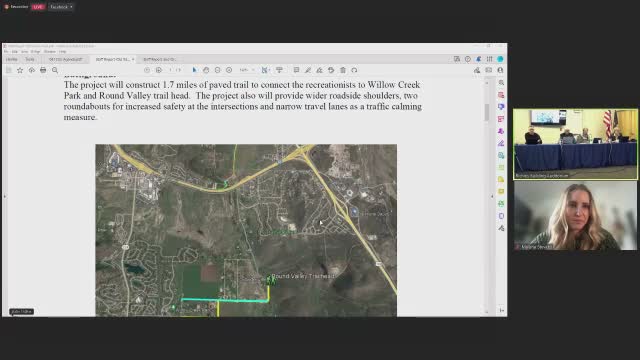
Summit County staff presented preliminary options on April 12 for Old Ranch Road: narrower travel lanes for traffic calming (proposed 10‑ft lanes), paved 5‑ft bike lanes, a separated south‑side trail, and two potential roundabouts. The design aims to balance safety, resident impacts, right‑of‑way acquisition and construction cost.
Council members questioned several elements: whether a mid‑block east roundabout was necessary given low traffic volumes at the intersecting legs; whether 10‑ft lanes are appropriate where approaches are wider; and whether to relocate existing overhead utility lines underground to avoid significant private property takings. County staff said Rocky Mountain Power’s easement and franchise terms will determine whether the utility must bear relocation costs; the county’s franchise agreement language (cited by staff) reserves the county’s right to require relocation of facilities 'in the county rights of way' and describes cost‑sharing or reimbursement rules when third‑party funding is available. Staff reported Rocky Mountain Power is preparing detailed pole‑by‑pole information and an estimator’s assessment, and recommended collecting recorded easement evidence and quantifying the delta between aerial and underground relocation costs before committing to a final cross section.
Council direction to staff:
- Pursue detailed title and easement checks to identify which poles are in county right‑of‑way and which are on privately recorded easements (those with independent recorded easements may have different relocation rules).
- Ask Rocky Mountain Power to provide pole‑level evidence of recorded easements and a cost estimate for relocation and undergrounding options.
- Return with an analysis that compares acquiring additional right‑of‑way versus paying the incremental cost to place utilities underground in constrained segments (staff said that in some locations removal of overhead facilities may be required because there is insufficient right‑of‑way for shoulders and trail).
Council also discussed surfacing for the trail: some residents asked for paved (asphalt) trail for year‑round usability and accessibility; other council members raised environmental and continuity concerns, noting much adjacent trail network is dirt/gravel and a short isolated asphalt stretch could create an 'island' of pavement. Staff will coordinate with Basin Recreation and the county’s trail master plan to recommend a consistent surfacing policy.
Next step: Staff will do targeted easement/title research, gather Rocky Mountain Power’s documented easements and relocation estimates, refine cross‑sections (including whether to keep 11‑ft lanes or narrow to 10‑ft in constrained segments), and return with recommended layout and budget estimates.
Quote and attribution: 'The county reserves the right to require grantee to relocate its electrical facilities in the county rights of way... at no cost to the county,' read County staff summarizing franchise language during the discussion. 'If the county receives funding for all or part of the relocation costs from a third party, the county shall assign or otherwise transfer to grantee all right it may have to that third party reimbursement,' the staff reading continued.
Why it matters: The project aims to create safer multimodal connections through a residential corridor; decisions about undergrounding utilities and alignment will affect project costs, private frontages and the eventual trail character.
Council members questioned several elements: whether a mid‑block east roundabout was necessary given low traffic volumes at the intersecting legs; whether 10‑ft lanes are appropriate where approaches are wider; and whether to relocate existing overhead utility lines underground to avoid significant private property takings. County staff said Rocky Mountain Power’s easement and franchise terms will determine whether the utility must bear relocation costs; the county’s franchise agreement language (cited by staff) reserves the county’s right to require relocation of facilities 'in the county rights of way' and describes cost‑sharing or reimbursement rules when third‑party funding is available. Staff reported Rocky Mountain Power is preparing detailed pole‑by‑pole information and an estimator’s assessment, and recommended collecting recorded easement evidence and quantifying the delta between aerial and underground relocation costs before committing to a final cross section.
Council direction to staff:
- Pursue detailed title and easement checks to identify which poles are in county right‑of‑way and which are on privately recorded easements (those with independent recorded easements may have different relocation rules).
- Ask Rocky Mountain Power to provide pole‑level evidence of recorded easements and a cost estimate for relocation and undergrounding options.
- Return with an analysis that compares acquiring additional right‑of‑way versus paying the incremental cost to place utilities underground in constrained segments (staff said that in some locations removal of overhead facilities may be required because there is insufficient right‑of‑way for shoulders and trail).
Council also discussed surfacing for the trail: some residents asked for paved (asphalt) trail for year‑round usability and accessibility; other council members raised environmental and continuity concerns, noting much adjacent trail network is dirt/gravel and a short isolated asphalt stretch could create an 'island' of pavement. Staff will coordinate with Basin Recreation and the county’s trail master plan to recommend a consistent surfacing policy.
Next step: Staff will do targeted easement/title research, gather Rocky Mountain Power’s documented easements and relocation estimates, refine cross‑sections (including whether to keep 11‑ft lanes or narrow to 10‑ft in constrained segments), and return with recommended layout and budget estimates.
Quote and attribution: 'The county reserves the right to require grantee to relocate its electrical facilities in the county rights of way... at no cost to the county,' read County staff summarizing franchise language during the discussion. 'If the county receives funding for all or part of the relocation costs from a third party, the county shall assign or otherwise transfer to grantee all right it may have to that third party reimbursement,' the staff reading continued.
Why it matters: The project aims to create safer multimodal connections through a residential corridor; decisions about undergrounding utilities and alignment will affect project costs, private frontages and the eventual trail character.
View the Full Meeting & All Its Details
This article offers just a summary. Unlock complete video, transcripts, and insights as a Founder Member.
✓
Watch full, unedited meeting videos
✓
Search every word spoken in unlimited transcripts
✓
AI summaries & real-time alerts (all government levels)
✓
Permanent access to expanding government content
30-day money-back guarantee
