Council reviews draft bylaws for Eastern Summit County wastewater district; health department proposed to operate systems temporarily
March 15, 2023 | Summit County Council, Summit County Commission and Boards, Summit County, Utah
This article was created by AI summarizing key points discussed. AI makes mistakes, so for full details and context, please refer to the video of the full meeting. Please report any errors so we can fix them. Report an error »
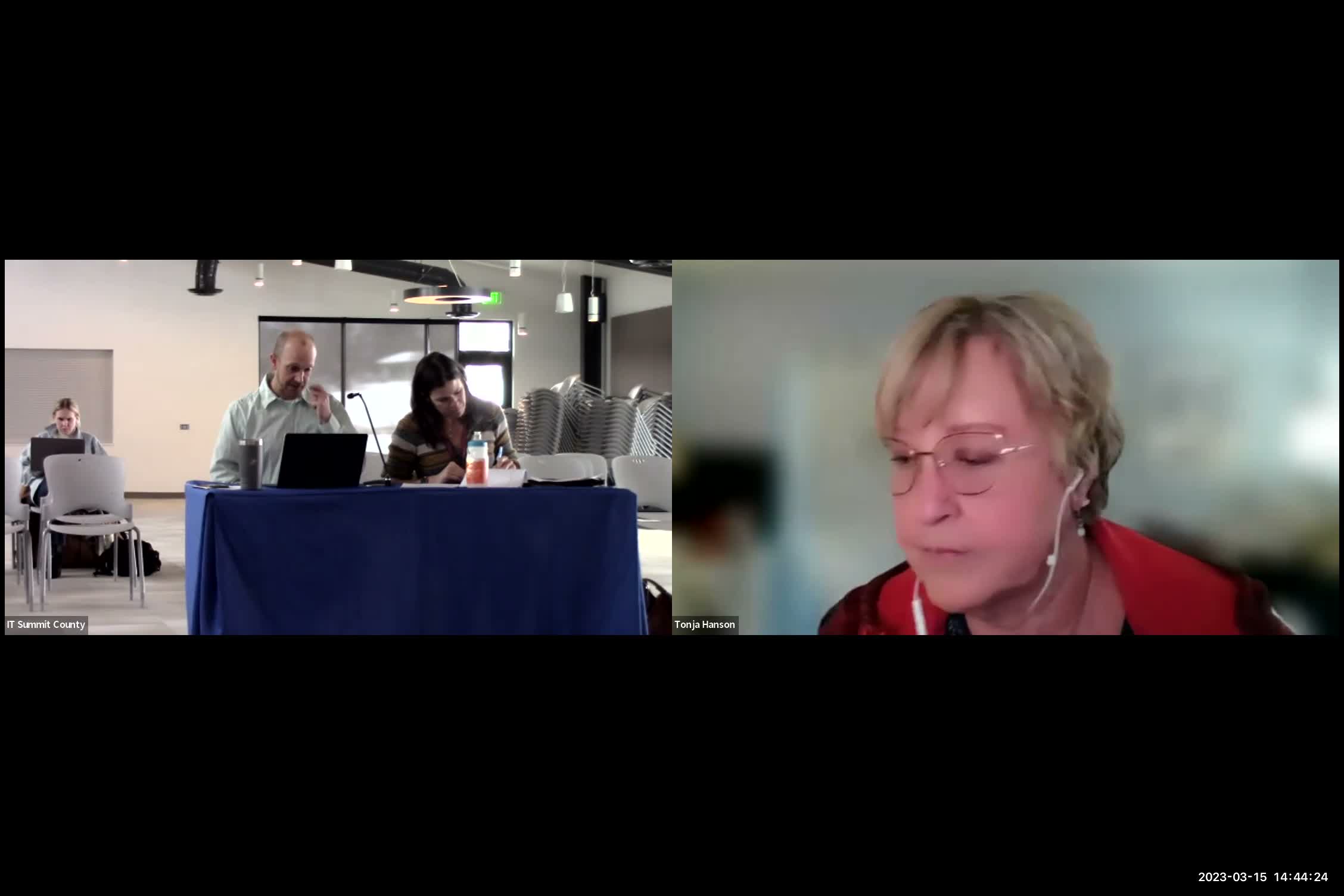
During a work-session segment on March 8, Summit County staff reviewed proposed bylaw changes and operations for the Eastern Summit County Water Conservancy Special Service District and recommended that the Summit County Health Department act as interim operator for certain community wastewater systems.
Staff outlined a tiered threshold in the draft bylaws: one to three lots would rely on standard on-site septic permitting; developments between four and 10 lots could be eligible for individual systems if the health department and district determine feasibility; proposed developments of 11 lots or more would be required to install a centralized large underground wastewater disposal system, subject to state rules and district approval.
Staff said the district would own the centralized treatment facility and main laterals while developers or individual lot owners would remain responsible for on-lot infrastructure. The draft also requires developers to bear 100% of design and preconstruction costs and to set up a reserve fund to cover catastrophic failures; staff said an initial example would be a $30,000 reserve estimate for one development (Trail Ridge), though the ordinance leaves the exact figure to district-level calculation when a system is proposed.
Concerns raised by council members included the 0.0069 factor used to calculate whether public sewer is "reasonably available" (a formula that, in one council example, produced a 1.7-mile connection threshold), the adequacy of reserve-fund calculations, homeowners-association financial stability, and reciprocal indemnification language in maintenance agreements. Councilors asked staff to clarify the background for the 0.0069 multiplier and provide examples of the calculation in practice.
Staff recommended commissioning a master sewer plan for the East Side to guide long-term investment and to craft an interlocal agreement between the district and the county that would allow the health department to act on an interim basis. Several council members signaled general support for the health department operating daily functions of the district for up to three developments while the district establishes its own administrative board and staff.
No ordinance vote was taken; staff said they will return with an ordinance to amend Chapter 20, a template maintenance agreement, a proposed fee schedule, and additional clarifications (including the calculation for "reasonably available").
Staff outlined a tiered threshold in the draft bylaws: one to three lots would rely on standard on-site septic permitting; developments between four and 10 lots could be eligible for individual systems if the health department and district determine feasibility; proposed developments of 11 lots or more would be required to install a centralized large underground wastewater disposal system, subject to state rules and district approval.
Staff said the district would own the centralized treatment facility and main laterals while developers or individual lot owners would remain responsible for on-lot infrastructure. The draft also requires developers to bear 100% of design and preconstruction costs and to set up a reserve fund to cover catastrophic failures; staff said an initial example would be a $30,000 reserve estimate for one development (Trail Ridge), though the ordinance leaves the exact figure to district-level calculation when a system is proposed.
Concerns raised by council members included the 0.0069 factor used to calculate whether public sewer is "reasonably available" (a formula that, in one council example, produced a 1.7-mile connection threshold), the adequacy of reserve-fund calculations, homeowners-association financial stability, and reciprocal indemnification language in maintenance agreements. Councilors asked staff to clarify the background for the 0.0069 multiplier and provide examples of the calculation in practice.
Staff recommended commissioning a master sewer plan for the East Side to guide long-term investment and to craft an interlocal agreement between the district and the county that would allow the health department to act on an interim basis. Several council members signaled general support for the health department operating daily functions of the district for up to three developments while the district establishes its own administrative board and staff.
No ordinance vote was taken; staff said they will return with an ordinance to amend Chapter 20, a template maintenance agreement, a proposed fee schedule, and additional clarifications (including the calculation for "reasonably available").
Don't Miss a Word: See the Full Meeting!
Go beyond summaries. Unlock every video, transcript, and key insight with a Founder Membership.
✓
Get instant access to full meeting videos
✓
Search and clip any phrase from complete transcripts
✓
Receive AI-powered summaries & custom alerts
✓
Enjoy lifetime, unrestricted access to government data
30-day money-back guarantee
