Council adopts countywide transportation impact‑fee facilities plan, extends projects beyond basin
April 12, 2023 | Summit County Council, Summit County Commission and Boards, Summit County, Utah
This article was created by AI summarizing key points discussed. AI makes mistakes, so for full details and context, please refer to the video of the full meeting. Please report any errors so we can fix them. Report an error »
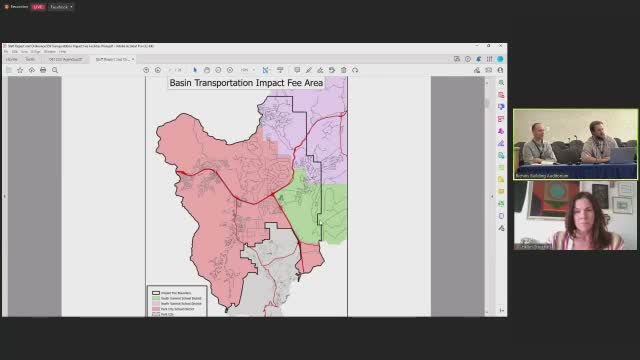
Summit County Council on April 12 adopted an updated Transportation Impact Fee Facilities Plan (Ordinance No. 959) after a public hearing limited to the facilities list. The plan updates the list of capacity projects, extends the fee area from the basin countywide, and establishes which capital projects are eligible to be funded by impact fees assessed on new development.
Staff explained the facilities plan portion lists 17 road and multimodal capacity projects taken from the county’s 2022 Long Range Transportation Plan. Helm Engineering clarified that the ‘eligible percent’ for each project reflects the share of new growth between 2022 and 2030 that will consume additional capacity and therefore can be financed with impact fees; impact‑fee monies can be spent only on capacity improvements (lanes, turn lanes, roundabouts, new links), not maintenance or resurfacing.
Council members asked about specific projects and whether some items (for example a sidepath or a multi‑lane expansion) carried underestimated costs relative to design complexity. Helm Engineering said the facilities plan uses accepted modeling assumptions for growth and capacity and that projects not constructed in a particular order can be funded from the pool of impact‑fee revenue so long as they appear in the approved facilities list. The actual fee schedule (part two of the update) — the dollar amounts charged to new development — is scheduled for a subsequent hearing.
Council adopted the facilities plan unanimously.
Context and next steps: Adoption of the facilities plan is a legal prerequisite to setting and charging impact fees. The council will reconvene for a second hearing on fee rates after staff and consultants finalize the calculation, which uses the facilities' eligible costs, growth forecasts and unit equivalencies by land‑use type.
Quote and attribution: 'The eligibility of projects is based on new growth in the next 8 years between 2022 and 2030,' explained Josh of Helm Engineering during the hearing.
Staff explained the facilities plan portion lists 17 road and multimodal capacity projects taken from the county’s 2022 Long Range Transportation Plan. Helm Engineering clarified that the ‘eligible percent’ for each project reflects the share of new growth between 2022 and 2030 that will consume additional capacity and therefore can be financed with impact fees; impact‑fee monies can be spent only on capacity improvements (lanes, turn lanes, roundabouts, new links), not maintenance or resurfacing.
Council members asked about specific projects and whether some items (for example a sidepath or a multi‑lane expansion) carried underestimated costs relative to design complexity. Helm Engineering said the facilities plan uses accepted modeling assumptions for growth and capacity and that projects not constructed in a particular order can be funded from the pool of impact‑fee revenue so long as they appear in the approved facilities list. The actual fee schedule (part two of the update) — the dollar amounts charged to new development — is scheduled for a subsequent hearing.
Council adopted the facilities plan unanimously.
Context and next steps: Adoption of the facilities plan is a legal prerequisite to setting and charging impact fees. The council will reconvene for a second hearing on fee rates after staff and consultants finalize the calculation, which uses the facilities' eligible costs, growth forecasts and unit equivalencies by land‑use type.
Quote and attribution: 'The eligibility of projects is based on new growth in the next 8 years between 2022 and 2030,' explained Josh of Helm Engineering during the hearing.
Don't Miss a Word: See the Full Meeting!
Go beyond summaries. Unlock every video, transcript, and key insight with a Founder Membership.
✓
Get instant access to full meeting videos
✓
Search and clip any phrase from complete transcripts
✓
Receive AI-powered summaries & custom alerts
✓
Enjoy lifetime, unrestricted access to government data
30-day money-back guarantee
