Council reviews Dakota Pacific traffic impact study and WCG peer review; experts recommend mitigation and monitoring
February 08, 2023 | Summit County Council, Summit County Commission and Boards, Summit County, Utah
This article was created by AI summarizing key points discussed. AI makes mistakes, so for full details and context, please refer to the video of the full meeting. Please report any errors so we can fix them. Report an error »
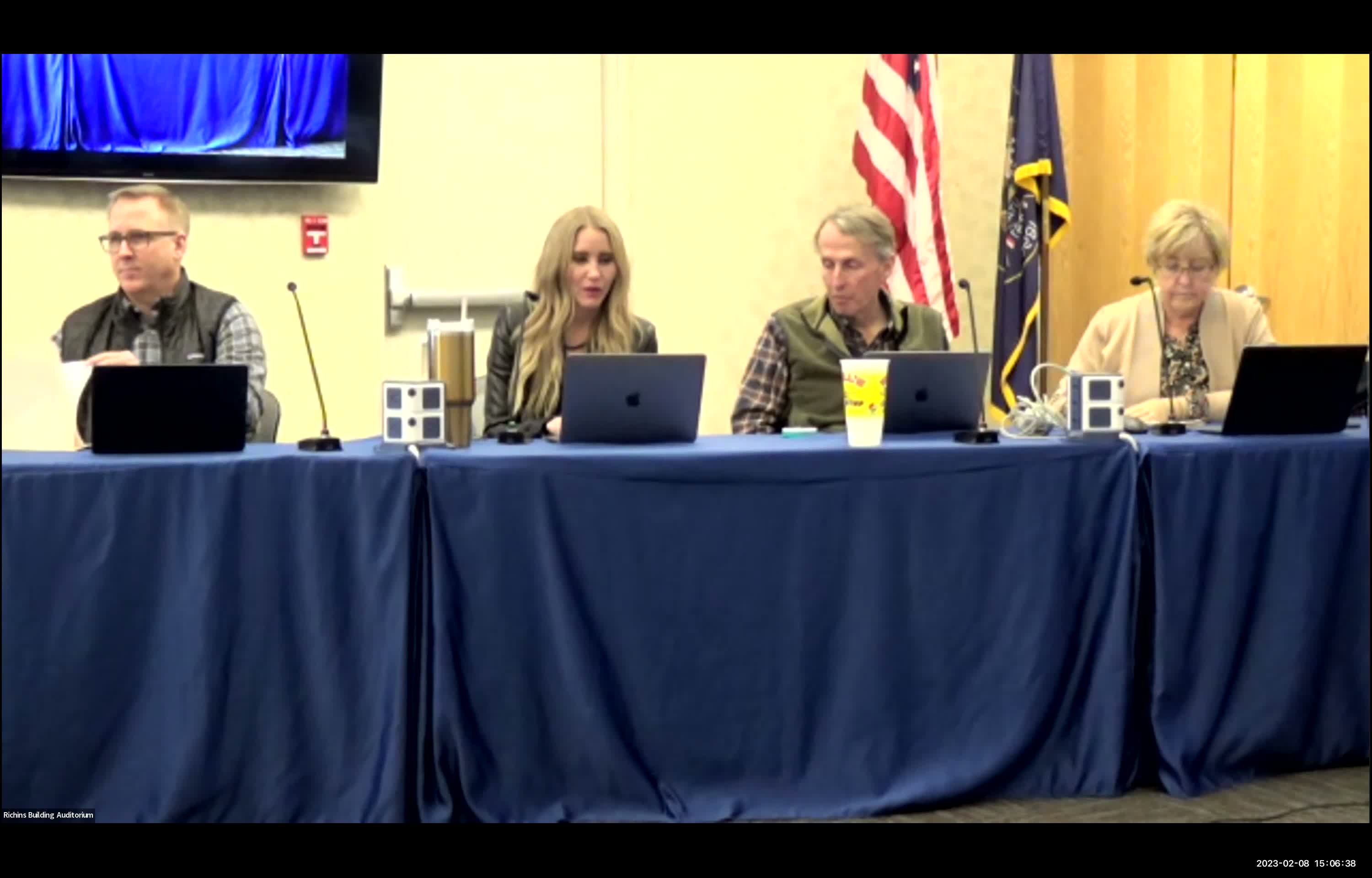
At a scheduled work session, Summit County council and staff reviewed Dakota Pacific’s amended traffic impact study (TIS) for proposed amendments to the Summit Research Park (Park City Tech Center) and an independent peer review by Wall Consulting Group (WCG). Patrick Puttum, Summit County Community Development Director, opened the session and outlined next steps: two public hearings (Feb. 20 and March 1, both at Ecker Hill Middle School Auditorium) and an applicant open house.
Applicant team representatives (Jeff Goughner, Preston Stenger of Farran Piers, Jim Charlier) presented the study methodology and findings. Key figures in the applicant’s analysis include projected daily site trip generation at build‑out of roughly 7,500 trips under the current 2022 land‑use program, versus about 8,000 trips in the original 2008 entitlement and just over 11,000 in a 2021 proposal. Preston Stenger emphasized the change in land use toward more residential and less office, which reduces peak‑hour peaking: "the current proposal is about 7,500" daily trips and shows a roughly 46% decrease in AM peak trips and 42% in PM compared with the 2008 entitlement.
The study used peak‑hour counts (worst hour within 7–9 a.m. and 4–6 p.m.), ITE trip‑generation rates, and adjustments based on UDOT continuous counters. The applicant noted two intersections of concern in multiple scenarios: the SR‑224 interchange and Olympic Parkway movements, where levels of service approached or fell into D/E/F in some modeled futures. Proposed mitigations included restricting particular left‑turn movements (channelized reconstruction rather than signage), adding an additional leg to the Olympic Parkway roundabout to improve distribution and building additional internal connectivity to reduce concentrated impacts.
Wall Consulting Group's peer review (Corey Mack and Jeremy Searle) generally concurred with the applicant’s technical approach and described the applicant’s estimates as conservative in some respects. WCG highlighted several recommendations: apply consistent seasonal adjustments (side‑street volumes and mainline volumes treated comparably), undertake a focused safety/crash‑pattern analysis (noting left‑turn crash concerns at Ute Boulevard), quantify queuing and travel‑time impacts as real‑world performance measures, and consider phased or milestone‑based occupancy tied to construction of mitigation improvements and external projects (for example, UDOT corridor improvements or BRT) rather than unconditional full buildout approvals.
Council members pressed on model calibration, the choice of an "average winter day" versus a peak winter day (UDOT uses peak winter days for environmental studies), the appropriate temporal horizon for analysis, and the practical feasibility of conditioning development on outside projects. Applicant and peer reviewers confirmed they used UDOT modeling inputs and that the county‑specified scope led to not assuming UDOT corridor reconstruction in base tables, although UDOT alternatives were evaluated as sensitivity scenarios and typically improve corridor LOS in modeled futures.
Staff, the applicant and WCG agreed the TIS shows measurable impacts at specific intersections and that mitigations can reduce, but not entirely eliminate, delays without broader corridor projects. WCG recommended ongoing post‑construction monitoring (queuing and travel time) and suggested that some build phases could be allowed contingent on mitigation milestones. The council was advised that additional public comment will be taken at the scheduled hearings and that staff will use the peer review and hearing input in subsequent hearings and findings.
Applicant team representatives (Jeff Goughner, Preston Stenger of Farran Piers, Jim Charlier) presented the study methodology and findings. Key figures in the applicant’s analysis include projected daily site trip generation at build‑out of roughly 7,500 trips under the current 2022 land‑use program, versus about 8,000 trips in the original 2008 entitlement and just over 11,000 in a 2021 proposal. Preston Stenger emphasized the change in land use toward more residential and less office, which reduces peak‑hour peaking: "the current proposal is about 7,500" daily trips and shows a roughly 46% decrease in AM peak trips and 42% in PM compared with the 2008 entitlement.
The study used peak‑hour counts (worst hour within 7–9 a.m. and 4–6 p.m.), ITE trip‑generation rates, and adjustments based on UDOT continuous counters. The applicant noted two intersections of concern in multiple scenarios: the SR‑224 interchange and Olympic Parkway movements, where levels of service approached or fell into D/E/F in some modeled futures. Proposed mitigations included restricting particular left‑turn movements (channelized reconstruction rather than signage), adding an additional leg to the Olympic Parkway roundabout to improve distribution and building additional internal connectivity to reduce concentrated impacts.
Wall Consulting Group's peer review (Corey Mack and Jeremy Searle) generally concurred with the applicant’s technical approach and described the applicant’s estimates as conservative in some respects. WCG highlighted several recommendations: apply consistent seasonal adjustments (side‑street volumes and mainline volumes treated comparably), undertake a focused safety/crash‑pattern analysis (noting left‑turn crash concerns at Ute Boulevard), quantify queuing and travel‑time impacts as real‑world performance measures, and consider phased or milestone‑based occupancy tied to construction of mitigation improvements and external projects (for example, UDOT corridor improvements or BRT) rather than unconditional full buildout approvals.
Council members pressed on model calibration, the choice of an "average winter day" versus a peak winter day (UDOT uses peak winter days for environmental studies), the appropriate temporal horizon for analysis, and the practical feasibility of conditioning development on outside projects. Applicant and peer reviewers confirmed they used UDOT modeling inputs and that the county‑specified scope led to not assuming UDOT corridor reconstruction in base tables, although UDOT alternatives were evaluated as sensitivity scenarios and typically improve corridor LOS in modeled futures.
Staff, the applicant and WCG agreed the TIS shows measurable impacts at specific intersections and that mitigations can reduce, but not entirely eliminate, delays without broader corridor projects. WCG recommended ongoing post‑construction monitoring (queuing and travel time) and suggested that some build phases could be allowed contingent on mitigation milestones. The council was advised that additional public comment will be taken at the scheduled hearings and that staff will use the peer review and hearing input in subsequent hearings and findings.
Don't Miss a Word: See the Full Meeting!
Go beyond summaries. Unlock every video, transcript, and key insight with a Founder Membership.
✓
Get instant access to full meeting videos
✓
Search and clip any phrase from complete transcripts
✓
Receive AI-powered summaries & custom alerts
✓
Enjoy lifetime, unrestricted access to government data
30-day money-back guarantee
