Summit County Council names Armstrong chair, Stevens vice chair; discusses regional renewable-energy agency
January 04, 2023 | Summit County Council, Summit County Commission and Boards, Summit County, Utah
This article was created by AI summarizing key points discussed. AI makes mistakes, so for full details and context, please refer to the video of the full meeting. Please report any errors so we can fix them. Report an error »
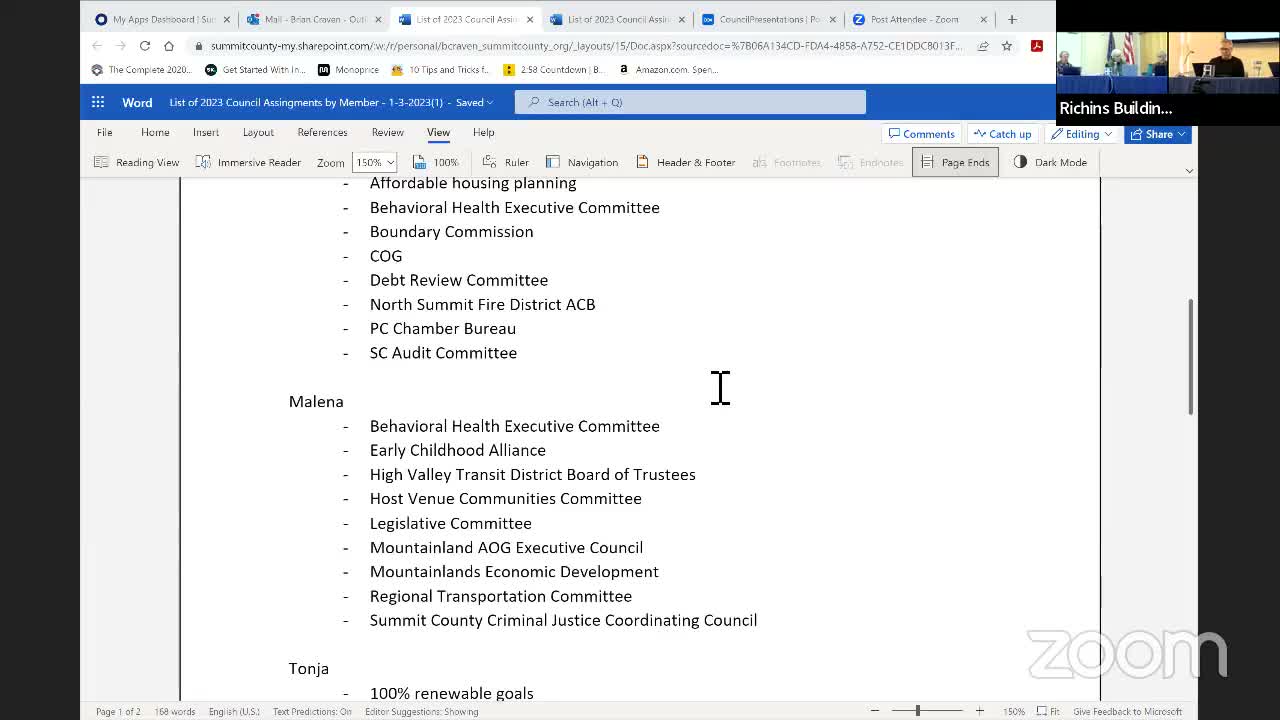
The Summit County Council voted by voice to appoint Roger Armstrong as council chair and Melina Stevens as vice chair for 2023, then approved a slate of committee and board assignments that will shape the county’s representation on regional bodies this year.
The actions came at the start of the council’s first regular meeting of the year, during a broad discussion about which council members would represent the county on bodies including the Mountainland Association of Governments, the Utah Association of Counties, the Utah Local Governments Trust and the Community Renewable Energy Agency (CREA). Chair appointments and committee rosters were approved by motion and carried by the council.
Council members spent significant time on CREA, an interlocal agency negotiating a power purchase agreement with Rocky Mountain Power that would deliver 100% renewable electricity to participating government facilities and, potentially, to county residents under a statutory opt-in/opt-out framework. Staff and council members explained that the CREA board next week planned to vote on draft ordinance language the counties and cities would later submit as part of the utility regulatory filing.
“Once we go through the Public Service Commission process, the county council will have a decision to make,” a council member said, describing how the public-service regulator’s approval of a project and its prices would inform whether the county opts in for all residents (with individual opt-outs) or declines participation.
Council members also assigned who will sit on CREA and related renewable-energy work groups, noting the matter’s technical and contractual complexity and the likelihood of continued negotiation through the spring and summer. Staff said the CREA board is aiming to finalize an initial power-purchase tranche this year and that the ordinance and utility agreement language will be refined during that process.
The council did not take a separate vote on CREA policy at the meeting; members asked staff to return with language and options once the agency’s draft ordinance and the public-service filing are available.
The actions came at the start of the council’s first regular meeting of the year, during a broad discussion about which council members would represent the county on bodies including the Mountainland Association of Governments, the Utah Association of Counties, the Utah Local Governments Trust and the Community Renewable Energy Agency (CREA). Chair appointments and committee rosters were approved by motion and carried by the council.
Council members spent significant time on CREA, an interlocal agency negotiating a power purchase agreement with Rocky Mountain Power that would deliver 100% renewable electricity to participating government facilities and, potentially, to county residents under a statutory opt-in/opt-out framework. Staff and council members explained that the CREA board next week planned to vote on draft ordinance language the counties and cities would later submit as part of the utility regulatory filing.
“Once we go through the Public Service Commission process, the county council will have a decision to make,” a council member said, describing how the public-service regulator’s approval of a project and its prices would inform whether the county opts in for all residents (with individual opt-outs) or declines participation.
Council members also assigned who will sit on CREA and related renewable-energy work groups, noting the matter’s technical and contractual complexity and the likelihood of continued negotiation through the spring and summer. Staff said the CREA board is aiming to finalize an initial power-purchase tranche this year and that the ordinance and utility agreement language will be refined during that process.
The council did not take a separate vote on CREA policy at the meeting; members asked staff to return with language and options once the agency’s draft ordinance and the public-service filing are available.
View the Full Meeting & All Its Details
This article offers just a summary. Unlock complete video, transcripts, and insights as a Founder Member.
✓
Watch full, unedited meeting videos
✓
Search every word spoken in unlimited transcripts
✓
AI summaries & real-time alerts (all government levels)
✓
Permanent access to expanding government content
30-day money-back guarantee
