Consultants recommend single countywide EMS operated by Park City Fire; council, chiefs and mayors debate coverage and costs
May 31, 2023 | Summit County Council, Summit County Commission and Boards, Summit County, Utah
This article was created by AI summarizing key points discussed. AI makes mistakes, so for full details and context, please refer to the video of the full meeting. Please report any errors so we can fix them. Report an error »
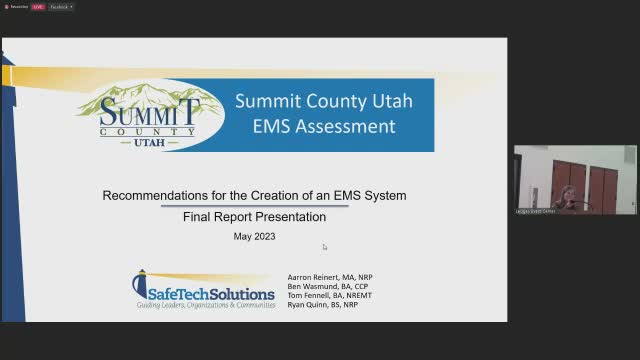
Summit County Council on May 31 heard the final emergency medical services assessment from Safetec Solutions, which recommended a single, countywide ambulance system governed and funded by the county and administered by an experienced provider — Safetec named Park City Fire Department as a likely operator. Safetec said a dynamically deployed fleet of seven ambulances, plus data‑driven governance and a readiness subsidy, would produce a reliable, equitable county system.
"Model 1, the model that we're recommending, a single EMS system across Summit County meets that criteria of sustainable, of reliable, of long term viable, as well as providing an equitable service to all," Safetec owner Aaron Reinert said during the presentation.
Safetec detailed its financial pro forma and said an ambulance's full ‘‘sticker price’’ can be substantially higher than commonly cited per‑unit operating figures when administrative infrastructure is included. Consultant Ben Wazmond summarized the firm’s range: "A BLS ambulance is usually between $500,000 and $750,000 a year. An ALS or paramedic level ambulance can be between $750,000 to 1.2 [million]." Safetec added administrative overhead — billing, Medicare compliance, controlled‑substances management, training and quality assurance — and used a conservative overhead assumption that raised its per‑ambulance pro forma toward roughly $1.4 million to $1.5 million.
"Ambulance billing alone is at least a full time person, if not more," Reinert said, listing discrete administrative duties that the consultants included in their model.
Safetec argued the countywide model would allow purchasing and staffing efficiencies, consistent clinical standards, and clearer performance accountability. The firm proposed a governance structure such as an emergency services district to deliver a dedicated revenue stream for readiness and to include municipal representation.
Several council members asked detailed questions about the calculations; Councilmember Candace pressed Safetec on whether higher local compensation explains higher costs and whether downgrading clinical levels would materially lower prices. Safetec replied that benefits and the need for ambulance administration explain much of the difference between headline numbers (for example, $1.2M vs. $1.4M), and that reducing service level or staffing fewer ambulances are the only realistic places to materially cut costs.
North Summit Fire Chief Ben Nielsen and others in public comment challenged parts of the recommendation. Nielsen said the East Side already experiences multi‑ambulance brownouts and that his district’s investments in ALS‑capable first response have cut response times. "A 30‑plus minute response time for an ambulance is outrageous," Nielsen said, arguing that a single staffed ambulance for a large rural East‑Side district would not be adequate and asserting his department can operate some functions more cheaply than the pro forma assumes.
Mayors across the county generally expressed support for a unified, sustainable model but insisted the system must guarantee minimum service levels on the East Side and not shift untenable tax burdens onto sparsely populated areas. Oakley Mayor Zane Wollston Hume and Colville Mayor Mark Marsh each asked how Park City — if selected — would be brought into cooperative agreements that preserve independent fire districts' local operations while hosting ambulances or building medic‑only substations.
Safetec reiterated that dynamic deployment must be data‑driven rather than ad hoc staging: its model uses analytics to reposition ambulances so the system meets a target response standard (for example, 15 minutes for 90% of calls), and it counts ALS‑capable first responders (engines and AMTs) as part of the chain of survival when ambulances must travel long distances.
Councilmembers and staff scheduled a technical follow‑up meeting (noted for June 6) for chiefs, board chairs and staff to develop implementation options, address governance and financing (including House Bill 303 compliance cited in the study), and work through municipal representation and mutual‑aid agreements. The council did not take a final vote on any model at the May 31 meeting.
Next steps: county staff and fire chiefs will meet to produce cost and governance options for further council and Council of Governments review; the council asked staff to ensure mayors and other stakeholders are included before any final decision is brought forward.
"Model 1, the model that we're recommending, a single EMS system across Summit County meets that criteria of sustainable, of reliable, of long term viable, as well as providing an equitable service to all," Safetec owner Aaron Reinert said during the presentation.
Safetec detailed its financial pro forma and said an ambulance's full ‘‘sticker price’’ can be substantially higher than commonly cited per‑unit operating figures when administrative infrastructure is included. Consultant Ben Wazmond summarized the firm’s range: "A BLS ambulance is usually between $500,000 and $750,000 a year. An ALS or paramedic level ambulance can be between $750,000 to 1.2 [million]." Safetec added administrative overhead — billing, Medicare compliance, controlled‑substances management, training and quality assurance — and used a conservative overhead assumption that raised its per‑ambulance pro forma toward roughly $1.4 million to $1.5 million.
"Ambulance billing alone is at least a full time person, if not more," Reinert said, listing discrete administrative duties that the consultants included in their model.
Safetec argued the countywide model would allow purchasing and staffing efficiencies, consistent clinical standards, and clearer performance accountability. The firm proposed a governance structure such as an emergency services district to deliver a dedicated revenue stream for readiness and to include municipal representation.
Several council members asked detailed questions about the calculations; Councilmember Candace pressed Safetec on whether higher local compensation explains higher costs and whether downgrading clinical levels would materially lower prices. Safetec replied that benefits and the need for ambulance administration explain much of the difference between headline numbers (for example, $1.2M vs. $1.4M), and that reducing service level or staffing fewer ambulances are the only realistic places to materially cut costs.
North Summit Fire Chief Ben Nielsen and others in public comment challenged parts of the recommendation. Nielsen said the East Side already experiences multi‑ambulance brownouts and that his district’s investments in ALS‑capable first response have cut response times. "A 30‑plus minute response time for an ambulance is outrageous," Nielsen said, arguing that a single staffed ambulance for a large rural East‑Side district would not be adequate and asserting his department can operate some functions more cheaply than the pro forma assumes.
Mayors across the county generally expressed support for a unified, sustainable model but insisted the system must guarantee minimum service levels on the East Side and not shift untenable tax burdens onto sparsely populated areas. Oakley Mayor Zane Wollston Hume and Colville Mayor Mark Marsh each asked how Park City — if selected — would be brought into cooperative agreements that preserve independent fire districts' local operations while hosting ambulances or building medic‑only substations.
Safetec reiterated that dynamic deployment must be data‑driven rather than ad hoc staging: its model uses analytics to reposition ambulances so the system meets a target response standard (for example, 15 minutes for 90% of calls), and it counts ALS‑capable first responders (engines and AMTs) as part of the chain of survival when ambulances must travel long distances.
Councilmembers and staff scheduled a technical follow‑up meeting (noted for June 6) for chiefs, board chairs and staff to develop implementation options, address governance and financing (including House Bill 303 compliance cited in the study), and work through municipal representation and mutual‑aid agreements. The council did not take a final vote on any model at the May 31 meeting.
Next steps: county staff and fire chiefs will meet to produce cost and governance options for further council and Council of Governments review; the council asked staff to ensure mayors and other stakeholders are included before any final decision is brought forward.
Don't Miss a Word: See the Full Meeting!
Go beyond summaries. Unlock every video, transcript, and key insight with a Founder Membership.
✓
Get instant access to full meeting videos
✓
Search and clip any phrase from complete transcripts
✓
Receive AI-powered summaries & custom alerts
✓
Enjoy lifetime, unrestricted access to government data
30-day money-back guarantee
