Presenter urges U.S. shift from liberal hegemony, warns of nuclear disadvantage and offers Ukraine 'neutrality' peace plan
November 16, 2023 | Other , Citizen Journalism , Utah Citizen Journalism, Elections, Utah
This article was created by AI summarizing key points discussed. AI makes mistakes, so for full details and context, please refer to the video of the full meeting. Please report any errors so we can fix them. Report an error »
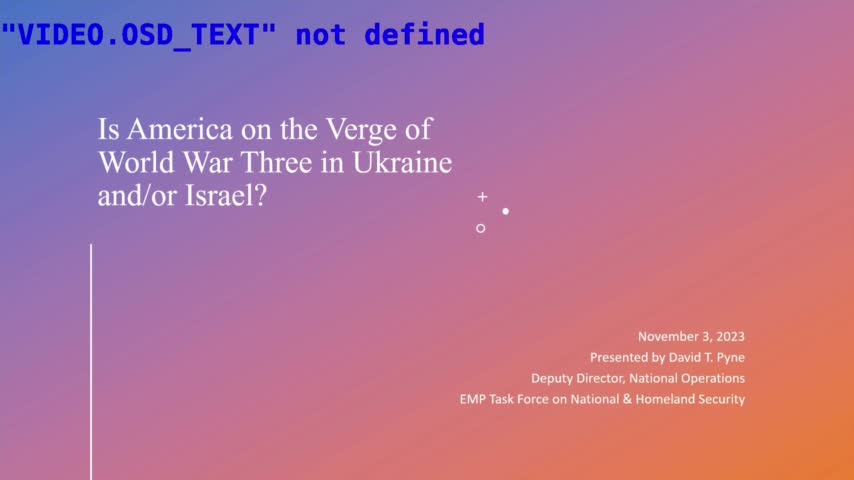
Speaker 1, the event's presenter, told an audience he believes the United States has become an "empire" whose interventionist policies have eroded U.S. strategic advantage and increased the risk of large‑scale war. "We're not just a constitutional republic, we're also an empire," he said, framing subsequent remarks about NATO, China and nuclear forces.
He argued China now spends roughly $700,000,000,000 a year on defense and that a purchasing‑power‑parity adjustment makes that figure far larger, and warned the U.S. nuclear force has shrunk dramatically over the past three decades. "We reduced our nuclear arsenal by 90%" (Speaker 1's characterization), he said, and later cited U.S. operational counts he described as insufficient relative to Russia and China.
On Ukraine, Speaker 1 faulted NATO expansion and argued U.S. policy conflated American interests with those of Kyiv. He summarized a public peace proposal he said he circulated earlier: Ukraine would be permanently neutral outside NATO, receive security guarantees from Western powers and use referenda in contested regions following phased withdrawals. "It would have essentially regained all of Ukraine's lost territory except for Crimea," he said when outlining the plan's contours.
Speaker 1 framed the plan as intended to reduce nuclear escalation risk and to re‑orient U.S. policy toward accommodation where possible. He said the Sino‑Russian alignment and a rising Chinese nuclear and conventional buildup make a different posture urgent. He recommended a substantive re‑examination of U.S. force posture including fewer overseas bases and closer attention to missile defenses and strategic parity.
During a question period, he defended his assessment of risk, cited a Stanford webinar he said reported a U.S. intelligence judgment that nuclear escalation risk rose in September 2022, and repeated that avoiding policies that could trigger nuclear escalation should be the top U.S. priority. He closed by encouraging listeners to contact legislators about the proposals and by promoting his public writing on the subject.
The presentation combined policy prescriptions (neutrality for Ukraine, reduced economic dependence on China, and modernization of U.S. nuclear and missile defenses) with forceful critiques of recent U.S. administrations' choices. The event concluded with extended audience discussion and no formal vote or action by any government body.
He argued China now spends roughly $700,000,000,000 a year on defense and that a purchasing‑power‑parity adjustment makes that figure far larger, and warned the U.S. nuclear force has shrunk dramatically over the past three decades. "We reduced our nuclear arsenal by 90%" (Speaker 1's characterization), he said, and later cited U.S. operational counts he described as insufficient relative to Russia and China.
On Ukraine, Speaker 1 faulted NATO expansion and argued U.S. policy conflated American interests with those of Kyiv. He summarized a public peace proposal he said he circulated earlier: Ukraine would be permanently neutral outside NATO, receive security guarantees from Western powers and use referenda in contested regions following phased withdrawals. "It would have essentially regained all of Ukraine's lost territory except for Crimea," he said when outlining the plan's contours.
Speaker 1 framed the plan as intended to reduce nuclear escalation risk and to re‑orient U.S. policy toward accommodation where possible. He said the Sino‑Russian alignment and a rising Chinese nuclear and conventional buildup make a different posture urgent. He recommended a substantive re‑examination of U.S. force posture including fewer overseas bases and closer attention to missile defenses and strategic parity.
During a question period, he defended his assessment of risk, cited a Stanford webinar he said reported a U.S. intelligence judgment that nuclear escalation risk rose in September 2022, and repeated that avoiding policies that could trigger nuclear escalation should be the top U.S. priority. He closed by encouraging listeners to contact legislators about the proposals and by promoting his public writing on the subject.
The presentation combined policy prescriptions (neutrality for Ukraine, reduced economic dependence on China, and modernization of U.S. nuclear and missile defenses) with forceful critiques of recent U.S. administrations' choices. The event concluded with extended audience discussion and no formal vote or action by any government body.
Don't Miss a Word: See the Full Meeting!
Go beyond summaries. Unlock every video, transcript, and key insight with a Founder Membership.
✓
Get instant access to full meeting videos
✓
Search and clip any phrase from complete transcripts
✓
Receive AI-powered summaries & custom alerts
✓
Enjoy lifetime, unrestricted access to government data
30-day money-back guarantee
