DC Everest presents state report-card results; district score 70.8, attendance cited as risk
December 30, 2024 | D C Everest Area School District, School Districts, Wisconsin
This article was created by AI summarizing key points discussed. AI makes mistakes, so for full details and context, please refer to the video of the full meeting. Please report any errors so we can fix them. Report an error »
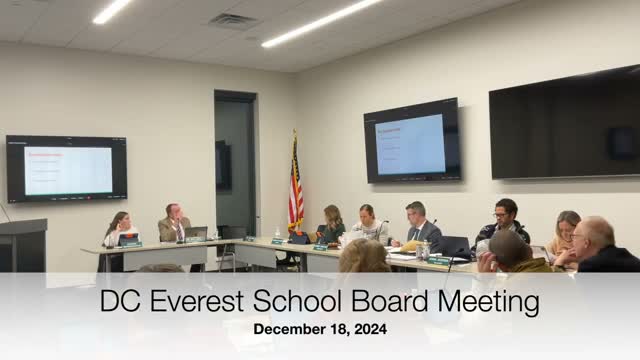
District administrators reviewed the state accountability report card and outlined steps the board and staff are taking to interpret and act on the data.
Speaker 2 told the board the district’s composite score is 70.8, down two points from last year. He said the state report card aggregates four component areas—achievement, growth, target-group outcomes and on-track-to-graduation—into a single score and a five-star rating. He warned that rolling averages for chronic absenteeism (including COVID-era distortions) and assessment transitions (forward exam to ACT suite between grades 8 and 9) can depress scores even when local measures show steady work in classrooms.
Administrators emphasized that the report card is only one snapshot. The district uses multiple assessments—FastBridge, BloomSight and local 'connections' surveys—to track progress during the year and to identify students needing supports. The presentation listed several local programs and metrics: seven schools exceeded expectations, three met expectations and one fell into a 'few expectations' category; 91% of seniors took dual-enrollment or AP courses with 75 AP exams scoring 3 or higher and 70 youth apprenticeships reported in the last three years.
Board members pressed whether the report card drives funding or direct state actions. Administrators described it primarily as informational for the community and a reminder of areas to target; they said state attention increases for chronically low-performing schools but that the district already monitors the underlying data and pursues improvement plans.
The board discussed how to present the broader story to the public to prevent overreliance on a single score. Speaker 7 said the district will mail contextual information and continue local communications so parents and community members see multiple measures rather than a lone numeric rating.
No formal vote was taken; administrators said they will return with calendar and staffing recommendations at the January meeting.
Speaker 2 told the board the district’s composite score is 70.8, down two points from last year. He said the state report card aggregates four component areas—achievement, growth, target-group outcomes and on-track-to-graduation—into a single score and a five-star rating. He warned that rolling averages for chronic absenteeism (including COVID-era distortions) and assessment transitions (forward exam to ACT suite between grades 8 and 9) can depress scores even when local measures show steady work in classrooms.
Administrators emphasized that the report card is only one snapshot. The district uses multiple assessments—FastBridge, BloomSight and local 'connections' surveys—to track progress during the year and to identify students needing supports. The presentation listed several local programs and metrics: seven schools exceeded expectations, three met expectations and one fell into a 'few expectations' category; 91% of seniors took dual-enrollment or AP courses with 75 AP exams scoring 3 or higher and 70 youth apprenticeships reported in the last three years.
Board members pressed whether the report card drives funding or direct state actions. Administrators described it primarily as informational for the community and a reminder of areas to target; they said state attention increases for chronically low-performing schools but that the district already monitors the underlying data and pursues improvement plans.
The board discussed how to present the broader story to the public to prevent overreliance on a single score. Speaker 7 said the district will mail contextual information and continue local communications so parents and community members see multiple measures rather than a lone numeric rating.
No formal vote was taken; administrators said they will return with calendar and staffing recommendations at the January meeting.
Don't Miss a Word: See the Full Meeting!
Go beyond summaries. Unlock every video, transcript, and key insight with a Founder Membership.
✓
Get instant access to full meeting videos
✓
Search and clip any phrase from complete transcripts
✓
Receive AI-powered summaries & custom alerts
✓
Enjoy lifetime, unrestricted access to government data
30-day money-back guarantee
