Pregnancy resource centers tell committee they fill maternal-care gaps; request clearer funding and DHS coordination
August 10, 2023 | PUBLIC HEALTH, WELFARE AND LABOR COMMITTEE - SENATE, Senate, Committees, Legislative, Arkansas
This article was created by AI summarizing key points discussed. AI makes mistakes, so for full details and context, please refer to the video of the full meeting. Please report any errors so we can fix them. Report an error »
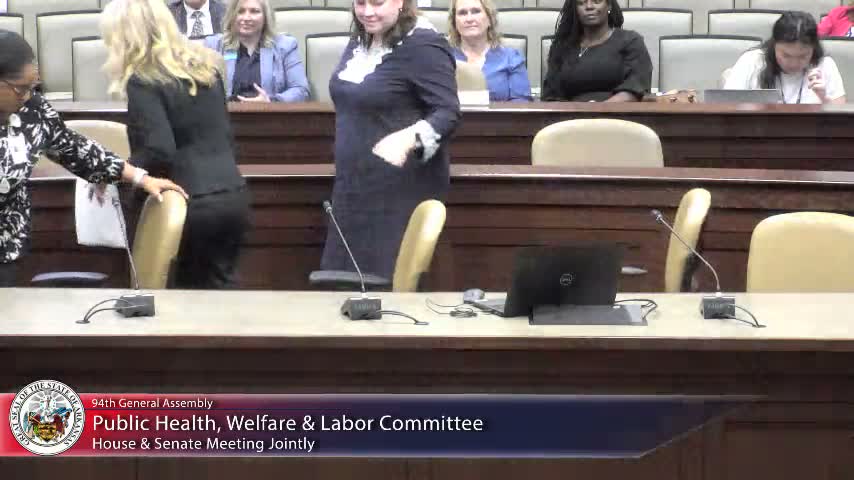
Representatives of three Arkansas pregnancy resource centers told the Senate Public Health, Welfare and Labor Committee that their organizations provide early-pregnancy confirmation, limited OB ultrasound, STI testing and treatment, parenting education, mental-health consultation and material assistance to families.
Shelly Lewis of the Little Rock Pregnancy Resource Center (APRC) said the center offers pregnancy testing, limited ultrasound and medical referrals and contracts with social workers and mental-health counselors to help clients navigate care. "We do make medical referrals within our community," Lewis said, citing UAMS and local OBs as partners.
Donna Ezell, a registered nurse and executive director of Caring Hearts Pregnancy Center, described two centers, a volunteer clinical staff including registered nurses trained in limited OB ultrasound, online parenting classes with incentive-based "mommy bucks," and a program to provide car seats and pack-and-plays. "We encourage and assist in early prenatal care," Ezell said, adding that centers step in to make calls and help clients enroll in services when needed.
Maria Spear of the Arkansas Pregnancy Network said the association counts about 40–45 pregnancy centers in the state, and that 20 centers responding to a recent survey served more than 15,000 women in 2022 and provided over 4,000 ultrasounds. Spear said some centers received state DFA grant awards (presenters indicated $51,000 grants to at least two centers) and that centers used funds for materials, staffing and outreach. She also said the network is developing a statewide telehealth hotline staffed by registered nurses to connect callers with medical advice and local resources before they pursue out-of-state care or online medication.
Committee members asked how pregnancy centers coordinate referrals with hospitals and county health units and whether centers connect uninsured women with Medicaid or other resources. Presenters said they make referrals, that Pulaski County no longer offers maternity services in some units, and that centers will coordinate with DHS to improve Medicaid enrollment and referral pathways. Several members urged the centers to track referrals for high-risk pregnancies (so the committee can measure program impact) and to propose ways to make grant funding less administratively burdensome for faith-based centers.
Presenters also raised public-health concerns about untracked mail-order abortion pills and women obtaining abortions out of state. "When people are not seeking medical care and they're ordering pills to their home, there's no way to track it," Maria Spear said; presenters asked for more public education and voluntary medical contacts so that women who use those services can still be connected to care.
Next steps: committee staff will follow up with DFA and DHS on grant allocations, referral pathways and options to expand prenatal-vitamin access and data on referrals from pregnancy centers to high-risk prenatal care.
Shelly Lewis of the Little Rock Pregnancy Resource Center (APRC) said the center offers pregnancy testing, limited ultrasound and medical referrals and contracts with social workers and mental-health counselors to help clients navigate care. "We do make medical referrals within our community," Lewis said, citing UAMS and local OBs as partners.
Donna Ezell, a registered nurse and executive director of Caring Hearts Pregnancy Center, described two centers, a volunteer clinical staff including registered nurses trained in limited OB ultrasound, online parenting classes with incentive-based "mommy bucks," and a program to provide car seats and pack-and-plays. "We encourage and assist in early prenatal care," Ezell said, adding that centers step in to make calls and help clients enroll in services when needed.
Maria Spear of the Arkansas Pregnancy Network said the association counts about 40–45 pregnancy centers in the state, and that 20 centers responding to a recent survey served more than 15,000 women in 2022 and provided over 4,000 ultrasounds. Spear said some centers received state DFA grant awards (presenters indicated $51,000 grants to at least two centers) and that centers used funds for materials, staffing and outreach. She also said the network is developing a statewide telehealth hotline staffed by registered nurses to connect callers with medical advice and local resources before they pursue out-of-state care or online medication.
Committee members asked how pregnancy centers coordinate referrals with hospitals and county health units and whether centers connect uninsured women with Medicaid or other resources. Presenters said they make referrals, that Pulaski County no longer offers maternity services in some units, and that centers will coordinate with DHS to improve Medicaid enrollment and referral pathways. Several members urged the centers to track referrals for high-risk pregnancies (so the committee can measure program impact) and to propose ways to make grant funding less administratively burdensome for faith-based centers.
Presenters also raised public-health concerns about untracked mail-order abortion pills and women obtaining abortions out of state. "When people are not seeking medical care and they're ordering pills to their home, there's no way to track it," Maria Spear said; presenters asked for more public education and voluntary medical contacts so that women who use those services can still be connected to care.
Next steps: committee staff will follow up with DFA and DHS on grant allocations, referral pathways and options to expand prenatal-vitamin access and data on referrals from pregnancy centers to high-risk prenatal care.
Don't Miss a Word: See the Full Meeting!
Go beyond summaries. Unlock every video, transcript, and key insight with a Founder Membership.
✓
Get instant access to full meeting videos
✓
Search and clip any phrase from complete transcripts
✓
Receive AI-powered summaries & custom alerts
✓
Enjoy lifetime, unrestricted access to government data
30-day money-back guarantee
