Senate committee advances bill eliminating 10-day post-auction redemption window for tax-delinquent parcels
February 22, 2023 | REVENUE & TAX - SENATE, Senate, Committees, Legislative, Arkansas
This article was created by AI summarizing key points discussed. AI makes mistakes, so for full details and context, please refer to the video of the full meeting. Please report any errors so we can fix them. Report an error »
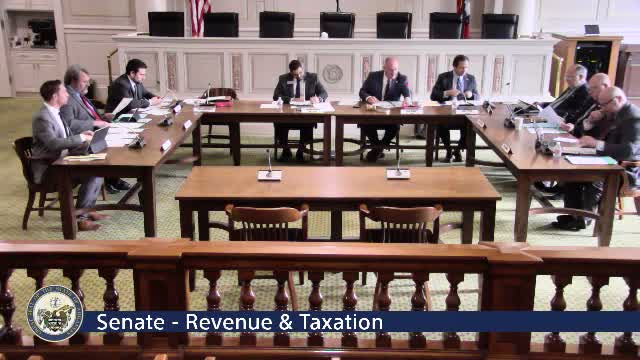
House Bill 1263, authored on the floor by Representative Marcus Richmond and presented to the Senate Revenue & Tax Committee, passed the committee by voice vote after testimony from the State Lands office and a brief member exchange.
The bill, as presented by Representative Marcus Richmond, seeks to eliminate the 10-day post-auction redemption window for tax-delinquent parcels and reduce administrative refund processing tied to that period. Richmond told the committee that auction purchasers have in recent years at times paid large sums in cash—"as much as $200,000"—and that eliminating the refund-and-return cycle would remove administrative costs and uncertainty for buyers. "This is an issue that can be totally eliminated by passage of it, HB 1263," Richmond said during his presentation.
Kelly Boyd, deputy commissioner of state lands, explained the mechanics: the bill removes the short 10-business-day post-sale window during which purchasers currently remain subject to a redemption by the owner. Boyd told senators that the change does not remove an owner's longer-term statutory right to redeem; it simply ends the interim refund step that requires State Lands to process reimbursements to purchasers when a parcel is redeemed shortly after sale. The committee also heard from Paul Gehring of the Department of Finance and Administration, who said DFA has not issued a fiscal-impact statement for the measure because it does not affect taxes the agency administers.
Senator Peyton pressed whether the bill would bar cash payments; Boyd replied, "we will be accepting cash for all of these payments," noting that the transaction remains public-record and subject to any law-enforcement review. Peyton, who identified himself as an auctioneer, supported the change as a way to reduce buyer hesitation and bring auction prices closer to market values.
After disclosures from committee members, Senator Caldwell moved to pass the bill, Senator Peyton seconded, and the committee approved HB1263 by voice vote. A committee clerk recorded the bill as passed out of committee.
Next steps: HB1263 advanced from this committee; the bill will proceed through the legislature per the regular calendar.
The bill, as presented by Representative Marcus Richmond, seeks to eliminate the 10-day post-auction redemption window for tax-delinquent parcels and reduce administrative refund processing tied to that period. Richmond told the committee that auction purchasers have in recent years at times paid large sums in cash—"as much as $200,000"—and that eliminating the refund-and-return cycle would remove administrative costs and uncertainty for buyers. "This is an issue that can be totally eliminated by passage of it, HB 1263," Richmond said during his presentation.
Kelly Boyd, deputy commissioner of state lands, explained the mechanics: the bill removes the short 10-business-day post-sale window during which purchasers currently remain subject to a redemption by the owner. Boyd told senators that the change does not remove an owner's longer-term statutory right to redeem; it simply ends the interim refund step that requires State Lands to process reimbursements to purchasers when a parcel is redeemed shortly after sale. The committee also heard from Paul Gehring of the Department of Finance and Administration, who said DFA has not issued a fiscal-impact statement for the measure because it does not affect taxes the agency administers.
Senator Peyton pressed whether the bill would bar cash payments; Boyd replied, "we will be accepting cash for all of these payments," noting that the transaction remains public-record and subject to any law-enforcement review. Peyton, who identified himself as an auctioneer, supported the change as a way to reduce buyer hesitation and bring auction prices closer to market values.
After disclosures from committee members, Senator Caldwell moved to pass the bill, Senator Peyton seconded, and the committee approved HB1263 by voice vote. A committee clerk recorded the bill as passed out of committee.
Next steps: HB1263 advanced from this committee; the bill will proceed through the legislature per the regular calendar.
View the Full Meeting & All Its Details
This article offers just a summary. Unlock complete video, transcripts, and insights as a Founder Member.
✓
Watch full, unedited meeting videos
✓
Search every word spoken in unlimited transcripts
✓
AI summaries & real-time alerts (all government levels)
✓
Permanent access to expanding government content
30-day money-back guarantee
