State health officials brief Senate committee on long COVID, diagnostic uncertainty and potential impacts
September 06, 2022 | PUBLIC HEALTH, WELFARE AND LABOR COMMITTEE - SENATE, Senate, Committees, Legislative, Arkansas
This article was created by AI summarizing key points discussed. AI makes mistakes, so for full details and context, please refer to the video of the full meeting. Please report any errors so we can fix them. Report an error »
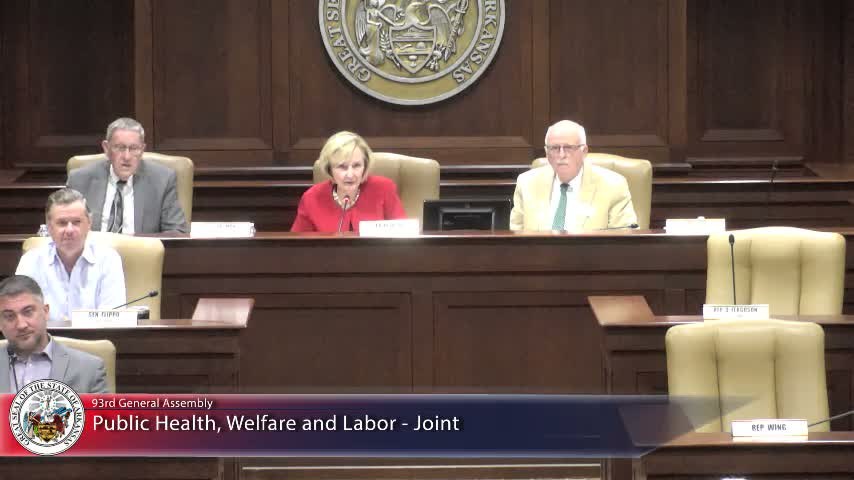
Joe Thompson, CEO of the Arkansas Center for Health Improvement, told the Senate Public Health, Welfare and Labor Committee that long COVID is a growing, poorly defined public‑health problem likely affecting thousands of Arkansans. Thompson said the state has seen multiple pandemic waves and is currently tracking BA.4/BA.5 variants; he emphasized that hospitalizations and deaths are the most reliable measures of severity because at‑home testing leads to undercounting of cases.
Thompson said definitions vary — the Centers for Disease Control and Prevention counts post‑COVID conditions beginning four weeks after infection, while the World Health Organization uses a three‑month threshold — complicating diagnosis and research. He noted that the ICD‑10 code U09.9 (post‑COVID condition, unspecified) was added to allow clinicians to record cases, but stressed that ‘‘there’s a difference between a symptom and a diagnosis’’ and that researchers still lack a single diagnostic standard for long COVID.
Dr. Naveen Patel, deputy state health officer for the Arkansas Department of Health, told senators that emerging international data suggest vaccination and early antiviral treatment reduce the probability of developing long‑term symptoms. Patel cited preliminary U.K. analyses showing higher long‑COVID rates after Delta than Omicron (he gave rough figures of about 10% versus 5%), but said Omicron’s higher overall case counts could increase the absolute number of long‑COVID cases in the population.
Both experts described a broad symptom profile — fatigue, headache, persistent loss of taste, sleep problems, chest pain, arrhythmias and cognitive 'brain fog' — and said dozens to hundreds of distinct symptoms have been associated with the condition. Thompson summarized the clinical picture: "I think the takeaway here is I think it's real, it's going to be present, it's going to be impactful, we're going to have to manage through it with limited concrete information." He added that reinfection appears to raise long‑COVID risk.
Committee members asked for more specific figures and operational implications. Thompson said randomized trials do not support ivermectin for prophylaxis and offered to provide more precise vaccine‑adverse‑event percentages (he estimated they are "far less than 1%" for serious reported side effects). On therapeutics, Patel identified Paxlovid (Pfizer) and molnupiravir (Merck) as oral antivirals and said Paxlovid performed best in trials at preventing severe disease and hospitalization.
On surveillance, both presenters said at‑home testing means official case totals undercount community spread; the department is therefore prioritizing hospitalizations and deaths for tracking. They urged lawmakers to prepare for increased numbers of Arkansans seeking guidance or disability supports and recommended the committee help combat misinformation while the science evolves.
The briefing closed with the presenters offering to provide follow‑up details on vaccine safety percentages, enrollment in large NIH studies (the RECOVER initiative) and prospects for diagnostic and therapeutic trials. The chair thanked the witnesses and moved to the next agenda item.
Thompson said definitions vary — the Centers for Disease Control and Prevention counts post‑COVID conditions beginning four weeks after infection, while the World Health Organization uses a three‑month threshold — complicating diagnosis and research. He noted that the ICD‑10 code U09.9 (post‑COVID condition, unspecified) was added to allow clinicians to record cases, but stressed that ‘‘there’s a difference between a symptom and a diagnosis’’ and that researchers still lack a single diagnostic standard for long COVID.
Dr. Naveen Patel, deputy state health officer for the Arkansas Department of Health, told senators that emerging international data suggest vaccination and early antiviral treatment reduce the probability of developing long‑term symptoms. Patel cited preliminary U.K. analyses showing higher long‑COVID rates after Delta than Omicron (he gave rough figures of about 10% versus 5%), but said Omicron’s higher overall case counts could increase the absolute number of long‑COVID cases in the population.
Both experts described a broad symptom profile — fatigue, headache, persistent loss of taste, sleep problems, chest pain, arrhythmias and cognitive 'brain fog' — and said dozens to hundreds of distinct symptoms have been associated with the condition. Thompson summarized the clinical picture: "I think the takeaway here is I think it's real, it's going to be present, it's going to be impactful, we're going to have to manage through it with limited concrete information." He added that reinfection appears to raise long‑COVID risk.
Committee members asked for more specific figures and operational implications. Thompson said randomized trials do not support ivermectin for prophylaxis and offered to provide more precise vaccine‑adverse‑event percentages (he estimated they are "far less than 1%" for serious reported side effects). On therapeutics, Patel identified Paxlovid (Pfizer) and molnupiravir (Merck) as oral antivirals and said Paxlovid performed best in trials at preventing severe disease and hospitalization.
On surveillance, both presenters said at‑home testing means official case totals undercount community spread; the department is therefore prioritizing hospitalizations and deaths for tracking. They urged lawmakers to prepare for increased numbers of Arkansans seeking guidance or disability supports and recommended the committee help combat misinformation while the science evolves.
The briefing closed with the presenters offering to provide follow‑up details on vaccine safety percentages, enrollment in large NIH studies (the RECOVER initiative) and prospects for diagnostic and therapeutic trials. The chair thanked the witnesses and moved to the next agenda item.
Don't Miss a Word: See the Full Meeting!
Go beyond summaries. Unlock every video, transcript, and key insight with a Founder Membership.
✓
Get instant access to full meeting videos
✓
Search and clip any phrase from complete transcripts
✓
Receive AI-powered summaries & custom alerts
✓
Enjoy lifetime, unrestricted access to government data
30-day money-back guarantee
