Implementation of SB 585 raises state redistribution concerns as agencies prepare to send electronics to private refurbisher
December 12, 2022 | PUBLIC HEALTH, WELFARE AND LABOR COMMITTEE - SENATE, Senate, Committees, Legislative, Arkansas
This article was created by AI summarizing key points discussed. AI makes mistakes, so for full details and context, please refer to the video of the full meeting. Please report any errors so we can fix them. Report an error »
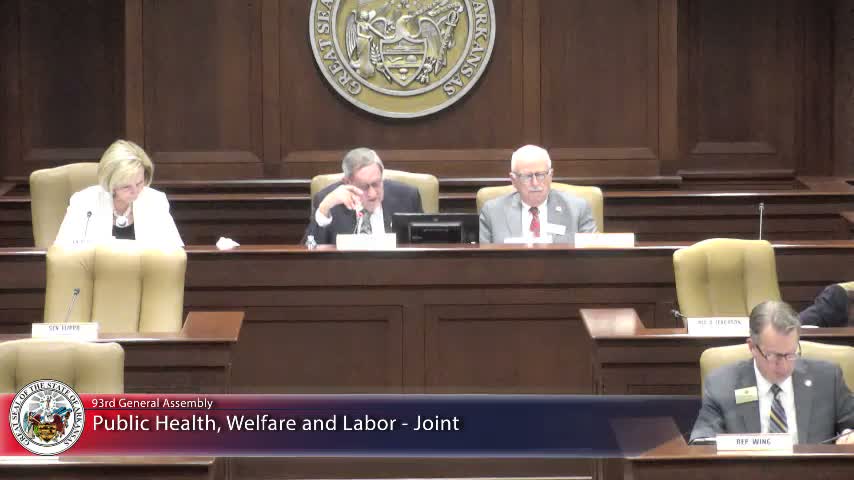
The committee moved item Z to the top of the agenda to hear how a recently passed law (Senate Bill 585) will affect state electronic asset management.
Philip Cole, manager of Transformation and Shared Services’ marketing and redistribution (M&R) operations, told the committee the new law requires state electronics to be routed to a private refurbisher rather than resold locally by M&R. Cole said M&R ‘‘sold $917,000 worth of electronic’’ last year and that resale revenue accounted for ‘‘right at 30% of my income,’’ warning that under the new process those funds would not return to the agency for salaries and operating expenses.
Representatives and staff sought details: Representative Wing and others said SB 585 (carried in the House and authored in the Senate by Sen. Wallace) aimed to create a self‑sustaining statewide e‑waste program and broaden participation to waste districts. Michael Grape of the Department of Energy and Environment clarified the program design: when the state participates, he said, ‘‘I don't think there was any money that was going to be distributed... it's just this service would be provided for free to the districts’’ (pick‑up/recycling), not a direct fund transfer between districts.
Committee members pressed whether items with resale value would be treated as waste under the bill’s consumer‑device definition; Lauren Ballard (interim chief legal, Transformation Shared Services) and Representative Gonzales noted confusion about the statutory definition. Philip Cole said his operation currently resells functioning equipment to state entities and the public and rarely ships material to landfills, and he raised concerns about the logistics of consolidating low‑volume items for the program and how the loss of resale revenue would affect M&R's ability to cover operating costs.
Chair Latham framed the discussion as an effort to surface unintended consequences and find solutions with stakeholders as implementation continues next year.
Philip Cole, manager of Transformation and Shared Services’ marketing and redistribution (M&R) operations, told the committee the new law requires state electronics to be routed to a private refurbisher rather than resold locally by M&R. Cole said M&R ‘‘sold $917,000 worth of electronic’’ last year and that resale revenue accounted for ‘‘right at 30% of my income,’’ warning that under the new process those funds would not return to the agency for salaries and operating expenses.
Representatives and staff sought details: Representative Wing and others said SB 585 (carried in the House and authored in the Senate by Sen. Wallace) aimed to create a self‑sustaining statewide e‑waste program and broaden participation to waste districts. Michael Grape of the Department of Energy and Environment clarified the program design: when the state participates, he said, ‘‘I don't think there was any money that was going to be distributed... it's just this service would be provided for free to the districts’’ (pick‑up/recycling), not a direct fund transfer between districts.
Committee members pressed whether items with resale value would be treated as waste under the bill’s consumer‑device definition; Lauren Ballard (interim chief legal, Transformation Shared Services) and Representative Gonzales noted confusion about the statutory definition. Philip Cole said his operation currently resells functioning equipment to state entities and the public and rarely ships material to landfills, and he raised concerns about the logistics of consolidating low‑volume items for the program and how the loss of resale revenue would affect M&R's ability to cover operating costs.
Chair Latham framed the discussion as an effort to surface unintended consequences and find solutions with stakeholders as implementation continues next year.
View the Full Meeting & All Its Details
This article offers just a summary. Unlock complete video, transcripts, and insights as a Founder Member.
✓
Watch full, unedited meeting videos
✓
Search every word spoken in unlimited transcripts
✓
AI summaries & real-time alerts (all government levels)
✓
Permanent access to expanding government content
30-day money-back guarantee
