Senate committee reviews broad DHS rule package: Medicaid billing, rates, waivers and behavioral‑health transformation
December 12, 2022 | PUBLIC HEALTH, WELFARE AND LABOR COMMITTEE - SENATE, Senate, Committees, Legislative, Arkansas
This article was created by AI summarizing key points discussed. AI makes mistakes, so for full details and context, please refer to the video of the full meeting. Please report any errors so we can fix them. Report an error »
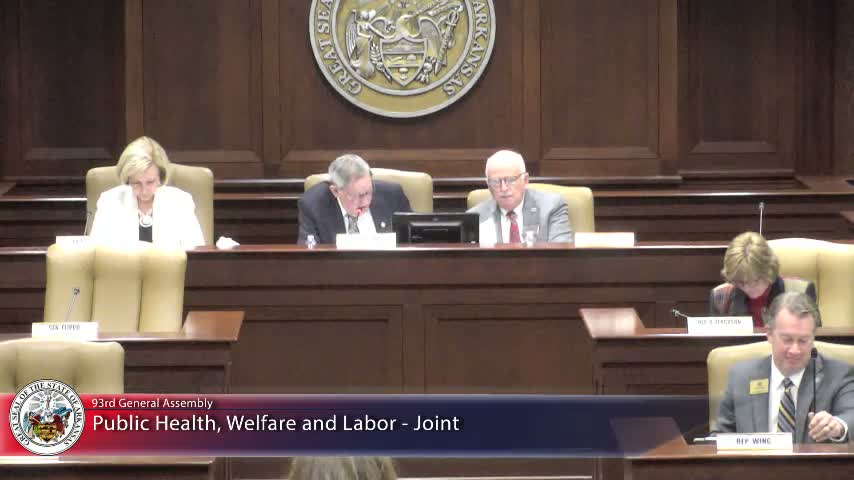
Department of Human Services officials presented a multi‑item rule packet to the Senate Public Health, Welfare and Labor Committee that touches Medicaid policy, provider payment rates, waiver implementations and a substantial behavioral health reorganization.
Key items reviewed included: a rule to allow caseworkers to sanction applicants/recipients who refuse to cooperate with child support without immediate OCSE referral; a rule restoring cost‑sharing for fee‑for‑service Medicaid to align with Centers for Medicare & Medicaid Services (CMS) requirements and implementing home‑cost sharing under a waiver; a proposed 90%‑of‑Medicare rate increase for prosthetics and orthotics; pharmacy billing updates adding National Drug Code modifiers and combining two review boards to reduce meeting burden; and 340B modifier requirements intended to correct billing errors and yield an estimated $1.6 million in savings this fiscal year.
The package also included rules implementing the Live 360 home waiver (maternal, rural and transitional youth models), expansion of pregnant‑women Medicaid coverage from limited to full benefits, and revisions to the certified nursing assistant (CNA) manual allowing virtual training. DHS said some items required CMS approval before filing (assisted‑living rate change) and that several changes were made after public comment.
A major portion of the hearing focused on an extensive behavioral‑health/CSSP manual intended to shift services toward team‑based models (assertive community treatment, intensive in‑home services) and away from fee‑for‑service, with reorganized manuals and client‑service support changes. Joel Landreno, executive director of the Arkansas Behavioral Health Council, praised DHS engagement but urged caution, flagging three concerns: (1) the repeal of the Independent Licensed Practitioner (ILP) manual could remove DHS enforcement for 24‑hour practitioner availability and incentivize clinicians to leave agencies for private practice; (2) unclear transition mechanisms from behavioral health agencies to CSSP enhanced designations; and (3) proposed cuts to group‑therapy rates before ACT teams and rate structures are fully operational would strain provider finances. DHS responded that crisis coverage remains contractually required of community mental health centers and that the task force and provider negotiations informed revisions; DHS also committed to monitoring implementation and adjusting policies if impacts materialize.
Committee members asked technical questions about timelines, provider supports for system changes, claims dispute channels for 340B pricing and how rate changes would be implemented; DHS offered follow‑up on specific CPT codes, actuarial PMPM rates for Live 360 homes and provider support channels for implementation issues.
Key items reviewed included: a rule to allow caseworkers to sanction applicants/recipients who refuse to cooperate with child support without immediate OCSE referral; a rule restoring cost‑sharing for fee‑for‑service Medicaid to align with Centers for Medicare & Medicaid Services (CMS) requirements and implementing home‑cost sharing under a waiver; a proposed 90%‑of‑Medicare rate increase for prosthetics and orthotics; pharmacy billing updates adding National Drug Code modifiers and combining two review boards to reduce meeting burden; and 340B modifier requirements intended to correct billing errors and yield an estimated $1.6 million in savings this fiscal year.
The package also included rules implementing the Live 360 home waiver (maternal, rural and transitional youth models), expansion of pregnant‑women Medicaid coverage from limited to full benefits, and revisions to the certified nursing assistant (CNA) manual allowing virtual training. DHS said some items required CMS approval before filing (assisted‑living rate change) and that several changes were made after public comment.
A major portion of the hearing focused on an extensive behavioral‑health/CSSP manual intended to shift services toward team‑based models (assertive community treatment, intensive in‑home services) and away from fee‑for‑service, with reorganized manuals and client‑service support changes. Joel Landreno, executive director of the Arkansas Behavioral Health Council, praised DHS engagement but urged caution, flagging three concerns: (1) the repeal of the Independent Licensed Practitioner (ILP) manual could remove DHS enforcement for 24‑hour practitioner availability and incentivize clinicians to leave agencies for private practice; (2) unclear transition mechanisms from behavioral health agencies to CSSP enhanced designations; and (3) proposed cuts to group‑therapy rates before ACT teams and rate structures are fully operational would strain provider finances. DHS responded that crisis coverage remains contractually required of community mental health centers and that the task force and provider negotiations informed revisions; DHS also committed to monitoring implementation and adjusting policies if impacts materialize.
Committee members asked technical questions about timelines, provider supports for system changes, claims dispute channels for 340B pricing and how rate changes would be implemented; DHS offered follow‑up on specific CPT codes, actuarial PMPM rates for Live 360 homes and provider support channels for implementation issues.
View the Full Meeting & All Its Details
This article offers just a summary. Unlock complete video, transcripts, and insights as a Founder Member.
✓
Watch full, unedited meeting videos
✓
Search every word spoken in unlimited transcripts
✓
AI summaries & real-time alerts (all government levels)
✓
Permanent access to expanding government content
30-day money-back guarantee
