Arkansas DHS outlines plan for statewide mobile crisis hub, three-region pilot
February 01, 2023 | PUBLIC HEALTH, WELFARE AND LABOR COMMITTEE - SENATE, Senate, Committees, Legislative, Arkansas
This article was created by AI summarizing key points discussed. AI makes mistakes, so for full details and context, please refer to the video of the full meeting. Please report any errors so we can fix them. Report an error »
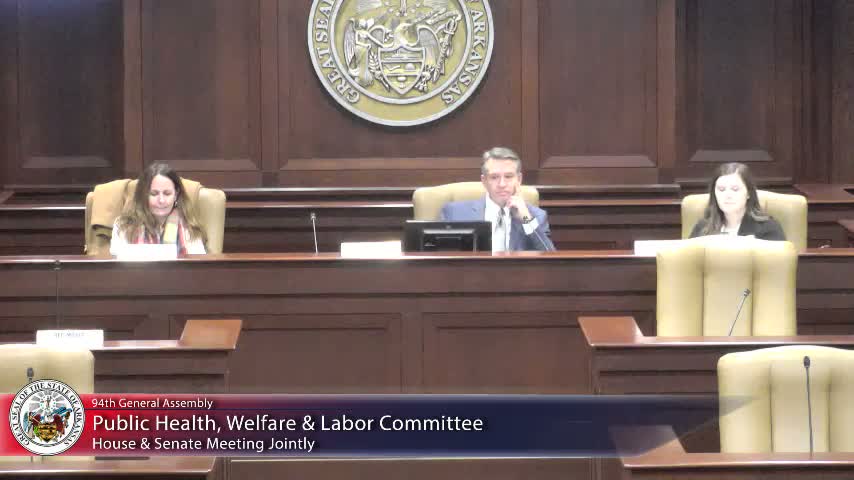
Janet Mann, deputy of health and Medicaid director for the Arkansas Department of Human Services, told the Senate Public Health, Welfare and Labor Committee that DHS is developing a statewide mobile crisis response system that would connect Arkansans in behavioral-health emergencies to local mobile crisis teams.
"This is the system that will connect you to a mobile crisis team," said Melissa Weatherton, division director for Developmental Disability Services, summarizing the proposed model that DHS staff developed with vendor Guidehouse. DHS officials said the system would serve people on Medicaid, Medicare and private insurance, and would include children, adults and people with intellectual and developmental disabilities.
DHS described two funding streams supporting the work. Weatherton said Arkansas received approximately $151 million in federal ARP-related funding tied to a Medicaid opportunity referenced in the presentation as "ARP 98 17," and that about $115 million of those funds were distributed directly to providers to recruit and retain staff. DHS officials said the remaining award and state ARP dollars are being used to build program infrastructure, including this crisis response initiative.
Paula Stone, who works for DHS across the Division of Medical Services and the Division of Aging Adult and Behavioral Health Services, said the vision is for a centralized hub that routes and records calls, deploys locally based teams and ensures warm handoffs and follow-up care. "We want to have that centralized hub because we have a lot of these kinds of services going on around the state with different providers and different funding sources, and we wanted to centralize that," Stone said.
DHS staff said Guidehouse researched other states and recommended combining elements of Georgia's centralized hub and Arizona's model for linking 911 and 988 so Arkansas would not introduce another public phone number. The plan DHS outlined would test those elements in three pilot regions with different service mixes before attempting a statewide rollout.
Officials emphasized the scope of need and current gaps in the system. "People go to jail. People are taken to emergency rooms," Weatherton said, arguing that many people in crisis are routed into higher-cost or institutional settings without appropriate community-based stabilization. DHS gave case examples including a 5-year-old in foster care with developmental delays who was admitted to a psychiatric hospital after community responses failed, and described adults with serious mental illness, co-occurring substance-use disorders, traumatic brain injuries and veterans' PTSD as populations that require tailored crisis responses.
DHS presented an example resource-need calculator based on national models to estimate community capacity and potential cost savings from diverting people away from emergency and inpatient care. Officials cautioned that Arkansas-specific savings are not yet confirmed because the state is still compiling claims data and lacks a reliable, real-time method to track local jail populations and diagnoses.
Committee members pressed DHS on what lawmakers could do. "Is this something that you can do by rules, or do you need legislative help?" asked one member. Weatherton said DHS is not seeking legislative changes "yet," and that staff are continuing planning with Guidehouse; she said the department will return to the committee if it needs statutory authority or specific funding. Members also raised concerns about sustainable financing beyond one-time federal grants and about the technology and data infrastructure needed to link disparate call lines and provider systems.
DHS noted a recent provider success: the company Benchmark, which ran a pilot program for people with intellectual and developmental disabilities, has enrolled as an Arkansas Medicaid provider, allowing some pilot services to bill Medicaid directly. DHS said that outcome demonstrates one path to sustainability for some provider models.
Mann and other DHS officials asked lawmakers to treat the briefing as an early status update and to direct colleagues who bring draft bills or proposals on related topics to consult with DHS so efforts align with the planned pilots and technical design.
The presentation closed with DHS describing next steps: finalizing the pilot strategy with Guidehouse, collecting Arkansas claims and jail-rotation data to refine capacity estimates, recruiting and training mobile teams, standing up necessary technology for the hub, and testing the full deployment across three regions before scaling statewide. No formal vote or legislative action resulted from the briefing.
The committee requested that DHS distribute the presentation packet by email to members who were not present; the hearing was recorded and will be available on the committee's video archive.
"This is the system that will connect you to a mobile crisis team," said Melissa Weatherton, division director for Developmental Disability Services, summarizing the proposed model that DHS staff developed with vendor Guidehouse. DHS officials said the system would serve people on Medicaid, Medicare and private insurance, and would include children, adults and people with intellectual and developmental disabilities.
DHS described two funding streams supporting the work. Weatherton said Arkansas received approximately $151 million in federal ARP-related funding tied to a Medicaid opportunity referenced in the presentation as "ARP 98 17," and that about $115 million of those funds were distributed directly to providers to recruit and retain staff. DHS officials said the remaining award and state ARP dollars are being used to build program infrastructure, including this crisis response initiative.
Paula Stone, who works for DHS across the Division of Medical Services and the Division of Aging Adult and Behavioral Health Services, said the vision is for a centralized hub that routes and records calls, deploys locally based teams and ensures warm handoffs and follow-up care. "We want to have that centralized hub because we have a lot of these kinds of services going on around the state with different providers and different funding sources, and we wanted to centralize that," Stone said.
DHS staff said Guidehouse researched other states and recommended combining elements of Georgia's centralized hub and Arizona's model for linking 911 and 988 so Arkansas would not introduce another public phone number. The plan DHS outlined would test those elements in three pilot regions with different service mixes before attempting a statewide rollout.
Officials emphasized the scope of need and current gaps in the system. "People go to jail. People are taken to emergency rooms," Weatherton said, arguing that many people in crisis are routed into higher-cost or institutional settings without appropriate community-based stabilization. DHS gave case examples including a 5-year-old in foster care with developmental delays who was admitted to a psychiatric hospital after community responses failed, and described adults with serious mental illness, co-occurring substance-use disorders, traumatic brain injuries and veterans' PTSD as populations that require tailored crisis responses.
DHS presented an example resource-need calculator based on national models to estimate community capacity and potential cost savings from diverting people away from emergency and inpatient care. Officials cautioned that Arkansas-specific savings are not yet confirmed because the state is still compiling claims data and lacks a reliable, real-time method to track local jail populations and diagnoses.
Committee members pressed DHS on what lawmakers could do. "Is this something that you can do by rules, or do you need legislative help?" asked one member. Weatherton said DHS is not seeking legislative changes "yet," and that staff are continuing planning with Guidehouse; she said the department will return to the committee if it needs statutory authority or specific funding. Members also raised concerns about sustainable financing beyond one-time federal grants and about the technology and data infrastructure needed to link disparate call lines and provider systems.
DHS noted a recent provider success: the company Benchmark, which ran a pilot program for people with intellectual and developmental disabilities, has enrolled as an Arkansas Medicaid provider, allowing some pilot services to bill Medicaid directly. DHS said that outcome demonstrates one path to sustainability for some provider models.
Mann and other DHS officials asked lawmakers to treat the briefing as an early status update and to direct colleagues who bring draft bills or proposals on related topics to consult with DHS so efforts align with the planned pilots and technical design.
The presentation closed with DHS describing next steps: finalizing the pilot strategy with Guidehouse, collecting Arkansas claims and jail-rotation data to refine capacity estimates, recruiting and training mobile teams, standing up necessary technology for the hub, and testing the full deployment across three regions before scaling statewide. No formal vote or legislative action resulted from the briefing.
The committee requested that DHS distribute the presentation packet by email to members who were not present; the hearing was recorded and will be available on the committee's video archive.
Don't Miss a Word: See the Full Meeting!
Go beyond summaries. Unlock every video, transcript, and key insight with a Founder Membership.
✓
Get instant access to full meeting videos
✓
Search and clip any phrase from complete transcripts
✓
Receive AI-powered summaries & custom alerts
✓
Enjoy lifetime, unrestricted access to government data
30-day money-back guarantee
