Senate panel advances interstate compact to ease cross-border care for audiologists and speech-language pathologists
March 06, 2023 | PUBLIC HEALTH, WELFARE AND LABOR COMMITTEE - SENATE, Senate, Committees, Legislative, Arkansas
This article was created by AI summarizing key points discussed. AI makes mistakes, so for full details and context, please refer to the video of the full meeting. Please report any errors so we can fix them. Report an error »
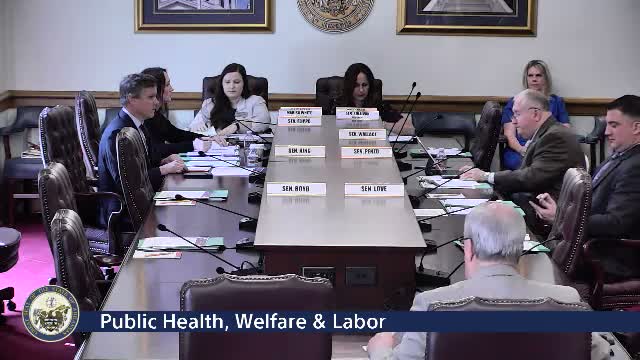
Senate Bill 91, which would join Arkansas to the interstate Speech-Language Pathology and Audiology compact, passed the Senate Public Health, Welfare and Labor Committee by voice vote after testimony and committee questions.
Senator Kim Hammer introduced the bill and yielded to witnesses who described clinical and family impacts that the compact is intended to address. "Sarah was diagnosed with hearing loss when she was 3 years old…Currently, without the interstate compact, I'm unable to provide follow-up care for Sarah," Dr. Madison Howe, an audiologist and vice president of the Arkansas Speech Language Hearing Association, told the committee, describing a child who lost continuity of care because of state-border licensing rules.
Nahali Kalfas, general counsel for the Speech-Language Pathology and Audiology Compact Commission, explained the compact’s mutual-recognition approach, which gives practitioners a compact privilege derived from their home-state license in good standing. Kalfas said the commission has fee provisions similar to other compacts such as PSYPACT and the physical-therapy compact, and that member-state assessments historically have been largely revenue neutral because commissions also pursue grants and other funding. She told the committee the commission currently has a secretariat service based in Alabama and that an executive director search is underway.
Committee members questioned where the commission and administration would be headquartered, how fees would be set, whether grant funding could affect state sovereignty, and how discipline would be handled for a practitioner treating an out-of-state patient. Kalfas said the home state drives most investigations and that the laws of the state where the patient is located control scope of practice at the time of treatment.
Supporters emphasized benefits for military families, noting that Department of Defense officials have encouraged interstate compacts as a portability solution for spouses of service members. Kalfas told the committee the National Appropriations Act has included a line item to support compact development and cited a $10,000,000 line item in federal appropriations to support the development of more compacts.
With no public opposition recorded in the transcript, Senator Hammer closed and asked for a "do pass" recommendation. The committee moved, seconded and approved the motion by voice vote; individual roll-call tallies were not specified in the transcript.
The committee’s action sends the bill forward; the transcript does not record next committee or floor steps, nor does it include a meeting date in the record.
Senator Kim Hammer introduced the bill and yielded to witnesses who described clinical and family impacts that the compact is intended to address. "Sarah was diagnosed with hearing loss when she was 3 years old…Currently, without the interstate compact, I'm unable to provide follow-up care for Sarah," Dr. Madison Howe, an audiologist and vice president of the Arkansas Speech Language Hearing Association, told the committee, describing a child who lost continuity of care because of state-border licensing rules.
Nahali Kalfas, general counsel for the Speech-Language Pathology and Audiology Compact Commission, explained the compact’s mutual-recognition approach, which gives practitioners a compact privilege derived from their home-state license in good standing. Kalfas said the commission has fee provisions similar to other compacts such as PSYPACT and the physical-therapy compact, and that member-state assessments historically have been largely revenue neutral because commissions also pursue grants and other funding. She told the committee the commission currently has a secretariat service based in Alabama and that an executive director search is underway.
Committee members questioned where the commission and administration would be headquartered, how fees would be set, whether grant funding could affect state sovereignty, and how discipline would be handled for a practitioner treating an out-of-state patient. Kalfas said the home state drives most investigations and that the laws of the state where the patient is located control scope of practice at the time of treatment.
Supporters emphasized benefits for military families, noting that Department of Defense officials have encouraged interstate compacts as a portability solution for spouses of service members. Kalfas told the committee the National Appropriations Act has included a line item to support compact development and cited a $10,000,000 line item in federal appropriations to support the development of more compacts.
With no public opposition recorded in the transcript, Senator Hammer closed and asked for a "do pass" recommendation. The committee moved, seconded and approved the motion by voice vote; individual roll-call tallies were not specified in the transcript.
The committee’s action sends the bill forward; the transcript does not record next committee or floor steps, nor does it include a meeting date in the record.
Don't Miss a Word: See the Full Meeting!
Go beyond summaries. Unlock every video, transcript, and key insight with a Founder Membership.
✓
Get instant access to full meeting videos
✓
Search and clip any phrase from complete transcripts
✓
Receive AI-powered summaries & custom alerts
✓
Enjoy lifetime, unrestricted access to government data
30-day money-back guarantee
