Arkansas committee debates state licensure for behavior analysts; bill fails for lack of a second
March 15, 2023 | PUBLIC HEALTH, WELFARE AND LABOR COMMITTEE - SENATE, Senate, Committees, Legislative, Arkansas
This article was created by AI summarizing key points discussed. AI makes mistakes, so for full details and context, please refer to the video of the full meeting. Please report any errors so we can fix them. Report an error »
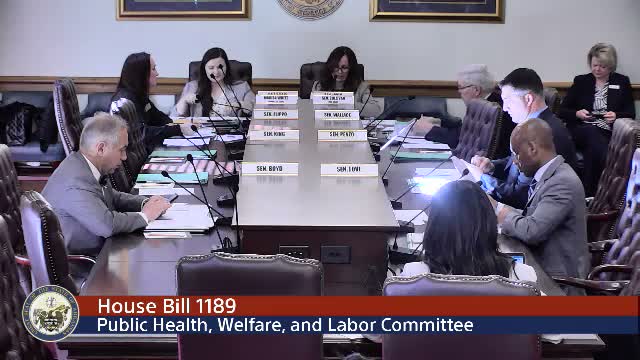
Representative Nicole Clowney introduced House Bill 11 89 to establish state licensure for applied behavior analysts, require criminal background checks for licensees and place oversight under the Arkansas Psychology Board. Supporters said state licensure would provide local oversight and consumer protections; opponents warned the change could create ambiguity about oversight, duplicate licensing costs and delay services.
Clowney told the committee the measure was the product of a behavioral health working group and would keep Arkansas aligned with neighboring states: "This bill creates a new license under an existing board," she said, adding the rules would mirror the national certifying standards while giving Arkansans the ability to handle ethics complaints locally. Elizabeth Laura, introduced to the committee as an expert witness, said local oversight is especially important for rural communities, where "dual relationships" are more common and national boards may not grasp local nuance.
Brandon Greenlee, director of policy and advocacy for Bridging Autism Services and speaking on behalf of Integrative Learning Consultants, urged caution. He disputed the committee's rationale that behavior analysts lack background checks: "Any service provider that is credentialed with Medicaid and or serves a Medicaid patient must have a background check," he said, noting schools, Medicaid providers and many private insurers already require vetting. Greenlee also warned that removing explicit references to the national certifying body and placing the license under the psychology board could leave the language ambiguous and allow psychologists to exercise oversight that might limit the practice and growth of the field.
Joel Landreno of the Arkansas Council for Behavioral Health called for a compromise that would avoid creating new financial burdens on clinicians who already hold other licenses. He asked for preamble language stating the intent "to be inclusive of all current providers without creating an additional expense to those licensed by other entities," and said the group's request for that preamble was rejected in amendment negotiations.
State officials addressed operational concerns. Matt Gilmore of the Department of Health said the psychology board had been chosen to avoid creating a new board and to leverage existing expertise; Melissa Weatherton of the Division of Developmental Disability Services said the state is already seeing rising costs for applied behavioral analysis and does not expect state licensure alone to increase Medicaid enrollment, because many ABA providers already serve Medicaid patients under national credentials.
Senator Mark Hammer, the Senate sponsor, characterized the bill as a narrow effort to improve local accountability. "We're trying to bring accountability," he said, arguing state oversight would let Arkansans raise ethics and practice concerns locally instead of relying on a national entity.
After extended questioning from committee members about scope, fees and whether the state license would be more or less restrictive than national certification, a motion to pass as amended was made. The motion received no second and "the bill dies for lack of a second," the chair announced.
The hearing record shows active stakeholder engagement on both sides and the committee may choose to rework language and reintroduce the measure in a subsequent session. The sponsor said there would be an opportunity to bring the bill back and continue negotiations.
Clowney told the committee the measure was the product of a behavioral health working group and would keep Arkansas aligned with neighboring states: "This bill creates a new license under an existing board," she said, adding the rules would mirror the national certifying standards while giving Arkansans the ability to handle ethics complaints locally. Elizabeth Laura, introduced to the committee as an expert witness, said local oversight is especially important for rural communities, where "dual relationships" are more common and national boards may not grasp local nuance.
Brandon Greenlee, director of policy and advocacy for Bridging Autism Services and speaking on behalf of Integrative Learning Consultants, urged caution. He disputed the committee's rationale that behavior analysts lack background checks: "Any service provider that is credentialed with Medicaid and or serves a Medicaid patient must have a background check," he said, noting schools, Medicaid providers and many private insurers already require vetting. Greenlee also warned that removing explicit references to the national certifying body and placing the license under the psychology board could leave the language ambiguous and allow psychologists to exercise oversight that might limit the practice and growth of the field.
Joel Landreno of the Arkansas Council for Behavioral Health called for a compromise that would avoid creating new financial burdens on clinicians who already hold other licenses. He asked for preamble language stating the intent "to be inclusive of all current providers without creating an additional expense to those licensed by other entities," and said the group's request for that preamble was rejected in amendment negotiations.
State officials addressed operational concerns. Matt Gilmore of the Department of Health said the psychology board had been chosen to avoid creating a new board and to leverage existing expertise; Melissa Weatherton of the Division of Developmental Disability Services said the state is already seeing rising costs for applied behavioral analysis and does not expect state licensure alone to increase Medicaid enrollment, because many ABA providers already serve Medicaid patients under national credentials.
Senator Mark Hammer, the Senate sponsor, characterized the bill as a narrow effort to improve local accountability. "We're trying to bring accountability," he said, arguing state oversight would let Arkansans raise ethics and practice concerns locally instead of relying on a national entity.
After extended questioning from committee members about scope, fees and whether the state license would be more or less restrictive than national certification, a motion to pass as amended was made. The motion received no second and "the bill dies for lack of a second," the chair announced.
The hearing record shows active stakeholder engagement on both sides and the committee may choose to rework language and reintroduce the measure in a subsequent session. The sponsor said there would be an opportunity to bring the bill back and continue negotiations.
Don't Miss a Word: See the Full Meeting!
Go beyond summaries. Unlock every video, transcript, and key insight with a Founder Membership.
✓
Get instant access to full meeting videos
✓
Search and clip any phrase from complete transcripts
✓
Receive AI-powered summaries & custom alerts
✓
Enjoy lifetime, unrestricted access to government data
30-day money-back guarantee
