Senate committee raises SNAP asset cap to $6,000, saying change will help families save
March 15, 2023 | PUBLIC HEALTH, WELFARE AND LABOR COMMITTEE - SENATE, Senate, Committees, Legislative, Arkansas
This article was created by AI summarizing key points discussed. AI makes mistakes, so for full details and context, please refer to the video of the full meeting. Please report any errors so we can fix them. Report an error »
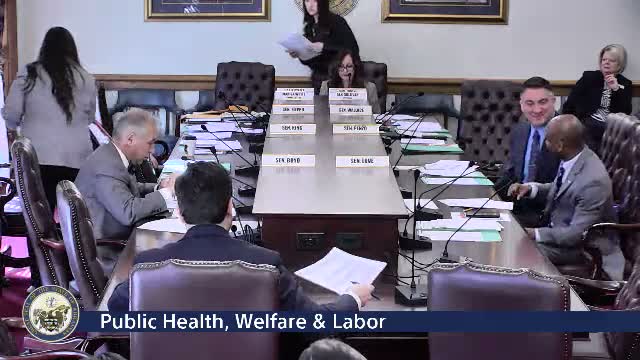
The Senate Public Health, Welfare and Labor Committee voted to pass Senate Bill 306 as amended to set a $6,000 asset limit for families receiving SNAP benefits. Sponsor Senator Jonathan Dismayne told the committee the amendment lowers the originally proposed cap and aims to eliminate the "cliff" that penalizes families for modest savings.
Dismayne argued the existing federal floor and Arkansas's prior statutory caps leave families unable to save for first month's rent or a used car: "If a poor person wants to save, then we should be supportive of that," he said. The amendment reduced the cap to $6,000 because that figure is easier to defend than the prior number and still below what an inflation adjustment would have produced.
State officials told the committee Arkansas has historically followed federal minimums for asset limits. Mark White of the Department of Human Services said federal law permits states to request exemptions and confirmed Arkansas has not made such a change in recent memory; DHS agreed to follow up with the committee on historical indexing and which CPI or index would be used for inflation adjustments.
Brian Burton, CEO of the Arkansas Food Bank, testified in support and described Nevada's experience after removing asset limits: participation patterns were largely unchanged while families gained the ability to build modest savings and avoid being disqualified for temporary assets. "For every meal we provide, SNAP provides 12 meals," Burton said, arguing the policy is an anti-hunger and anti-poverty measure.
Pediatricians from the Arkansas chapter of the American Academy of Pediatrics also supported the bill, telling the committee that the inability to save can undermine family and child health.
After public testimony and committee questions, the committee adopted the amendment and passed Senate Bill 306 as amended by voice vote.
Dismayne argued the existing federal floor and Arkansas's prior statutory caps leave families unable to save for first month's rent or a used car: "If a poor person wants to save, then we should be supportive of that," he said. The amendment reduced the cap to $6,000 because that figure is easier to defend than the prior number and still below what an inflation adjustment would have produced.
State officials told the committee Arkansas has historically followed federal minimums for asset limits. Mark White of the Department of Human Services said federal law permits states to request exemptions and confirmed Arkansas has not made such a change in recent memory; DHS agreed to follow up with the committee on historical indexing and which CPI or index would be used for inflation adjustments.
Brian Burton, CEO of the Arkansas Food Bank, testified in support and described Nevada's experience after removing asset limits: participation patterns were largely unchanged while families gained the ability to build modest savings and avoid being disqualified for temporary assets. "For every meal we provide, SNAP provides 12 meals," Burton said, arguing the policy is an anti-hunger and anti-poverty measure.
Pediatricians from the Arkansas chapter of the American Academy of Pediatrics also supported the bill, telling the committee that the inability to save can undermine family and child health.
After public testimony and committee questions, the committee adopted the amendment and passed Senate Bill 306 as amended by voice vote.
View the Full Meeting & All Its Details
This article offers just a summary. Unlock complete video, transcripts, and insights as a Founder Member.
✓
Watch full, unedited meeting videos
✓
Search every word spoken in unlimited transcripts
✓
AI summaries & real-time alerts (all government levels)
✓
Permanent access to expanding government content
30-day money-back guarantee
