Senate committee hears wide debate on permanent-cosmetics bill, stops short of final action
March 29, 2023 | PUBLIC HEALTH, WELFARE AND LABOR COMMITTEE - SENATE, Senate, Committees, Legislative, Arkansas
This article was created by AI summarizing key points discussed. AI makes mistakes, so for full details and context, please refer to the video of the full meeting. Please report any errors so we can fix them. Report an error »
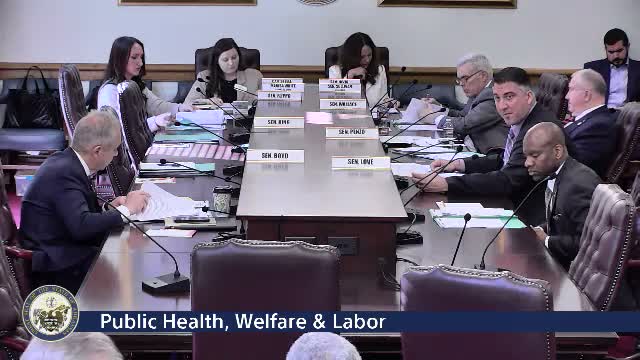
Senator Bridal Davis, sponsor of Senate Bill 392, told the Public Health, Welfare and Labor Committee that the bill primarily cleans up language from Act 900 of 2021 and reunites regulation of permanent cosmetics with other body-art rules while adding programmatic safeguards. "We have been working with the industry and with the Department of Health for, I mean, probably 10 months now," she said in presenting the measure.
The bill would add two seats to the cosmetology technical advisory committee to represent tattooing and piercing artists, change the instructor-to-student ratio to no more than 1-to-8, increase training from 375 to 400 clock hours and require annual Department of Health inspections. It would also limit online instruction to 20 percent of the curriculum, raising the in-person requirement to 80 percent.
Industry witnesses described the rationale and the concern on both sides. Lena Gabrihana, who identified herself as representing the permanent cosmetics industry, said the bill also clarifies consent rules where minors have medical necessity: "We're not only stating that we would like the parental permission, but also the medical consent in that instance." Gabrihana told senators she supported stronger, apprenticeship-style in-person training to reduce poor outcomes she has observed in less-regulated states.
Opponents warned the changes could make training unaffordable or inaccessible for some students. Darren Taylor, owner of a permanent-cosmetic school, said his program relies on a 50/50 online–in-person model to accommodate working students and single parents. He argued the proposed shift would reduce enrollment sharply: "If we made the changes currently proposed as law, 50% of all my enrolled students will not be able to attend." Taylor also said Arkansas has only about 22 people eligible to be instructors under certain strict criteria, which he said would be insufficient to staff expanded in-person programs.
Committee members pressed witnesses on outcomes data and on how Arkansas regulations compare to other states. Proponents said Arkansas lies toward the more stringent end of the spectrum compared with neighboring states, while opponents pointed to accreditation and apprenticeship pathways they said had worked for their students. No formal vote on SB 392 was recorded at this hearing; the sponsor acknowledged an amendment was still being prepared and the committee pulled the item to return later with the engrossed language.
The committee left the bill pending the sponsor's amendment and additional information from the Department of Health and industry stakeholders.
The bill would add two seats to the cosmetology technical advisory committee to represent tattooing and piercing artists, change the instructor-to-student ratio to no more than 1-to-8, increase training from 375 to 400 clock hours and require annual Department of Health inspections. It would also limit online instruction to 20 percent of the curriculum, raising the in-person requirement to 80 percent.
Industry witnesses described the rationale and the concern on both sides. Lena Gabrihana, who identified herself as representing the permanent cosmetics industry, said the bill also clarifies consent rules where minors have medical necessity: "We're not only stating that we would like the parental permission, but also the medical consent in that instance." Gabrihana told senators she supported stronger, apprenticeship-style in-person training to reduce poor outcomes she has observed in less-regulated states.
Opponents warned the changes could make training unaffordable or inaccessible for some students. Darren Taylor, owner of a permanent-cosmetic school, said his program relies on a 50/50 online–in-person model to accommodate working students and single parents. He argued the proposed shift would reduce enrollment sharply: "If we made the changes currently proposed as law, 50% of all my enrolled students will not be able to attend." Taylor also said Arkansas has only about 22 people eligible to be instructors under certain strict criteria, which he said would be insufficient to staff expanded in-person programs.
Committee members pressed witnesses on outcomes data and on how Arkansas regulations compare to other states. Proponents said Arkansas lies toward the more stringent end of the spectrum compared with neighboring states, while opponents pointed to accreditation and apprenticeship pathways they said had worked for their students. No formal vote on SB 392 was recorded at this hearing; the sponsor acknowledged an amendment was still being prepared and the committee pulled the item to return later with the engrossed language.
The committee left the bill pending the sponsor's amendment and additional information from the Department of Health and industry stakeholders.
Don't Miss a Word: See the Full Meeting!
Go beyond summaries. Unlock every video, transcript, and key insight with a Founder Membership.
✓
Get instant access to full meeting videos
✓
Search and clip any phrase from complete transcripts
✓
Receive AI-powered summaries & custom alerts
✓
Enjoy lifetime, unrestricted access to government data
30-day money-back guarantee
