Senate committee approves overhaul of Arkansas’ waste‑tire program, expands $3 fee to vehicle registrations
March 31, 2023 | PUBLIC HEALTH, WELFARE AND LABOR COMMITTEE - SENATE, Senate, Committees, Legislative, Arkansas
This article was created by AI summarizing key points discussed. AI makes mistakes, so for full details and context, please refer to the video of the full meeting. Please report any errors so we can fix them. Report an error »
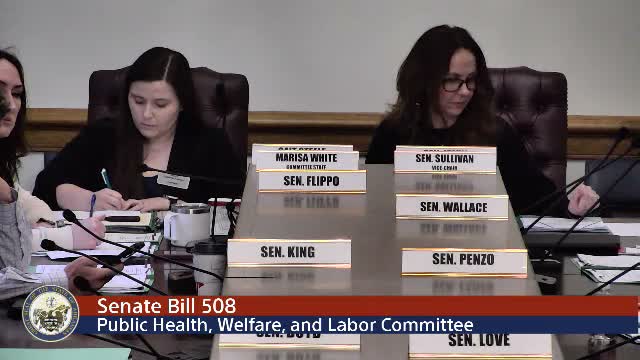
The Senate Public Health, Welfare and Labor Committee voted Friday to advance Senate Bill 508, a measure its sponsor said will shore up Arkansas’ struggling waste‑tire program by expanding the point at which disposal fees are collected and creating four regional “waste tire accountability” boards.
Senator Peyton (District 22), the bill’s sponsor, told the committee the current system has under‑collected for years and that shifting the fee to the point of vehicle registration will capture many tires the state now misses. “When you go to pay the sales tax on your new vehicle or your new trailer…there’s gonna be $3 per tire that’ll be collected at that point,” Peyton said, describing the provision that applies the existing per‑tire fee to new vehicles and trailers as a way to broaden the base of payers and generate stable revenue.
Why it matters: The tire program has required state intervention in prior years when reimbursements fell short; sponsors estimated SB508 will generate roughly $3 million to $4 million in new annual revenue. The bill also eliminates the rim‑removal fee on used tires to encourage resale and reuse, and creates four geographic quadrants, each governed by an accountability board made up of county judges and mayors that will contract with processors and set caps for large tires.
What the bill does: SB508 (as presented) would
- remove the fee on used tire transactions to encourage reuse;
- collect the $3 per‑tire fee on new passenger tires when a new vehicle or trailer is registered;
- allow local accountability boards in four quadrants to set higher caps on large tires (up to $7.50) and extra‑large tires (up to $30);
- require business plans from each quadrant and periodic legislative audits.
Supporters including Lonoke County Judge Doug Erwin and other county judges told the committee the program’s prior structure and fragmented districts left funding gaps. “Seventy‑five of us unanimously support Senator Peyton’s bill,” Erwin said, framing the change as preferable to full privatization and as a way to avoid unpaid, uncollected fees and illegal dumps.
Agency concerns and fiscal data: Lauren Ballard, chief legal counsel for the Department of Energy and Environment, said the measure does increase fees and broadens the fee base to vehicle registrations, trailers and some small‑equipment tires that were previously exempt. “The fee increase is, of course, the biggest concern for us,” Ballard said, urging careful drafting on who collects the money and how administrative percentages are set.
Paul Gearing of the Department of Finance and Administration told the committee DFA is preparing a final fiscal impact statement and provided preliminary estimates: about $2.37 million from new motor‑vehicle registrations and roughly $318,000 from new trailers under the registration‑collection approach. He also noted the bill adds an administrative mechanism to close delinquent businesses; DFA reported roughly $4.6 million in delinquent waste‑tire fees currently on the books.
Oversight and local control: The bill gives each regional board latitude to negotiate contracts with private or public processors and to direct where tires are shipped to minimize transport costs. Sponsor Peyton said transport is among the program’s largest expenses and that boards will need flexibility to route tires to the most efficient processor in or near each quadrant.
Vote and next steps: The committee approved immediate consideration and then passed SB508 by voice vote. The bill now advances to the next stage of the legislative process.
What’s next: The boards will be required to file business plans and will be subject to legislative audit; DFNA will review forecasts to ensure planned expenditures match projected fee revenue. The committee record shows outstanding drafting questions about fund allocations and the program’s administrative percentages that the sponsor and agencies said they will continue to resolve.
Senator Peyton (District 22), the bill’s sponsor, told the committee the current system has under‑collected for years and that shifting the fee to the point of vehicle registration will capture many tires the state now misses. “When you go to pay the sales tax on your new vehicle or your new trailer…there’s gonna be $3 per tire that’ll be collected at that point,” Peyton said, describing the provision that applies the existing per‑tire fee to new vehicles and trailers as a way to broaden the base of payers and generate stable revenue.
Why it matters: The tire program has required state intervention in prior years when reimbursements fell short; sponsors estimated SB508 will generate roughly $3 million to $4 million in new annual revenue. The bill also eliminates the rim‑removal fee on used tires to encourage resale and reuse, and creates four geographic quadrants, each governed by an accountability board made up of county judges and mayors that will contract with processors and set caps for large tires.
What the bill does: SB508 (as presented) would
- remove the fee on used tire transactions to encourage reuse;
- collect the $3 per‑tire fee on new passenger tires when a new vehicle or trailer is registered;
- allow local accountability boards in four quadrants to set higher caps on large tires (up to $7.50) and extra‑large tires (up to $30);
- require business plans from each quadrant and periodic legislative audits.
Supporters including Lonoke County Judge Doug Erwin and other county judges told the committee the program’s prior structure and fragmented districts left funding gaps. “Seventy‑five of us unanimously support Senator Peyton’s bill,” Erwin said, framing the change as preferable to full privatization and as a way to avoid unpaid, uncollected fees and illegal dumps.
Agency concerns and fiscal data: Lauren Ballard, chief legal counsel for the Department of Energy and Environment, said the measure does increase fees and broadens the fee base to vehicle registrations, trailers and some small‑equipment tires that were previously exempt. “The fee increase is, of course, the biggest concern for us,” Ballard said, urging careful drafting on who collects the money and how administrative percentages are set.
Paul Gearing of the Department of Finance and Administration told the committee DFA is preparing a final fiscal impact statement and provided preliminary estimates: about $2.37 million from new motor‑vehicle registrations and roughly $318,000 from new trailers under the registration‑collection approach. He also noted the bill adds an administrative mechanism to close delinquent businesses; DFA reported roughly $4.6 million in delinquent waste‑tire fees currently on the books.
Oversight and local control: The bill gives each regional board latitude to negotiate contracts with private or public processors and to direct where tires are shipped to minimize transport costs. Sponsor Peyton said transport is among the program’s largest expenses and that boards will need flexibility to route tires to the most efficient processor in or near each quadrant.
Vote and next steps: The committee approved immediate consideration and then passed SB508 by voice vote. The bill now advances to the next stage of the legislative process.
What’s next: The boards will be required to file business plans and will be subject to legislative audit; DFNA will review forecasts to ensure planned expenditures match projected fee revenue. The committee record shows outstanding drafting questions about fund allocations and the program’s administrative percentages that the sponsor and agencies said they will continue to resolve.
Don't Miss a Word: See the Full Meeting!
Go beyond summaries. Unlock every video, transcript, and key insight with a Founder Membership.
✓
Get instant access to full meeting videos
✓
Search and clip any phrase from complete transcripts
✓
Receive AI-powered summaries & custom alerts
✓
Enjoy lifetime, unrestricted access to government data
30-day money-back guarantee
