Committee hears Medicaid redetermination update; agency reports 5,206 children reenrolled
September 12, 2023 | PUBLIC HEALTH, WELFARE AND LABOR COMMITTEE - SENATE, Senate, Committees, Legislative, Arkansas
This article was created by AI summarizing key points discussed. AI makes mistakes, so for full details and context, please refer to the video of the full meeting. Please report any errors so we can fix them. Report an error »
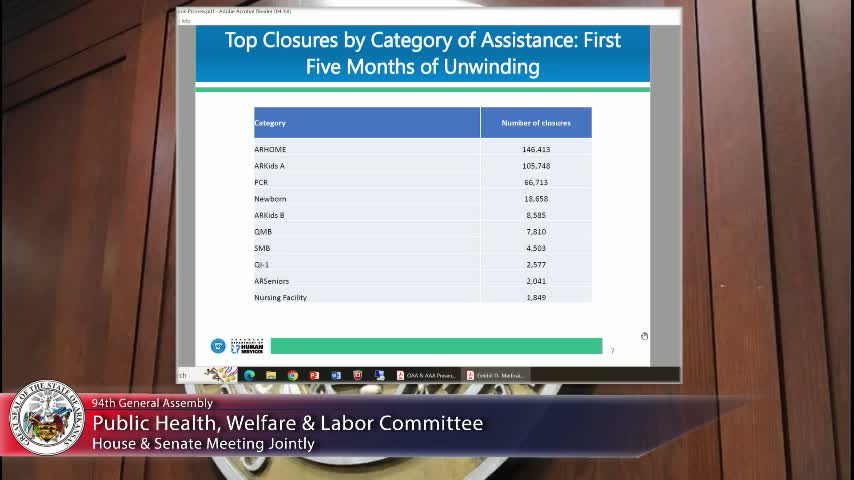
Unidentified Speaker told the Public Health, Welfare and Labor Committee that the agency has begun analyzing "churn"—whether beneficiaries disenrolled for procedural reasons come back onto Medicaid—and shared initial results for June through August. "So far we've had a total of 5,206 children come back to the roles and that is, approximately 3.91 percent of all the children that have been disenrolled," the presenter said. The presenter added that, "We do have 90 day retroactive coverage for children," and that the agency will make coverage retroactive where applicable.
The update explained that the office continued monthly casework during the federal public‑health emergency but in many cases had to place eligible cases into an "extended" category instead of disenrolling. With the federal pause lifted and annual determinations resuming after April 1, 2023, staff said they have been working through extended categories and expect workload and eligibility baselines to stabilize in mid‑October into November and into December. The agency referenced a state statute passed in 2021 that required reporting to the legislature and stressed compliance with CMS rules for redeterminations.
Members pressed for context on the results. One legislator asked why there are roughly 51,000 more female closures than male closures; staff said they will ask program analysts to investigate the gender disparity. Senator Boyd, who participated as a committee member and also practices as a pharmacist, said his office had not received constituent complaints and asked whether providers had raised surprises; staff and a provider liaison said providers have participated in regular outreach calls and casework, and the agency has fielded provider reports and constituent inquiries that it is working to resolve.
Committee members asked how the churn data affects next year’s budget planning. The presenter said finance and operations are updating budget assumptions as new eligibility and enrollment numbers come in but were cautious about giving provisional totals until the churn baseline stabilizes. The agency emphasized it has worked case‑by‑case to correct errors brought to its attention and that some reenrollments represent reinstatements (not new eligibility determinations).
The committee took no formal vote on the report; members asked for further demographic and churn breakdowns to inform budgeting and oversight. The agency agreed to provide follow‑up information on gender and age patterns, and to continue reporting churn metrics to the committee.
The update explained that the office continued monthly casework during the federal public‑health emergency but in many cases had to place eligible cases into an "extended" category instead of disenrolling. With the federal pause lifted and annual determinations resuming after April 1, 2023, staff said they have been working through extended categories and expect workload and eligibility baselines to stabilize in mid‑October into November and into December. The agency referenced a state statute passed in 2021 that required reporting to the legislature and stressed compliance with CMS rules for redeterminations.
Members pressed for context on the results. One legislator asked why there are roughly 51,000 more female closures than male closures; staff said they will ask program analysts to investigate the gender disparity. Senator Boyd, who participated as a committee member and also practices as a pharmacist, said his office had not received constituent complaints and asked whether providers had raised surprises; staff and a provider liaison said providers have participated in regular outreach calls and casework, and the agency has fielded provider reports and constituent inquiries that it is working to resolve.
Committee members asked how the churn data affects next year’s budget planning. The presenter said finance and operations are updating budget assumptions as new eligibility and enrollment numbers come in but were cautious about giving provisional totals until the churn baseline stabilizes. The agency emphasized it has worked case‑by‑case to correct errors brought to its attention and that some reenrollments represent reinstatements (not new eligibility determinations).
The committee took no formal vote on the report; members asked for further demographic and churn breakdowns to inform budgeting and oversight. The agency agreed to provide follow‑up information on gender and age patterns, and to continue reporting churn metrics to the committee.
Don't Miss a Word: See the Full Meeting!
Go beyond summaries. Unlock every video, transcript, and key insight with a Founder Membership.
✓
Get instant access to full meeting videos
✓
Search and clip any phrase from complete transcripts
✓
Receive AI-powered summaries & custom alerts
✓
Enjoy lifetime, unrestricted access to government data
30-day money-back guarantee
