Committee recommends ARPA funds to expand senior meal workforce; AAAs warn about one‑time funding
September 12, 2023 | PUBLIC HEALTH, WELFARE AND LABOR COMMITTEE - SENATE, Senate, Committees, Legislative, Arkansas
This article was created by AI summarizing key points discussed. AI makes mistakes, so for full details and context, please refer to the video of the full meeting. Please report any errors so we can fix them. Report an error »
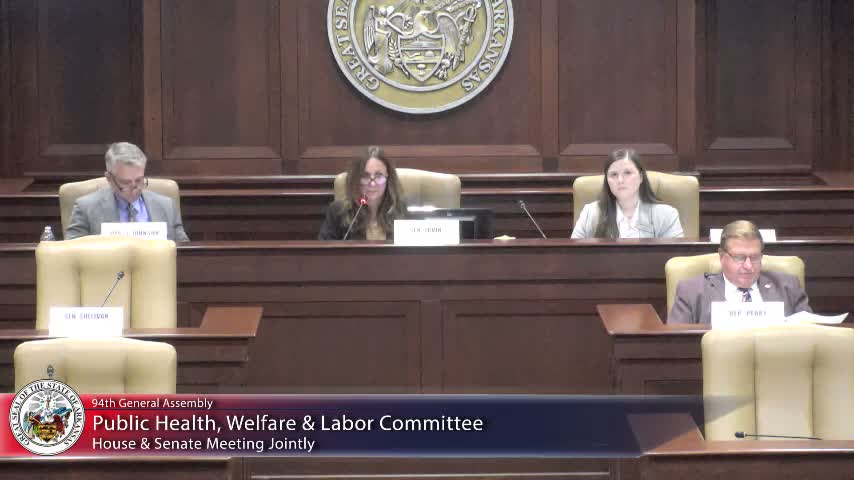
The Public Health, Welfare and Labor Committee reviewed an ARPA request for "a little over $600,000" (later discussed as $628,000) to expand workforce services that support home‑delivered meals and other AAA activities. Jay Hill (Division of Aging and Behavioral Health) said the request is distributed across eight Area Agencies on Aging (AAAs) using the Older Americans Act funding formula, with awards ranging from about $131,000 down to $56,000 depending on region. Hill said the funds would be used "to both bring on new contractors or expand the hours of existing staff to deliver additional home delivered meals."
Brad Bailey, Executive Director of an Area Agency on Aging and president of the Association of Area Agencies on Aging, described the AAAs’ core services and funding pressures. He said AAAs project serving 3,296,674 meals this year across home‑delivered and congregate programs, operate 145 senior centers, and contract with 32 providers. Bailey told the committee that administrative fees across funding streams average about 9.2% and that AAAs face rising labor, food and fuel costs while some revenue sources such as cigarette‑tax receipts have declined.
Several legislators pressed on sustainability. Representative Vaught asked what happens when one‑time ARPA funds are exhausted; Bailey said AAAs have not yet notified prospective hires because the funding is not yet confirmed and emphasized the temporary nature of ARPA and one‑time funds. Committee members asked for regional funding breakdowns and for the division to provide more detail on state versus federal versus private funding by region.
After discussion, the committee voted on a recommendation to allow the Department of Finance to move forward with the ARPA request. A motion was offered and seconded; the chair declared, "Ayes have it," and the committee recommended proceeding with the request to the Department of Finance and ALC peer subcommittee for further action.
The committee flagged the merits of the request—more meals and strengthened workforce capacity—while also expressing concern that using one‑time federal dollars to fund positions could create unsustainable expectations once the money expires. Members asked that AAAs and the division improve communication to senior‑center directors about funding sources and timelines.
Brad Bailey, Executive Director of an Area Agency on Aging and president of the Association of Area Agencies on Aging, described the AAAs’ core services and funding pressures. He said AAAs project serving 3,296,674 meals this year across home‑delivered and congregate programs, operate 145 senior centers, and contract with 32 providers. Bailey told the committee that administrative fees across funding streams average about 9.2% and that AAAs face rising labor, food and fuel costs while some revenue sources such as cigarette‑tax receipts have declined.
Several legislators pressed on sustainability. Representative Vaught asked what happens when one‑time ARPA funds are exhausted; Bailey said AAAs have not yet notified prospective hires because the funding is not yet confirmed and emphasized the temporary nature of ARPA and one‑time funds. Committee members asked for regional funding breakdowns and for the division to provide more detail on state versus federal versus private funding by region.
After discussion, the committee voted on a recommendation to allow the Department of Finance to move forward with the ARPA request. A motion was offered and seconded; the chair declared, "Ayes have it," and the committee recommended proceeding with the request to the Department of Finance and ALC peer subcommittee for further action.
The committee flagged the merits of the request—more meals and strengthened workforce capacity—while also expressing concern that using one‑time federal dollars to fund positions could create unsustainable expectations once the money expires. Members asked that AAAs and the division improve communication to senior‑center directors about funding sources and timelines.
Don't Miss a Word: See the Full Meeting!
Go beyond summaries. Unlock every video, transcript, and key insight with a Founder Membership.
✓
Get instant access to full meeting videos
✓
Search and clip any phrase from complete transcripts
✓
Receive AI-powered summaries & custom alerts
✓
Enjoy lifetime, unrestricted access to government data
30-day money-back guarantee
