Arkansas agencies outline executive order to tackle maternal and women's health, name five pilot counties
March 29, 2024 | PUBLIC HEALTH, WELFARE AND LABOR COMMITTEE - SENATE, Senate, Committees, Legislative, Arkansas
This article was created by AI summarizing key points discussed. AI makes mistakes, so for full details and context, please refer to the video of the full meeting. Please report any errors so we can fix them. Report an error »
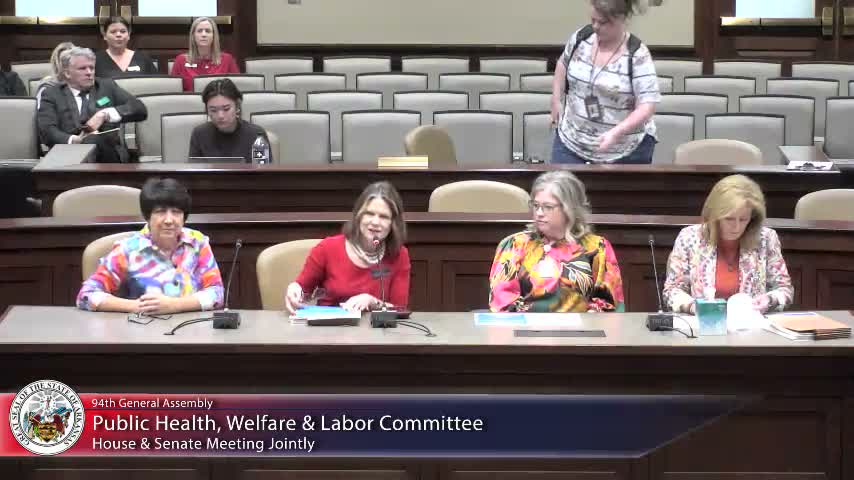
State health and human services officials on Good Friday briefed the Senate Public Health, Welfare and Labor Committee on an executive order signed by Governor Sanders on March 6 that directs an interagency initiative to improve women's health and reduce maternal harm.
Secretary Christy Putnam and Department of Health Secretary Renee Mallory described a multi-agency strategy that will "look at women's health holistically" to improve outcomes before, during and after pregnancy. Mallory told the committee that maternal mortality is closely tied to chronic conditions and said the state has "over 10,000 women who don't get appropriate prenatal care." She said local public health units will act as gap-fillers where private providers are scarce.
The agencies said they selected one county from each of the state's five public-health regions for pilots where prenatal care metrics were worst: Garland, Scott, Phillips, Crittenden and Polk. The pilots will review clinic processes and local services, bring community stakeholders together and identify resources to fill gaps. "Where we identify gaps, we'll work with local stakeholders to identify resources to fill those gaps locally," Deputy Director Casey Cochran said.
Janet Mann, Deputy Secretary of Programs and Medicaid Director, outlined efforts to map Medicaid enrollment and eligibility for pregnant individuals. She said limited-pregnancy coverage currently spans people above roughly 138% of income up to about 209% and that the program provides 60-day postpartum coverage; staff are exploring automated transfers between eligibility categories and ways to track encounters because, she said, "Medicaid pays for a global pregnancy, which means we do not track the visits. We only pay at the time of birth." Mann said better data, reporting and technology are among the executive order's top tasks.
Committee members asked how the initiative would be measured and whether it intended to reduce the share of infants born on Medicaid. Mann said the order sets four main goals (education, access and quality, pilot implementation, and data/technology) and emphasized that workforce and economic-support programs are part of the long-term strategy. The agency plans a statewide stakeholder meeting on April 22 to broaden participation.
Officials also announced a public launch tied to Women's Health Month: a May 2 "Mom Event" at the State Capitol offering blood-pressure and blood-sugar checks, distribution of a health-journey booklet and partnerships with local businesses and health departments to promote screening and preventive care.
The committee asked agencies to provide demographic and county-specific maternal mortality and pregnancy-breakout data — including Pulaski County and racial disparities — and officials agreed to supply the requested numbers.
Next steps: agencies will pursue the pilot work in the five counties, refine Medicaid enrollment transition processes and report back with data and stakeholder engagement outcomes.
Secretary Christy Putnam and Department of Health Secretary Renee Mallory described a multi-agency strategy that will "look at women's health holistically" to improve outcomes before, during and after pregnancy. Mallory told the committee that maternal mortality is closely tied to chronic conditions and said the state has "over 10,000 women who don't get appropriate prenatal care." She said local public health units will act as gap-fillers where private providers are scarce.
The agencies said they selected one county from each of the state's five public-health regions for pilots where prenatal care metrics were worst: Garland, Scott, Phillips, Crittenden and Polk. The pilots will review clinic processes and local services, bring community stakeholders together and identify resources to fill gaps. "Where we identify gaps, we'll work with local stakeholders to identify resources to fill those gaps locally," Deputy Director Casey Cochran said.
Janet Mann, Deputy Secretary of Programs and Medicaid Director, outlined efforts to map Medicaid enrollment and eligibility for pregnant individuals. She said limited-pregnancy coverage currently spans people above roughly 138% of income up to about 209% and that the program provides 60-day postpartum coverage; staff are exploring automated transfers between eligibility categories and ways to track encounters because, she said, "Medicaid pays for a global pregnancy, which means we do not track the visits. We only pay at the time of birth." Mann said better data, reporting and technology are among the executive order's top tasks.
Committee members asked how the initiative would be measured and whether it intended to reduce the share of infants born on Medicaid. Mann said the order sets four main goals (education, access and quality, pilot implementation, and data/technology) and emphasized that workforce and economic-support programs are part of the long-term strategy. The agency plans a statewide stakeholder meeting on April 22 to broaden participation.
Officials also announced a public launch tied to Women's Health Month: a May 2 "Mom Event" at the State Capitol offering blood-pressure and blood-sugar checks, distribution of a health-journey booklet and partnerships with local businesses and health departments to promote screening and preventive care.
The committee asked agencies to provide demographic and county-specific maternal mortality and pregnancy-breakout data — including Pulaski County and racial disparities — and officials agreed to supply the requested numbers.
Next steps: agencies will pursue the pilot work in the five counties, refine Medicaid enrollment transition processes and report back with data and stakeholder engagement outcomes.
Don't Miss a Word: See the Full Meeting!
Go beyond summaries. Unlock every video, transcript, and key insight with a Founder Membership.
✓
Get instant access to full meeting videos
✓
Search and clip any phrase from complete transcripts
✓
Receive AI-powered summaries & custom alerts
✓
Enjoy lifetime, unrestricted access to government data
30-day money-back guarantee
