Committee hears Faulkner County testimony on crypto mine noise, water use and permitting; topic referred to subcommittee
February 29, 2024 | PUBLIC HEALTH, WELFARE AND LABOR COMMITTEE - SENATE, Senate, Committees, Legislative, Arkansas
This article was created by AI summarizing key points discussed. AI makes mistakes, so for full details and context, please refer to the video of the full meeting. Please report any errors so we can fix them. Report an error »
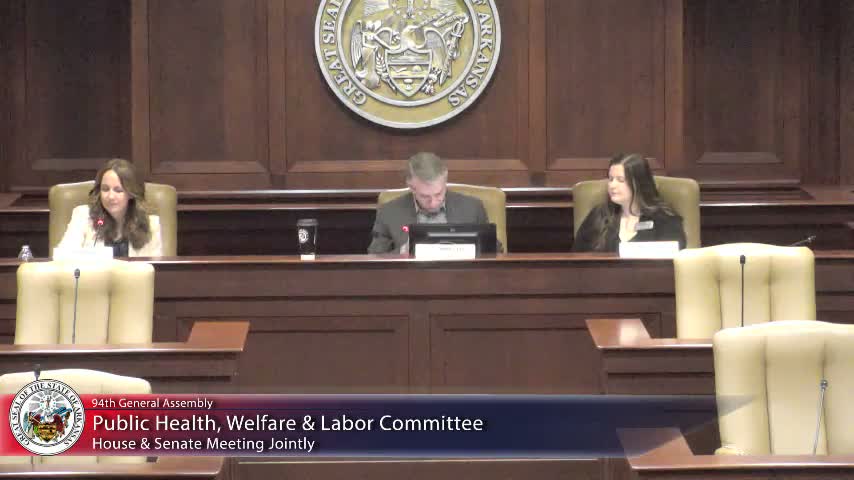
County officials told the Senate Public Health, Welfare and Labor Committee that a crypto mining facility in Faulkner County has caused sustained noise and strained local water supplies, prompting an interim study referral and further state review.
Senator Jonathan Irvin introduced the interim‑study proposal and invited the Faulkner County delegation to explain local effects. Allen Dodson, Faulkner County judge, described the operational noise as “like a jet airliner at idle” and said machines run 24/7. He raised concerns about residents living within about 100 feet of the site, and cited an estimate that the facility used roughly "600,000 gallons of water in a month," which he characterized as alarming for small rural water systems.
Randy Higgins, Faulkner County administrator, and Philip Murphy, county attorney, told the committee that noise measurement efforts showed decibel levels dropped from the low 70s into the low‑to‑mid 50s after installation of multiple sound walls, but that residents continue to experience constant sound and health impacts: Murphy said a neighbor with an autistic child had reported migraines and stress linked to the noise.
Department of Health representatives said that water runoff and wastewater concerns fall under DEQ’s permitting authority. Caleb Osborne, DEQ director, explained that properly operated closed‑loop cooling systems would not typically require a discharge permit, but DEQ had observed leaks and pooled water at the Faulkner site and has opened enforcement matters. "If that happens, they need a permit," Osborne said, noting that DEQ can require corrective measures and pursue civil penalties; in extreme noncompliance, operations could be ordered to cease.
Committee members pressed for clearer numeric thresholds for when a closed‑loop system triggers permitting. DEQ said there is no single statutory “magic number”; permitting questions are driven by volume, whether water is discharged and how operators plan to manage or truck off process water. DEQ said it will pursue enforcement where it finds discharges and will follow up with the committee.
Several legislators and county officials urged statewide guidance because counties lack consistent science and enforcement resources. Secretary Corey (state official) noted that other commissions (such as the Oil and Gas Commission) have been able to adopt industry‑specific noise standards and suggested that industry cooperation played a role in those efforts.
The committee chair referred the interim study on crypto/digital‑asset mining to the labor and environment subcommittee for a focused meeting and asked staff to schedule follow‑up briefings and site visits. The referral was intended to produce options—legislative or rule‑making—to consider before the 2025 session.
Senator Jonathan Irvin introduced the interim‑study proposal and invited the Faulkner County delegation to explain local effects. Allen Dodson, Faulkner County judge, described the operational noise as “like a jet airliner at idle” and said machines run 24/7. He raised concerns about residents living within about 100 feet of the site, and cited an estimate that the facility used roughly "600,000 gallons of water in a month," which he characterized as alarming for small rural water systems.
Randy Higgins, Faulkner County administrator, and Philip Murphy, county attorney, told the committee that noise measurement efforts showed decibel levels dropped from the low 70s into the low‑to‑mid 50s after installation of multiple sound walls, but that residents continue to experience constant sound and health impacts: Murphy said a neighbor with an autistic child had reported migraines and stress linked to the noise.
Department of Health representatives said that water runoff and wastewater concerns fall under DEQ’s permitting authority. Caleb Osborne, DEQ director, explained that properly operated closed‑loop cooling systems would not typically require a discharge permit, but DEQ had observed leaks and pooled water at the Faulkner site and has opened enforcement matters. "If that happens, they need a permit," Osborne said, noting that DEQ can require corrective measures and pursue civil penalties; in extreme noncompliance, operations could be ordered to cease.
Committee members pressed for clearer numeric thresholds for when a closed‑loop system triggers permitting. DEQ said there is no single statutory “magic number”; permitting questions are driven by volume, whether water is discharged and how operators plan to manage or truck off process water. DEQ said it will pursue enforcement where it finds discharges and will follow up with the committee.
Several legislators and county officials urged statewide guidance because counties lack consistent science and enforcement resources. Secretary Corey (state official) noted that other commissions (such as the Oil and Gas Commission) have been able to adopt industry‑specific noise standards and suggested that industry cooperation played a role in those efforts.
The committee chair referred the interim study on crypto/digital‑asset mining to the labor and environment subcommittee for a focused meeting and asked staff to schedule follow‑up briefings and site visits. The referral was intended to produce options—legislative or rule‑making—to consider before the 2025 session.
View the Full Meeting & All Its Details
This article offers just a summary. Unlock complete video, transcripts, and insights as a Founder Member.
✓
Watch full, unedited meeting videos
✓
Search every word spoken in unlimited transcripts
✓
AI summaries & real-time alerts (all government levels)
✓
Permanent access to expanding government content
30-day money-back guarantee
