Senate committee holds DHS rule to route CGM coverage through pharmacies after DME providers warn of access and cost risks
March 29, 2024 | PUBLIC HEALTH, WELFARE AND LABOR COMMITTEE - SENATE, Senate, Committees, Legislative, Arkansas
This article was created by AI summarizing key points discussed. AI makes mistakes, so for full details and context, please refer to the video of the full meeting. Please report any errors so we can fix them. Report an error »
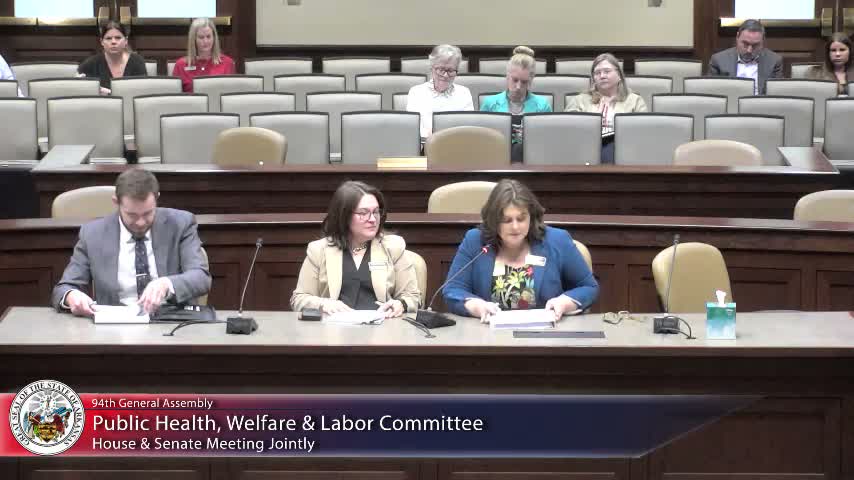
The Senate Public Health, Welfare and Labor Committee voted to hold a contested Department of Human Services rule that would expand continuous glucose monitor (CGM) coverage under Medicaid to be payable through pharmacy point-of-sale billing using wholesale acquisition cost (WAC) pricing and a $10.50 dispensing fee.
DHS said the rule implements Act 393 (2023) and was approved by CMS. The change would let pharmacies provide CGMs as a pharmacy benefit, allow the Medicaid program to collect pharmacy rebates and require point-of-sale pharmacy billing rather than the current DME billing pathway. DHS staff told the committee the WAC methodology is needed so the program can identify exactly what was provided and then submit rebate claims to manufacturers.
Members and multiple DME witnesses raised concerns. Representative Bentley and others pressed DHS on how WAC pricing and the pharmacy portal would affect small Arkansas DME businesses and rural access. Witnesses from the newly formed Arkansas Medical Equipment Providers association (Steve Good), Eclipse Medical (Sean McCoy) and Petit Jean Medical (Brad White) said the proposed pricing model could raise manufacturers' commercial list prices and erase DME margins because the state's reimbursement under WAC would align with the higher commercial cost.
"Our product cost is currently around $150 for a month's supply of sensors — under the new pricing model our cost goes up to $350 and our reimbursement is $365," Sean McCoy said, arguing that the net margin would not cover shipping, handling, case management and audit risk for small providers. DME providers warned that pharmacies may not offer home delivery or the monthly case management and patient education the DME channel provides, creating access risks for homebound or rural patients.
Witnesses also flagged rebate opacity: DHS officials said manufacturer rebate contracts are proprietary and the program reports only aggregate rebate receipts (DHS cited $84,000,000 in pharmacy rebates in the prior quarter). DME representatives said the statute's language about "beneficiary" eligibility raised legal questions and that the state should consider dual billing (allow both pharmacy and DME channels) rather than pushing providers onto a pharmacy-only path.
After extended questioning and public testimony, Representative McGee moved to defer and hold the rule in committee; the committee voted and the motion passed. Chair and staff said the rule will remain in committee for further discussion and that a follow-up meeting will be scheduled next month.
Next steps: the committee will convene again to review the rule; DHS and stakeholders were asked to provide further documentation on rebate mechanics, comparison of current DME reimbursements with WAC pricing, and options for dual billing or rural-access protections.
DHS said the rule implements Act 393 (2023) and was approved by CMS. The change would let pharmacies provide CGMs as a pharmacy benefit, allow the Medicaid program to collect pharmacy rebates and require point-of-sale pharmacy billing rather than the current DME billing pathway. DHS staff told the committee the WAC methodology is needed so the program can identify exactly what was provided and then submit rebate claims to manufacturers.
Members and multiple DME witnesses raised concerns. Representative Bentley and others pressed DHS on how WAC pricing and the pharmacy portal would affect small Arkansas DME businesses and rural access. Witnesses from the newly formed Arkansas Medical Equipment Providers association (Steve Good), Eclipse Medical (Sean McCoy) and Petit Jean Medical (Brad White) said the proposed pricing model could raise manufacturers' commercial list prices and erase DME margins because the state's reimbursement under WAC would align with the higher commercial cost.
"Our product cost is currently around $150 for a month's supply of sensors — under the new pricing model our cost goes up to $350 and our reimbursement is $365," Sean McCoy said, arguing that the net margin would not cover shipping, handling, case management and audit risk for small providers. DME providers warned that pharmacies may not offer home delivery or the monthly case management and patient education the DME channel provides, creating access risks for homebound or rural patients.
Witnesses also flagged rebate opacity: DHS officials said manufacturer rebate contracts are proprietary and the program reports only aggregate rebate receipts (DHS cited $84,000,000 in pharmacy rebates in the prior quarter). DME representatives said the statute's language about "beneficiary" eligibility raised legal questions and that the state should consider dual billing (allow both pharmacy and DME channels) rather than pushing providers onto a pharmacy-only path.
After extended questioning and public testimony, Representative McGee moved to defer and hold the rule in committee; the committee voted and the motion passed. Chair and staff said the rule will remain in committee for further discussion and that a follow-up meeting will be scheduled next month.
Next steps: the committee will convene again to review the rule; DHS and stakeholders were asked to provide further documentation on rebate mechanics, comparison of current DME reimbursements with WAC pricing, and options for dual billing or rural-access protections.
View the Full Meeting & All Its Details
This article offers just a summary. Unlock complete video, transcripts, and insights as a Founder Member.
✓
Watch full, unedited meeting videos
✓
Search every word spoken in unlimited transcripts
✓
AI summaries & real-time alerts (all government levels)
✓
Permanent access to expanding government content
30-day money-back guarantee
