Panel debates Medicaid move to pharmacy billing for continuous glucose monitors; committee sends rule to rules committee with no recommendation
April 30, 2024 | PUBLIC HEALTH, WELFARE AND LABOR COMMITTEE - SENATE, Senate, Committees, Legislative, Arkansas
This article was created by AI summarizing key points discussed. AI makes mistakes, so for full details and context, please refer to the video of the full meeting. Please report any errors so we can fix them. Report an error »
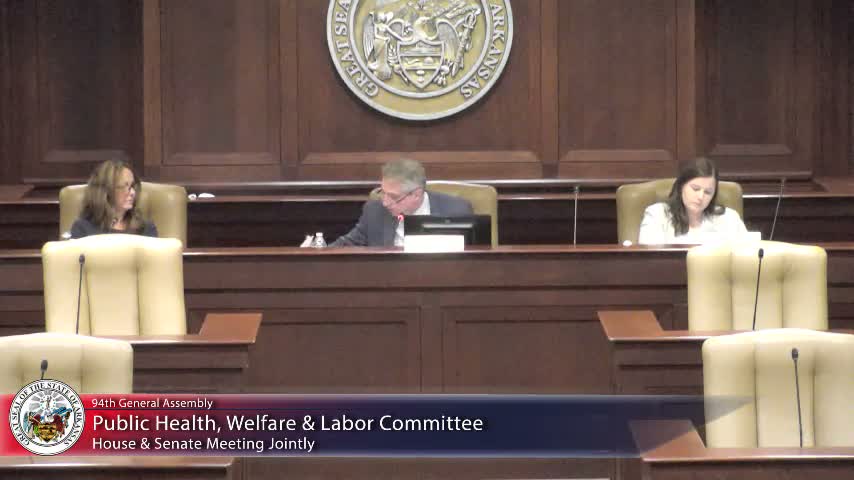
The Senate Public Health, Welfare and Labor Committee reviewed a Department of Human Services rule to change how continuous glucose monitors (CGMs) are billed under Medicaid so that pharmacies can adjudicate and be eligible for manufacturer rebates.
Janet Mann, Medicaid director, and Elizabeth Pittman, medical services, explained DHS's reading of Act 393 and said the rule would allow pharmacists and DME vendors to provide CGM benefits while enabling the state to collect pharmacy rebates through the pharmacy point-of-sale system. Mann told the committee that pharmacy adjudication is necessary to secure manufacturer rebates and that those rebates are used within the Medicaid program; she said beneficiaries would not receive the rebates directly.
Some legislators and DME representatives warned the change could price DMEs out of parts of the market because of differences in reimbursement schedules. Representative Ryan and others asked whether shifting billing to the pharmacy channel would raise the vendor'level unit price before rebate by roughly $100; DHS said gross prices vary by vendor and that, after rebates, independent analyses project net savings for the program. Committee members asked DHS to provide supporting CMS documentation and a clearer breakdown of the fiscal impact.
Industry and clinical witnesses urged faster access for patients. Morgan Butler and Jennifer Sellers, both registered nurses and certified diabetes care and education specialists, said the DME approval process for Medicaid can take "upwards of 30 business days," delaying patients who clinicians say can begin using a CGM within two to three days if dispensed by a pharmacy. John Burris, representing Dexcom, told the committee that commercial plans and the state's employee benefits plan already use the pharmacy channel and that shifting Medicaid to the same channel both increases access and allows the state to claim rebates that reduce net spending.
Committee members debated several procedural motions: a motion that the committee "do not review" the rule on grounds of alleged conflict with legislative intent failed; a motion to hold the rule until more information was provided did not secure the committee's approval in the joint consideration. The committee ultimately approved a motion to "take no action," sending the rule to the rules committee without recommendation.
The committee asked DHS for written materials—specifically CMS correspondence and comparative statutory language about rebates—and for more granular fiscal detail on per-unit pricing and rebate estimates before further action.
Janet Mann, Medicaid director, and Elizabeth Pittman, medical services, explained DHS's reading of Act 393 and said the rule would allow pharmacists and DME vendors to provide CGM benefits while enabling the state to collect pharmacy rebates through the pharmacy point-of-sale system. Mann told the committee that pharmacy adjudication is necessary to secure manufacturer rebates and that those rebates are used within the Medicaid program; she said beneficiaries would not receive the rebates directly.
Some legislators and DME representatives warned the change could price DMEs out of parts of the market because of differences in reimbursement schedules. Representative Ryan and others asked whether shifting billing to the pharmacy channel would raise the vendor'level unit price before rebate by roughly $100; DHS said gross prices vary by vendor and that, after rebates, independent analyses project net savings for the program. Committee members asked DHS to provide supporting CMS documentation and a clearer breakdown of the fiscal impact.
Industry and clinical witnesses urged faster access for patients. Morgan Butler and Jennifer Sellers, both registered nurses and certified diabetes care and education specialists, said the DME approval process for Medicaid can take "upwards of 30 business days," delaying patients who clinicians say can begin using a CGM within two to three days if dispensed by a pharmacy. John Burris, representing Dexcom, told the committee that commercial plans and the state's employee benefits plan already use the pharmacy channel and that shifting Medicaid to the same channel both increases access and allows the state to claim rebates that reduce net spending.
Committee members debated several procedural motions: a motion that the committee "do not review" the rule on grounds of alleged conflict with legislative intent failed; a motion to hold the rule until more information was provided did not secure the committee's approval in the joint consideration. The committee ultimately approved a motion to "take no action," sending the rule to the rules committee without recommendation.
The committee asked DHS for written materials—specifically CMS correspondence and comparative statutory language about rebates—and for more granular fiscal detail on per-unit pricing and rebate estimates before further action.
View the Full Meeting & All Its Details
This article offers just a summary. Unlock complete video, transcripts, and insights as a Founder Member.
✓
Watch full, unedited meeting videos
✓
Search every word spoken in unlimited transcripts
✓
AI summaries & real-time alerts (all government levels)
✓
Permanent access to expanding government content
30-day money-back guarantee
