Committee backs bill setting reserve targets, reporting for state employee health plan
February 16, 2022 | INSURANCE & COMMERCE - SENATE, Senate, Committees, Legislative, Arkansas
This article was created by AI summarizing key points discussed. AI makes mistakes, so for full details and context, please refer to the video of the full meeting. Please report any errors so we can fix them. Report an error »
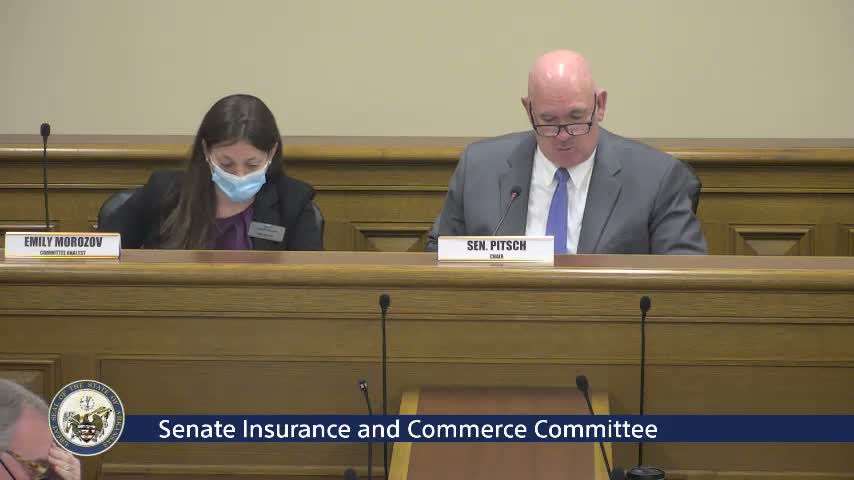
Senator Hickey successfully won a committee do-pass recommendation for Senate Bill 86, a measure that would require the Employee Benefits Division (EBD) to maintain specified reserve levels for the state and public school life and health insurance program and to report annually to the legislature through ALC.
The bill sets an acceptable reserve band—12% minimum and 16% maximum—with 14% identified as the target level the committee described as ‘‘optimal.’’ Senator Hickey said the requirement is intended to give the legislature regular oversight and prevent the steep, unplanned premium increases that can follow sudden shortfalls. "What this is gonna do . . . on an annual basis is gonna require us to keep those [reserves]," Hickey said, adding that the annual review allows smaller, incremental adjustments rather than abrupt funding steps.
Under SB86, if reserves fall below 12% the EBD would have to notify ALC; ALC would review and could recommend action, including asking the governor to call a special session. If the legislature does not act, the EBD director would be required by statute to initiate measures to collect needed funds, including raising employee premiums, reducing benefits, or both. The bill also authorizes the EBD director to apply reserves above 16% to lower premiums for the following year; if the director opts not to lower premiums, the director would report the reasons to the legislature.
Committee members pressed for clarity on how the bill would prevent past funding shortfalls and what recourse the legislature would have if the director declined to reduce premiums when reserves exceeded the cap. Senator Hammer asked, "If they choose not to lower the premium rate and the money is there to do that, what's our recourse other than wait till the next session?" Senator Hickey replied that the statute balances mandatory reporting with discretionary language (using "may" rather than "shall") so the director can avoid small, temporary premium swings when short-term costs are anticipated.
No members of the public signed up to testify. Senator Hickey made the motion for a do-pass recommendation and Senator Teague seconded; the committee approved SB86 by voice vote.
The committee’s recommendation advances SB86 to the next stage where ALC and the governor’s office would be involved if further action is required.
The bill sets an acceptable reserve band—12% minimum and 16% maximum—with 14% identified as the target level the committee described as ‘‘optimal.’’ Senator Hickey said the requirement is intended to give the legislature regular oversight and prevent the steep, unplanned premium increases that can follow sudden shortfalls. "What this is gonna do . . . on an annual basis is gonna require us to keep those [reserves]," Hickey said, adding that the annual review allows smaller, incremental adjustments rather than abrupt funding steps.
Under SB86, if reserves fall below 12% the EBD would have to notify ALC; ALC would review and could recommend action, including asking the governor to call a special session. If the legislature does not act, the EBD director would be required by statute to initiate measures to collect needed funds, including raising employee premiums, reducing benefits, or both. The bill also authorizes the EBD director to apply reserves above 16% to lower premiums for the following year; if the director opts not to lower premiums, the director would report the reasons to the legislature.
Committee members pressed for clarity on how the bill would prevent past funding shortfalls and what recourse the legislature would have if the director declined to reduce premiums when reserves exceeded the cap. Senator Hammer asked, "If they choose not to lower the premium rate and the money is there to do that, what's our recourse other than wait till the next session?" Senator Hickey replied that the statute balances mandatory reporting with discretionary language (using "may" rather than "shall") so the director can avoid small, temporary premium swings when short-term costs are anticipated.
No members of the public signed up to testify. Senator Hickey made the motion for a do-pass recommendation and Senator Teague seconded; the committee approved SB86 by voice vote.
The committee’s recommendation advances SB86 to the next stage where ALC and the governor’s office would be involved if further action is required.
View the Full Meeting & All Its Details
This article offers just a summary. Unlock complete video, transcripts, and insights as a Founder Member.
✓
Watch full, unedited meeting videos
✓
Search every word spoken in unlimited transcripts
✓
AI summaries & real-time alerts (all government levels)
✓
Permanent access to expanding government content
30-day money-back guarantee
