Arkansas DHS, insurance regulators urge caution over proposed HHS nondiscrimination rule that could affect coverage for gender‑affirming care
October 05, 2022 | INSURANCE & COMMERCE - SENATE, Senate, Committees, Legislative, Arkansas
This article was created by AI summarizing key points discussed. AI makes mistakes, so for full details and context, please refer to the video of the full meeting. Please report any errors so we can fix them. Report an error »
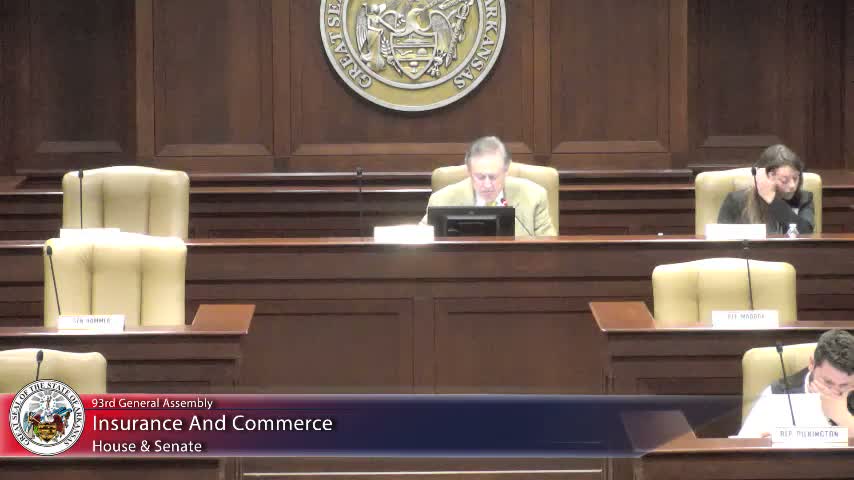
State Department of Human Services and insurance regulators told the joint Insurance & Commerce committee on June 21 that a proposed HHS nondiscrimination rule could expand health‑plan obligations and raise legal and cost questions for Arkansas.
Mark White of the Department of Human Services said the rule is a proposed regulation that would restore and expand nondiscrimination language removed in 2020 and ‘‘appear[s] to try to take the reasoning and the rationale from the Bostock decision’’ and apply it outside the employment context. White added: ‘‘We think that setting aside whether it's a good idea or not ... legally we just don't think they have the authority to do it.’’
White said the rule's scope reaches Medicaid and Medicare and, in his reading, could apply ‘‘directly or indirectly'to all health insurance’’ by reaching third‑party administrators and vendors. He told lawmakers the state's comments to HHS focus on legal authority and on preserving Medicaid's long‑standing standard that coverage is limited to ‘‘medically necessary’’ procedures.
Booth Rand, introduced as general counsel for the Arkansas Insurance Department, told the committee he agreed with DHS's legal assessment: ‘‘There would have to be a federally mandated law that requires the states to cover transgender services in their essential health benefits. Until there is a federal law requiring it, I don't believe HHS can impose this requirement.’’
Committee members pushed witnesses on likely effects. Representative Ray asked whether Medicaid would be required to cover gender‑transition procedures; White said that intent appears to be part of HHS's goal but that the rule's language is ambiguous and courts will likely resolve key questions about medical necessity versus elective care. Representative Lundstrom warned of long‑term health concerns for children if such procedures were expanded.
Insurance carriers provided written statements to the committee. The chair noted exhibits from Centene and Blue Cross Blue Shield; Blue Cross's statement, committee members said, concluded the rule would not affect premiums because the carrier regards the services as elective. Several members pressed how the carrier reached that conclusion; Rand said issuers use actuarial studies and he would follow up with the carriers and share details with committee members.
Witnesses also noted that one state has obtained CMS approval to add gender‑affirming services to its state essential health benefits list, a development White said raises the question of whether CMS can "force" other states to do the same. White said DHS believes states retain authority over EHB content for their plans.
The witnesses emphasized uncertainty: the rule is proposed, enforcement could vary between CMS and HHS, and ultimately litigation could resolve whether HHS exceeded its statutory authority. The committee did not take formal action on the rule itself; DHS said it has submitted comments to HHS and will answer members' follow‑up questions about insurer cost estimates.
What happens next: the state's comments are on record with HHS; the Insurance Department will follow up with carriers on actuarial analyses and the rule remains a proposed federal action pending finalization or legal challenge.
Mark White of the Department of Human Services said the rule is a proposed regulation that would restore and expand nondiscrimination language removed in 2020 and ‘‘appear[s] to try to take the reasoning and the rationale from the Bostock decision’’ and apply it outside the employment context. White added: ‘‘We think that setting aside whether it's a good idea or not ... legally we just don't think they have the authority to do it.’’
White said the rule's scope reaches Medicaid and Medicare and, in his reading, could apply ‘‘directly or indirectly'to all health insurance’’ by reaching third‑party administrators and vendors. He told lawmakers the state's comments to HHS focus on legal authority and on preserving Medicaid's long‑standing standard that coverage is limited to ‘‘medically necessary’’ procedures.
Booth Rand, introduced as general counsel for the Arkansas Insurance Department, told the committee he agreed with DHS's legal assessment: ‘‘There would have to be a federally mandated law that requires the states to cover transgender services in their essential health benefits. Until there is a federal law requiring it, I don't believe HHS can impose this requirement.’’
Committee members pushed witnesses on likely effects. Representative Ray asked whether Medicaid would be required to cover gender‑transition procedures; White said that intent appears to be part of HHS's goal but that the rule's language is ambiguous and courts will likely resolve key questions about medical necessity versus elective care. Representative Lundstrom warned of long‑term health concerns for children if such procedures were expanded.
Insurance carriers provided written statements to the committee. The chair noted exhibits from Centene and Blue Cross Blue Shield; Blue Cross's statement, committee members said, concluded the rule would not affect premiums because the carrier regards the services as elective. Several members pressed how the carrier reached that conclusion; Rand said issuers use actuarial studies and he would follow up with the carriers and share details with committee members.
Witnesses also noted that one state has obtained CMS approval to add gender‑affirming services to its state essential health benefits list, a development White said raises the question of whether CMS can "force" other states to do the same. White said DHS believes states retain authority over EHB content for their plans.
The witnesses emphasized uncertainty: the rule is proposed, enforcement could vary between CMS and HHS, and ultimately litigation could resolve whether HHS exceeded its statutory authority. The committee did not take formal action on the rule itself; DHS said it has submitted comments to HHS and will answer members' follow‑up questions about insurer cost estimates.
What happens next: the state's comments are on record with HHS; the Insurance Department will follow up with carriers on actuarial analyses and the rule remains a proposed federal action pending finalization or legal challenge.
View the Full Meeting & All Its Details
This article offers just a summary. Unlock complete video, transcripts, and insights as a Founder Member.
✓
Watch full, unedited meeting videos
✓
Search every word spoken in unlimited transcripts
✓
AI summaries & real-time alerts (all government levels)
✓
Permanent access to expanding government content
30-day money-back guarantee
