Senate committee advances net‑metering rewrite after hours of technical debate
February 23, 2023 | INSURANCE & COMMERCE - SENATE, Senate, Committees, Legislative, Arkansas
This article was created by AI summarizing key points discussed. AI makes mistakes, so for full details and context, please refer to the video of the full meeting. Please report any errors so we can fix them. Report an error »
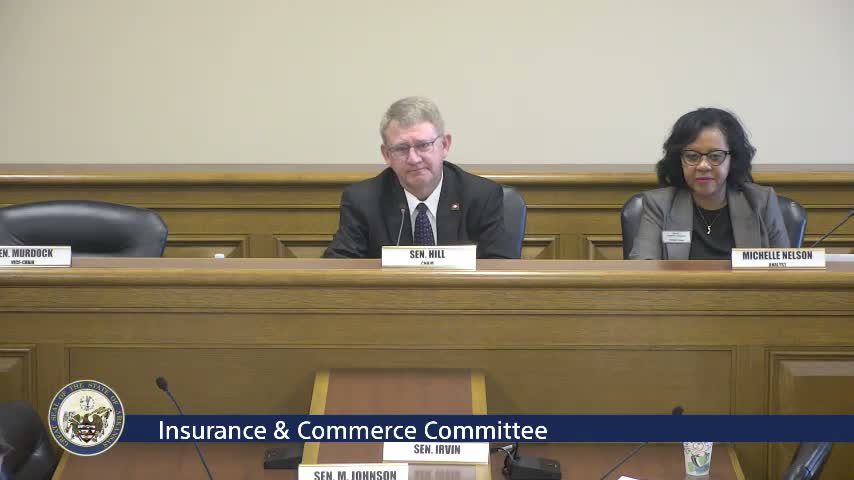
The Senate Insurance & Commerce Committee voted to pass, as amended, legislation that would alter Arkansas' net‑metering rules, reduce the maximum eligible facility size and bar certain interruptible contracts from participating in retail net metering.
Mister Tinsley, an industry representative testifying for several manufacturing members, told the committee the companies that responded to his survey represent more than 5,500 Arkansas jobs and warned the bill would make large customer investment in self‑generation uneconomic. "The real purpose of this bill is to protect the utilities monopoly," he said, urging members to weigh how the measure would affect industrial recruitment and retention.
The bill's sponsors say the changes are needed to address cost shifting — the possibility that customers with distributed generation avoid charges that other ratepayers then must cover. Valerie Boyce, chief administrative law judge and chief of commissioner staff for the Arkansas Public Service Commission, told senators the PSC has an open docket examining the question and has not yet concluded whether cost shifting exists. "The commission has not made a decision yet on whether there is cost shifting," she said, pointing the committee to the PSC's evidentiary process.
Energy Arkansas, the utilities' trade group, and other witnesses gave the committee concrete estimates of current impacts. "The cost shift from customers with panels and net‑metering facilities at their homes and place of business to customers that don't have those is about $7,000,000 annually" for Entergy, John Bethel, director of public affairs for Energy Arkansas, testified, and he said a similar methodology yields roughly $16–18 million across Arkansas utilities for the most recent period.
Opponents emphasized technical drafting and statutory language. Sean McMurray, representing Arkansas Electric Energy Consumers, criticized the bill's proposed definition of "avoided cost" — a 12‑month average of locational marginal price — as likely to understate the value of generation that occurs during high‑price hours. McMurray and others also objected to striking statutory language that allowed the PSC to account for quantifiable ratepayer benefits when setting rates.
Former PSC chairman Ted Thomas, speaking as a private citizen and consultant, urged keeping the point‑of‑sale approach that pays generation based on the wholesale market price at the time power is produced. He said shifting to an annual average and removing recognized benefits would reduce the economic case for development: "This bill is wrong," he told the committee, arguing the change would undercut both avoided‑cost accounting and the ability to measure benefits such as reduced line losses.
The bill would also lower the maximum permitted size for qualifying net‑metering facilities (current law allows up to 20 MW in some cases; the bill would reduce the threshold to 5 MW), and it restricts net metering for customers on interruptible service tariffs — provisions multiple industrial witnesses said could prevent large facilities from justifying self‑generation investments.
After more than four hours of testimony and repeated technical exchanges — including back‑and‑forth over docket histories, statutory references and the PSC's earlier June 2020 order — Senator Dismay moved that the committee "do pass as amended." Senator Ervin seconded the motion, the committee voice‑voted in favor and the chair declared the motion adopted. The committee adjourned without further amendment votes noted on the record.
What happens next: The bill, having cleared committee as amended, moves on in the legislative process; the PSC's docket remains the formal venue where utilities and interveners continue to develop the evidentiary record about cost shifting and potential grid charges.
Sources: Testimony in session of the Senate Insurance & Commerce Committee, including witness statements by Mister Tinsley; Valerie Boyce, Arkansas Public Service Commission; Sean McMurray, Arkansas Electric Energy Consumers; John Bethel, Energy Arkansas; Brent Stevenson, industry representative; and Ted Thomas, former PSC chairman.
Mister Tinsley, an industry representative testifying for several manufacturing members, told the committee the companies that responded to his survey represent more than 5,500 Arkansas jobs and warned the bill would make large customer investment in self‑generation uneconomic. "The real purpose of this bill is to protect the utilities monopoly," he said, urging members to weigh how the measure would affect industrial recruitment and retention.
The bill's sponsors say the changes are needed to address cost shifting — the possibility that customers with distributed generation avoid charges that other ratepayers then must cover. Valerie Boyce, chief administrative law judge and chief of commissioner staff for the Arkansas Public Service Commission, told senators the PSC has an open docket examining the question and has not yet concluded whether cost shifting exists. "The commission has not made a decision yet on whether there is cost shifting," she said, pointing the committee to the PSC's evidentiary process.
Energy Arkansas, the utilities' trade group, and other witnesses gave the committee concrete estimates of current impacts. "The cost shift from customers with panels and net‑metering facilities at their homes and place of business to customers that don't have those is about $7,000,000 annually" for Entergy, John Bethel, director of public affairs for Energy Arkansas, testified, and he said a similar methodology yields roughly $16–18 million across Arkansas utilities for the most recent period.
Opponents emphasized technical drafting and statutory language. Sean McMurray, representing Arkansas Electric Energy Consumers, criticized the bill's proposed definition of "avoided cost" — a 12‑month average of locational marginal price — as likely to understate the value of generation that occurs during high‑price hours. McMurray and others also objected to striking statutory language that allowed the PSC to account for quantifiable ratepayer benefits when setting rates.
Former PSC chairman Ted Thomas, speaking as a private citizen and consultant, urged keeping the point‑of‑sale approach that pays generation based on the wholesale market price at the time power is produced. He said shifting to an annual average and removing recognized benefits would reduce the economic case for development: "This bill is wrong," he told the committee, arguing the change would undercut both avoided‑cost accounting and the ability to measure benefits such as reduced line losses.
The bill would also lower the maximum permitted size for qualifying net‑metering facilities (current law allows up to 20 MW in some cases; the bill would reduce the threshold to 5 MW), and it restricts net metering for customers on interruptible service tariffs — provisions multiple industrial witnesses said could prevent large facilities from justifying self‑generation investments.
After more than four hours of testimony and repeated technical exchanges — including back‑and‑forth over docket histories, statutory references and the PSC's earlier June 2020 order — Senator Dismay moved that the committee "do pass as amended." Senator Ervin seconded the motion, the committee voice‑voted in favor and the chair declared the motion adopted. The committee adjourned without further amendment votes noted on the record.
What happens next: The bill, having cleared committee as amended, moves on in the legislative process; the PSC's docket remains the formal venue where utilities and interveners continue to develop the evidentiary record about cost shifting and potential grid charges.
Sources: Testimony in session of the Senate Insurance & Commerce Committee, including witness statements by Mister Tinsley; Valerie Boyce, Arkansas Public Service Commission; Sean McMurray, Arkansas Electric Energy Consumers; John Bethel, Energy Arkansas; Brent Stevenson, industry representative; and Ted Thomas, former PSC chairman.
Don't Miss a Word: See the Full Meeting!
Go beyond summaries. Unlock every video, transcript, and key insight with a Founder Membership.
✓
Get instant access to full meeting videos
✓
Search and clip any phrase from complete transcripts
✓
Receive AI-powered summaries & custom alerts
✓
Enjoy lifetime, unrestricted access to government data
30-day money-back guarantee
