Senate committee advances age‑verification Social Media Safety Act after heated testimony
March 28, 2023 | INSURANCE & COMMERCE - SENATE, Senate, Committees, Legislative, Arkansas
This article was created by AI summarizing key points discussed. AI makes mistakes, so for full details and context, please refer to the video of the full meeting. Please report any errors so we can fix them. Report an error »
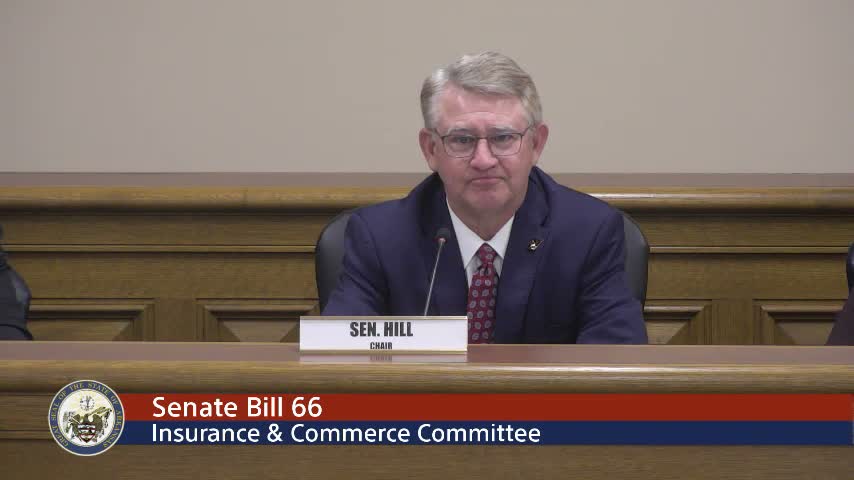
Senators on the Insurance & Commerce Committee advanced SB396, the Social Media Safety Act, on a voice vote after sponsor Senator Tyler Deese said the measure would protect children by requiring parental verification for new social‑media accounts on large platforms.
Deese, the Senate sponsor, said the bill would require social platforms with at least $100 million in annual revenue to use third‑party age verifiers for any new account opened in Arkansas so a parent or guardian must confirm a minor’s participation. ‘‘We are trying to make the most impact possible,’’ Deese said, framing the proposal as a parental‑empowerment measure designed to reduce youth exposure to harmful material.
Emergency physician Dr. Kevin Beth Meaders, introduced by Deese as an expert witness, described clinical experience treating young people with suicidality and argued social media can produce addiction‑like brain changes in vulnerable adolescents. ‘‘Social media is no exception,’’ Meaders said, adding the bill would ‘‘heighten awareness’’ for families and help prevent harm.
Opponents, including Dustin Brighton of NetChoice, urged defeat, arguing the bill would condition access to constitutionally protected speech and could be inconsistent with Supreme Court precedent. ‘‘The bill violates the First Amendment,’’ Brighton said, citing Brown v. Entertainment Merchants Association and warning that conditioning access on prior parental consent risks excluding protected speech and creating costly litigation. He also said the statute’s anti‑retention language would not prevent platforms from generating logs and records necessary to prove verification, exposing additional data‑security risks.
Committee members pressed the sponsor and witnesses on practical details: which companies would be covered, how third‑party verifiers would identify parents in split‑family situations, and how the system would prevent teenagers from gaming verification processes. Deese said the bill targets the largest platforms (he named Facebook, TikTok, Snapchat and Roblox as examples) and that vendors exist who can verify age and then purge personal data while retaining logs that prove verification occurred.
Deese told the panel that the governor’s office and the attorney general’s office had reviewed the language and that the bill ‘‘is not a First Amendment issue.’’ Supporters countered that the measure applies only to new accounts and would allow parental consent as an option rather than a prohibition.
After questions and brief debate, the committee moved, seconded and approved SB396 to advance. Sponsors and several senators acknowledged unanswered technical and implementation questions they expect to refine in subsequent stages.
The committee action is procedural; the bill will next proceed through the Senate calendar and the other chamber for further consideration.
Deese, the Senate sponsor, said the bill would require social platforms with at least $100 million in annual revenue to use third‑party age verifiers for any new account opened in Arkansas so a parent or guardian must confirm a minor’s participation. ‘‘We are trying to make the most impact possible,’’ Deese said, framing the proposal as a parental‑empowerment measure designed to reduce youth exposure to harmful material.
Emergency physician Dr. Kevin Beth Meaders, introduced by Deese as an expert witness, described clinical experience treating young people with suicidality and argued social media can produce addiction‑like brain changes in vulnerable adolescents. ‘‘Social media is no exception,’’ Meaders said, adding the bill would ‘‘heighten awareness’’ for families and help prevent harm.
Opponents, including Dustin Brighton of NetChoice, urged defeat, arguing the bill would condition access to constitutionally protected speech and could be inconsistent with Supreme Court precedent. ‘‘The bill violates the First Amendment,’’ Brighton said, citing Brown v. Entertainment Merchants Association and warning that conditioning access on prior parental consent risks excluding protected speech and creating costly litigation. He also said the statute’s anti‑retention language would not prevent platforms from generating logs and records necessary to prove verification, exposing additional data‑security risks.
Committee members pressed the sponsor and witnesses on practical details: which companies would be covered, how third‑party verifiers would identify parents in split‑family situations, and how the system would prevent teenagers from gaming verification processes. Deese said the bill targets the largest platforms (he named Facebook, TikTok, Snapchat and Roblox as examples) and that vendors exist who can verify age and then purge personal data while retaining logs that prove verification occurred.
Deese told the panel that the governor’s office and the attorney general’s office had reviewed the language and that the bill ‘‘is not a First Amendment issue.’’ Supporters countered that the measure applies only to new accounts and would allow parental consent as an option rather than a prohibition.
After questions and brief debate, the committee moved, seconded and approved SB396 to advance. Sponsors and several senators acknowledged unanswered technical and implementation questions they expect to refine in subsequent stages.
The committee action is procedural; the bill will next proceed through the Senate calendar and the other chamber for further consideration.
Don't Miss a Word: See the Full Meeting!
Go beyond summaries. Unlock every video, transcript, and key insight with a Founder Membership.
✓
Get instant access to full meeting videos
✓
Search and clip any phrase from complete transcripts
✓
Receive AI-powered summaries & custom alerts
✓
Enjoy lifetime, unrestricted access to government data
30-day money-back guarantee
