Committee advances bill to expand and clarify NIL rules for Arkansas student-athletes
April 04, 2023 | INSURANCE & COMMERCE - SENATE, Senate, Committees, Legislative, Arkansas
This article was created by AI summarizing key points discussed. AI makes mistakes, so for full details and context, please refer to the video of the full meeting. Please report any errors so we can fix them. Report an error »
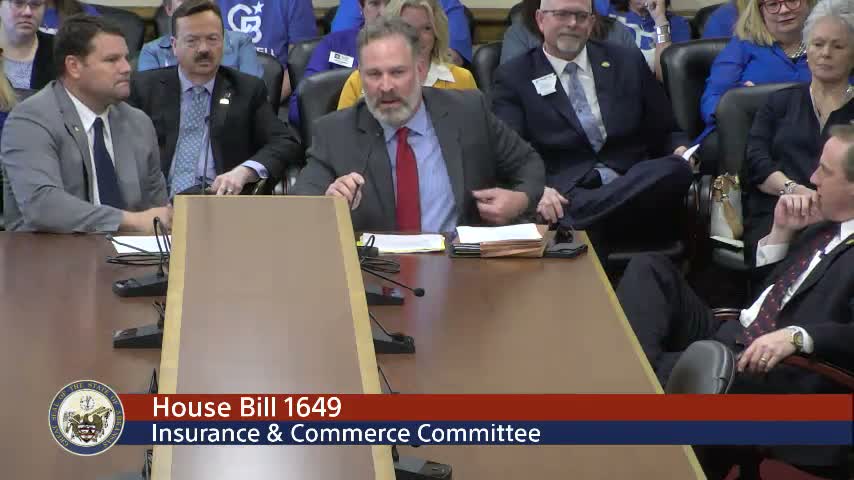
The Senate Insurance & Commerce committee voted Tuesday to advance House Bill 16-49, a package of changes to Arkansas law governing name, image and likeness (NIL) rights for student-athletes. The bill, backed by the University of Arkansas system and Arkansas State University, updates definitions and clarifies permitted activity by institutions and third parties.
"We asked this committee and the general assembly to assist our student athletes with a law that allows them to be treated like anyone else in the state and to be fairly compensated when their name, image and likeness are used," said Matt McCoy, senior associate general counsel for the University of Arkansas system, who testified in support. McCoy outlined three principal changes: expanding the definition of student-athlete to include admitted students who have signed a national letter of intent or comparable enrollment agreement, clarifying that institutions and affiliated entities may identify and enable NIL opportunities, and allowing nonprofits to compensate athletes for charitable work.
McCoy also said HB 16-49 would restate and codify prohibitions on inducements — payments intended to recruit or induce athletes already enrolled at another institution — consistent with current NCAA rules. "That's merely a codification of a current NCAA rule," he said.
Committee members asked how universities would protect young athletes, particularly with respect to financial literacy and contract negotiation. Hunter Yurczyk, director of athletics at the University of Arkansas, and Jeff Urington, Arkansas State vice chancellor for intercollegiate athletics, described existing and planned educational programs, including finance and tax training and outreach through campus business colleges.
University witnesses also cited examples of charitable and community benefits tied to NIL activity, including fundraising and disaster-relief efforts.
After testimony and questions, the committee approved HB 16-49 by voice vote (mover: Sen. Irvin; seconder: Sen. Murdoch). The legislation will move forward in the legislative process.
"We asked this committee and the general assembly to assist our student athletes with a law that allows them to be treated like anyone else in the state and to be fairly compensated when their name, image and likeness are used," said Matt McCoy, senior associate general counsel for the University of Arkansas system, who testified in support. McCoy outlined three principal changes: expanding the definition of student-athlete to include admitted students who have signed a national letter of intent or comparable enrollment agreement, clarifying that institutions and affiliated entities may identify and enable NIL opportunities, and allowing nonprofits to compensate athletes for charitable work.
McCoy also said HB 16-49 would restate and codify prohibitions on inducements — payments intended to recruit or induce athletes already enrolled at another institution — consistent with current NCAA rules. "That's merely a codification of a current NCAA rule," he said.
Committee members asked how universities would protect young athletes, particularly with respect to financial literacy and contract negotiation. Hunter Yurczyk, director of athletics at the University of Arkansas, and Jeff Urington, Arkansas State vice chancellor for intercollegiate athletics, described existing and planned educational programs, including finance and tax training and outreach through campus business colleges.
University witnesses also cited examples of charitable and community benefits tied to NIL activity, including fundraising and disaster-relief efforts.
After testimony and questions, the committee approved HB 16-49 by voice vote (mover: Sen. Irvin; seconder: Sen. Murdoch). The legislation will move forward in the legislative process.
View the Full Meeting & All Its Details
This article offers just a summary. Unlock complete video, transcripts, and insights as a Founder Member.
✓
Watch full, unedited meeting videos
✓
Search every word spoken in unlimited transcripts
✓
AI summaries & real-time alerts (all government levels)
✓
Permanent access to expanding government content
30-day money-back guarantee
