Senate panel declines to advance bill allowing executive sessions for economic development amid transparency concerns
April 08, 2021 | CITY, COUNTY & LOCAL AFFAIRS COMMITTEE - SENATE, Senate, Committees, Legislative, Arkansas
This article was created by AI summarizing key points discussed. AI makes mistakes, so for full details and context, please refer to the video of the full meeting. Please report any errors so we can fix them. Report an error »
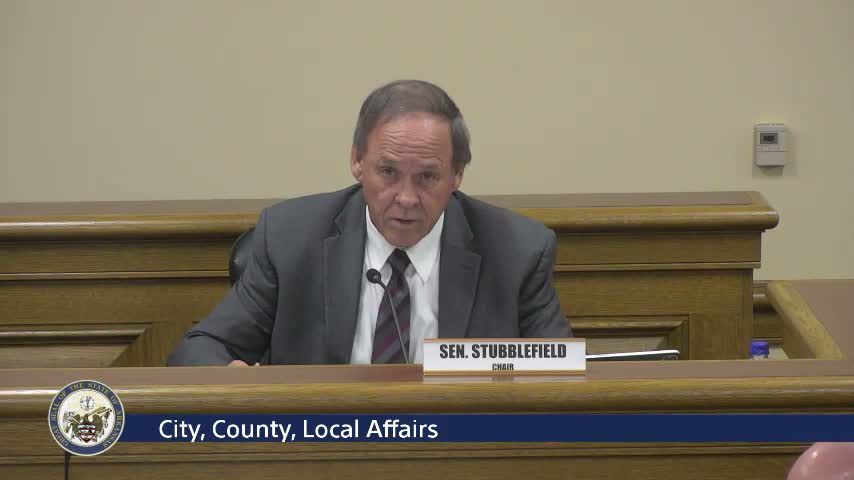
Chair called the committee to order and the panel took up House Bill 12‑80, which would allow cities and counties to enter executive session to discuss certain economic‑development matters already exempt under the 2017 Jobs Act. Senator Taiz introduced the bill and Mark Hayes, executive director of the Arkansas Municipal League, outlined its purpose: to let municipal leaders hold confidential, preliminary discussions with prospective businesses without making decisions in private.
Proponents framed the bill as a narrowly tailored tool. Hayes and other municipal representatives said the Jobs Act already exempts certain records and that HB12‑80 adds procedural safeguards: required public notice of the session, an audio recording retained for one year and an oral public summary after the session. Peter Christie, mayor of Bella Vista, said neighboring states allow similar practices and that confidentiality is often necessary to persuade firms to engage with local governments.
Opponents questioned whether the safeguards would protect the public’s right to know. Andrew Bagley of the Arkansas Press Association and Joy McCutcheon of the Arkansas Transparency and Government Group argued that the bill would create a new route to secrecy, leave recordings unavailable to the public except in litigation, and invite more lawsuits and attorney‑driven in‑camera review. Mavut Ocalulu, an economist at the University of Central Arkansas, said academic evidence questions the net benefit of secret economic incentives and urged preserving Arkansas’ FOIA standards.
Committee members pressed both sides on specifics: the statute’s interaction with Amendment 82 and the Jobs Act’s one‑year contracting limit, the 5% budget pledge cap in bonding, quarterly reporting and clawback provisions, and whether cities have actually lost projects due to current public disclosure rules. Municipal League witnesses said they could not point to specific lost projects but maintained that businesses are often unwilling to discuss proprietary information in public.
Senator Eaves closed by reiterating that the bill would not change the existing set of confidential categories under the Jobs Act and that it would provide more transparency than informal, private conversations happening outside any public record. After closing remarks the chair asked for a motion; none was offered and the chair declared HB12‑80 dead for lack of a motion.
The committee’s action leaves the existing Jobs Act exemptions and related procedural safeguards intact. Supporters said they will continue work on competitive tools for cities; opponents left the committee insisting public access must be preserved.
Proponents framed the bill as a narrowly tailored tool. Hayes and other municipal representatives said the Jobs Act already exempts certain records and that HB12‑80 adds procedural safeguards: required public notice of the session, an audio recording retained for one year and an oral public summary after the session. Peter Christie, mayor of Bella Vista, said neighboring states allow similar practices and that confidentiality is often necessary to persuade firms to engage with local governments.
Opponents questioned whether the safeguards would protect the public’s right to know. Andrew Bagley of the Arkansas Press Association and Joy McCutcheon of the Arkansas Transparency and Government Group argued that the bill would create a new route to secrecy, leave recordings unavailable to the public except in litigation, and invite more lawsuits and attorney‑driven in‑camera review. Mavut Ocalulu, an economist at the University of Central Arkansas, said academic evidence questions the net benefit of secret economic incentives and urged preserving Arkansas’ FOIA standards.
Committee members pressed both sides on specifics: the statute’s interaction with Amendment 82 and the Jobs Act’s one‑year contracting limit, the 5% budget pledge cap in bonding, quarterly reporting and clawback provisions, and whether cities have actually lost projects due to current public disclosure rules. Municipal League witnesses said they could not point to specific lost projects but maintained that businesses are often unwilling to discuss proprietary information in public.
Senator Eaves closed by reiterating that the bill would not change the existing set of confidential categories under the Jobs Act and that it would provide more transparency than informal, private conversations happening outside any public record. After closing remarks the chair asked for a motion; none was offered and the chair declared HB12‑80 dead for lack of a motion.
The committee’s action leaves the existing Jobs Act exemptions and related procedural safeguards intact. Supporters said they will continue work on competitive tools for cities; opponents left the committee insisting public access must be preserved.
View the Full Meeting & All Its Details
This article offers just a summary. Unlock complete video, transcripts, and insights as a Founder Member.
✓
Watch full, unedited meeting videos
✓
Search every word spoken in unlimited transcripts
✓
AI summaries & real-time alerts (all government levels)
✓
Permanent access to expanding government content
30-day money-back guarantee
