Committee recommends keeping Small Town Economic Development Act threshold at $250,000
October 31, 2022 | CITY, COUNTY & LOCAL AFFAIRS COMMITTEE - SENATE, Senate, Committees, Legislative, Arkansas
This article was created by AI summarizing key points discussed. AI makes mistakes, so for full details and context, please refer to the video of the full meeting. Please report any errors so we can fix them. Report an error »
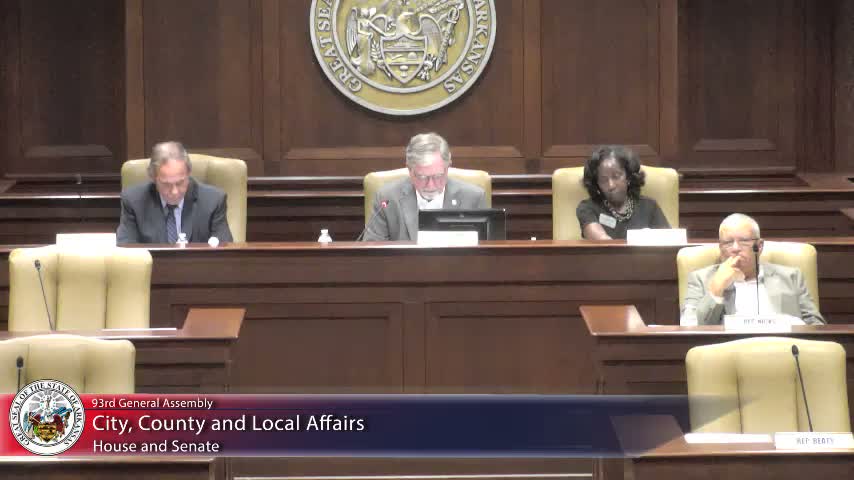
Representative Aaron Pilkington told the City, County & Local Affairs Committee on Sept. 7 that the Small Town Economic Development Act's building-value threshold should be raised from $100,000 to $250,000 to reflect inflation and reduce burdens on small downtown projects. "We wanted to change that to $250,000," Pilkington said, describing mayoral requests and examples of small projects that were burdened by fees and architectural requirements under the older threshold.
The issue matters because the law's $100,000 cumulative fair-market-value limit dates from decades ago and, Pilkington and supporters said, has not kept pace with construction inflation. Michelle Davenport of the Bureau of Legislative Research told the committee the bill's language allows the higher amount to be implemented for now but requires the legislature to act next session to keep the higher threshold in place: "it would require legislation to maintain the amount," she said.
Witnesses representing the State Board of Architects, Landscape Architects and Interior Designers and the Department of Labor and Licensing said they had no objection to the proposed change. Wesley Walls, president of the architects board, said the board "do[es] not take any objection to Act 568 as proposed" and emphasized the board's regulatory mission to protect health, safety and welfare when considering thresholds.
Representatives of local governments also urged the committee to retain the $250,000 figure. Mark Whitmore of the Association of Counties and John Wilkerson of the Arkansas Municipal League said construction-inflation and difficulty securing architects for small projects make the higher threshold practical for courthouse repairs and downtown improvements.
During the hearing a committee member asserted that the dollar has lost value since 1980, a point used in debate; the transcript records an unidentified speaker saying the dollar had "lost 71%." Committee members and witnesses used inflation-based reasoning to support the change; the percentage figure was cited in testimony and has not been independently verified in the hearing record.
Representative Dahlberg moved that the committee "consider Act 568 reviewed with the language to remain at $250,000 and not revert back to the hundred thousand." The motion was seconded, there was no discussion, and the committee approved the motion by voice vote. The committee's recommendation does not by itself change the law; as the Bureau of Legislative Research explained, retaining the higher threshold will require legislative action during the next session to be made permanent.
Next steps: the committee issued a recommendation to keep the $250,000 threshold; formal statutory continuation or amendment must be carried in the next legislative session for the amount to remain in force.
The issue matters because the law's $100,000 cumulative fair-market-value limit dates from decades ago and, Pilkington and supporters said, has not kept pace with construction inflation. Michelle Davenport of the Bureau of Legislative Research told the committee the bill's language allows the higher amount to be implemented for now but requires the legislature to act next session to keep the higher threshold in place: "it would require legislation to maintain the amount," she said.
Witnesses representing the State Board of Architects, Landscape Architects and Interior Designers and the Department of Labor and Licensing said they had no objection to the proposed change. Wesley Walls, president of the architects board, said the board "do[es] not take any objection to Act 568 as proposed" and emphasized the board's regulatory mission to protect health, safety and welfare when considering thresholds.
Representatives of local governments also urged the committee to retain the $250,000 figure. Mark Whitmore of the Association of Counties and John Wilkerson of the Arkansas Municipal League said construction-inflation and difficulty securing architects for small projects make the higher threshold practical for courthouse repairs and downtown improvements.
During the hearing a committee member asserted that the dollar has lost value since 1980, a point used in debate; the transcript records an unidentified speaker saying the dollar had "lost 71%." Committee members and witnesses used inflation-based reasoning to support the change; the percentage figure was cited in testimony and has not been independently verified in the hearing record.
Representative Dahlberg moved that the committee "consider Act 568 reviewed with the language to remain at $250,000 and not revert back to the hundred thousand." The motion was seconded, there was no discussion, and the committee approved the motion by voice vote. The committee's recommendation does not by itself change the law; as the Bureau of Legislative Research explained, retaining the higher threshold will require legislative action during the next session to be made permanent.
Next steps: the committee issued a recommendation to keep the $250,000 threshold; formal statutory continuation or amendment must be carried in the next legislative session for the amount to remain in force.
Don't Miss a Word: See the Full Meeting!
Go beyond summaries. Unlock every video, transcript, and key insight with a Founder Membership.
✓
Get instant access to full meeting videos
✓
Search and clip any phrase from complete transcripts
✓
Receive AI-powered summaries & custom alerts
✓
Enjoy lifetime, unrestricted access to government data
30-day money-back guarantee
