Sherwood officials tout economic boost as bill would wet annexed dry township; opponents say bill removes local votes
February 14, 2023 | CITY, COUNTY & LOCAL AFFAIRS COMMITTEE - SENATE, Senate, Committees, Legislative, Arkansas
This article was created by AI summarizing key points discussed. AI makes mistakes, so for full details and context, please refer to the video of the full meeting. Please report any errors so we can fix them. Report an error »
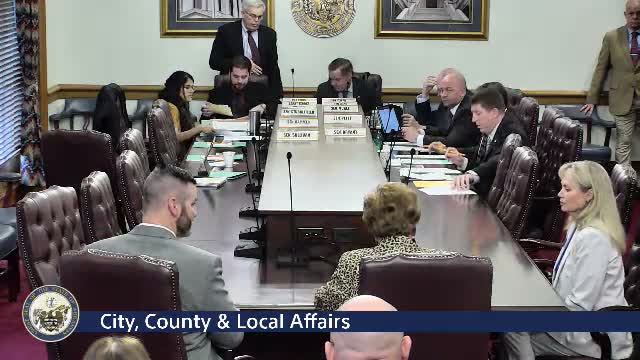
Sen. Jane English brought Senate Bill 201 to the City, County & Local Affairs Committee with Sherwood Mayor Mary Jo Hay and economic development director Josh Alexander at the table, saying the measure is vital for the city’s economic future and equity.
"I cannot express how important this is for Sherwood's future," Mayor Mary Jo Hay said, asking the committee for support on behalf of "33 plus thousand residents." Josh Alexander told senators the bill is aimed at opening a large annexed area to "anchor retailers" — principally a grocery store — that have not located there because the defunct Gray Township territory remains dry. "This is 100% about getting an anchor into that area that will then get light retail, other restaurants," Alexander said.
Supporters framed SB 201 as a targeted economic development change to address a local food‑desert problem, noting that portions of Sherwood now make up roughly "55% of our city limits" and that retail leakage sends residents to neighboring Little Rock and North Little Rock. Representative Pilkington and others earlier described the issue as one of enabling municipalities to pursue the development they need.
But several business owners and associations testified in opposition, saying the measure would deny residents a local vote on whether the annexed territory should become wet. John Crow, who said he owns "107 liquor," told the committee the bill "will have a negative impact on my business" and that changes of this kind "need to happen with the vote." Steve Good of the Arkansas Grocers and Retail Merchants Association said grocers support the policy aim but emphasized it is an economic development change rather than a simple alcohol policy fix.
Attorney Charles Singleton, representing the Arkansas Retail Beverage Association, argued the proposal "deprives people of due process" by effectively wetting territory by legislative action rather than local option election. Singleton cited Act 144 of 2017 and Arkansas Code provisions as precedent for setting up elections in defunct townships and said those laws could be amended instead of removing the local vote. "If you pass this bill, every person who lives out there enjoying living in a dry area ... will be deprived of due process," he said.
Committee members pressed sponsors on scope and process. Sen. Rice asked for geographic limits and was told the bill’s language confines its effect to Sherwood’s current borders. There were repeated exchanges about whether the 2017 act and subsequent practices had already provided mechanisms for local votes; proponents said those approaches either did not apply or had practical limits in the annexed areas.
No formal motion to advance the bill was recorded in committee at the time of the transcript; the bill drew extended public comment and a mix of municipal and small‑business concerns. The committee left the matter without an immediate vote during the session recorded in this transcript.
"I cannot express how important this is for Sherwood's future," Mayor Mary Jo Hay said, asking the committee for support on behalf of "33 plus thousand residents." Josh Alexander told senators the bill is aimed at opening a large annexed area to "anchor retailers" — principally a grocery store — that have not located there because the defunct Gray Township territory remains dry. "This is 100% about getting an anchor into that area that will then get light retail, other restaurants," Alexander said.
Supporters framed SB 201 as a targeted economic development change to address a local food‑desert problem, noting that portions of Sherwood now make up roughly "55% of our city limits" and that retail leakage sends residents to neighboring Little Rock and North Little Rock. Representative Pilkington and others earlier described the issue as one of enabling municipalities to pursue the development they need.
But several business owners and associations testified in opposition, saying the measure would deny residents a local vote on whether the annexed territory should become wet. John Crow, who said he owns "107 liquor," told the committee the bill "will have a negative impact on my business" and that changes of this kind "need to happen with the vote." Steve Good of the Arkansas Grocers and Retail Merchants Association said grocers support the policy aim but emphasized it is an economic development change rather than a simple alcohol policy fix.
Attorney Charles Singleton, representing the Arkansas Retail Beverage Association, argued the proposal "deprives people of due process" by effectively wetting territory by legislative action rather than local option election. Singleton cited Act 144 of 2017 and Arkansas Code provisions as precedent for setting up elections in defunct townships and said those laws could be amended instead of removing the local vote. "If you pass this bill, every person who lives out there enjoying living in a dry area ... will be deprived of due process," he said.
Committee members pressed sponsors on scope and process. Sen. Rice asked for geographic limits and was told the bill’s language confines its effect to Sherwood’s current borders. There were repeated exchanges about whether the 2017 act and subsequent practices had already provided mechanisms for local votes; proponents said those approaches either did not apply or had practical limits in the annexed areas.
No formal motion to advance the bill was recorded in committee at the time of the transcript; the bill drew extended public comment and a mix of municipal and small‑business concerns. The committee left the matter without an immediate vote during the session recorded in this transcript.
Don't Miss a Word: See the Full Meeting!
Go beyond summaries. Unlock every video, transcript, and key insight with a Founder Membership.
✓
Get instant access to full meeting videos
✓
Search and clip any phrase from complete transcripts
✓
Receive AI-powered summaries & custom alerts
✓
Enjoy lifetime, unrestricted access to government data
30-day money-back guarantee
