Senate committee approves bill to change when county jail costs start accruing
February 07, 2023 | CITY, COUNTY & LOCAL AFFAIRS COMMITTEE - SENATE, Senate, Committees, Legislative, Arkansas
This article was created by AI summarizing key points discussed. AI makes mistakes, so for full details and context, please refer to the video of the full meeting. Please report any errors so we can fix them. Report an error »
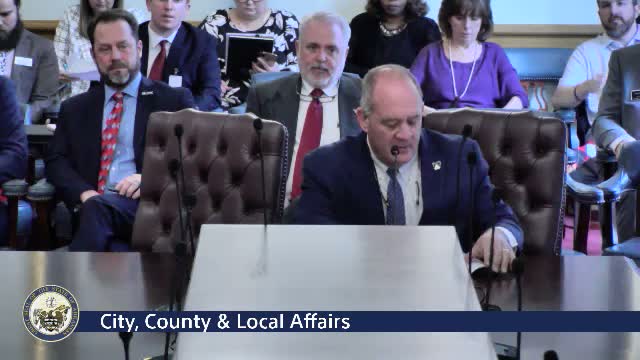
The Senate City, County & Local Affairs Committee approved Senate Bill 72 after a brief presentation from the bill sponsor, Senator Hickey. The measure would set the accrual date for county jail costs at the date of sentencing when the Division of Corrections has not received the sentencing order within 22 days; the Division would not be required to issue payment until it actually receives the sentencing order.
Senator Hickey told the committee the bill contains some cleanup language — including changing a departmental reference to a division — but that the primary change is on page two of the bill, which addresses the timing of accrual when sentencing orders are delayed. "If the Division of Corrections does not receive that sentencing order within 22 days, then whatever the accrual is from the date of the sentencing up to when they receive it ... it's not received by the county jails," he said, adding the accrual would run from the date of sentencing even if the Division later receives the order.
Hickey said the Division would not be required to issue payment until it receives the sentencing order: "Now the Division of Corrections is not gonna be required to actually pay the money or to write the check until they receive it to make sure it's alright. But, again, it will accrue and it will go back to the county jails." He characterized the change as technical but consequential for accounting of county jail costs.
On fiscal impact, Senator Hickey said the Association of County officials and the Division of Corrections worked together on a number. In the transcript he cited an unclear total — "looks like it's gonna be, like, $4,400,000.0666" — and separately said, "$667,000 per year is what the cost will be." The committee did not provide a reconciled fiscal note on the record during the meeting; Hickey said leadership and RSA development would refine the numbers later in the session.
There were no questions from committee members and no members of the public signed up to speak for or against the bill. After Senator Hickey closed, the chair called for a motion; a second was recorded by Senator Sullivan. The committee approved the bill by voice vote and the chair declared the bill passed.
The meeting adjourned with no further business recorded in the transcript. The record does not show a roll-call vote or a detailed, reconciled fiscal note; any further procedural steps or amendments will be reflected in subsequent committee or chamber records.
Senator Hickey told the committee the bill contains some cleanup language — including changing a departmental reference to a division — but that the primary change is on page two of the bill, which addresses the timing of accrual when sentencing orders are delayed. "If the Division of Corrections does not receive that sentencing order within 22 days, then whatever the accrual is from the date of the sentencing up to when they receive it ... it's not received by the county jails," he said, adding the accrual would run from the date of sentencing even if the Division later receives the order.
Hickey said the Division would not be required to issue payment until it receives the sentencing order: "Now the Division of Corrections is not gonna be required to actually pay the money or to write the check until they receive it to make sure it's alright. But, again, it will accrue and it will go back to the county jails." He characterized the change as technical but consequential for accounting of county jail costs.
On fiscal impact, Senator Hickey said the Association of County officials and the Division of Corrections worked together on a number. In the transcript he cited an unclear total — "looks like it's gonna be, like, $4,400,000.0666" — and separately said, "$667,000 per year is what the cost will be." The committee did not provide a reconciled fiscal note on the record during the meeting; Hickey said leadership and RSA development would refine the numbers later in the session.
There were no questions from committee members and no members of the public signed up to speak for or against the bill. After Senator Hickey closed, the chair called for a motion; a second was recorded by Senator Sullivan. The committee approved the bill by voice vote and the chair declared the bill passed.
The meeting adjourned with no further business recorded in the transcript. The record does not show a roll-call vote or a detailed, reconciled fiscal note; any further procedural steps or amendments will be reflected in subsequent committee or chamber records.
View the Full Meeting & All Its Details
This article offers just a summary. Unlock complete video, transcripts, and insights as a Founder Member.
✓
Watch full, unedited meeting videos
✓
Search every word spoken in unlimited transcripts
✓
AI summaries & real-time alerts (all government levels)
✓
Permanent access to expanding government content
30-day money-back guarantee
