Senate Committee Approves Request for HUD to Allow Work Requirement for Public‑Housing Recipients
February 16, 2023 | CITY, COUNTY & LOCAL AFFAIRS COMMITTEE - SENATE, Senate, Committees, Legislative, Arkansas
This article was created by AI summarizing key points discussed. AI makes mistakes, so for full details and context, please refer to the video of the full meeting. Please report any errors so we can fix them. Report an error »
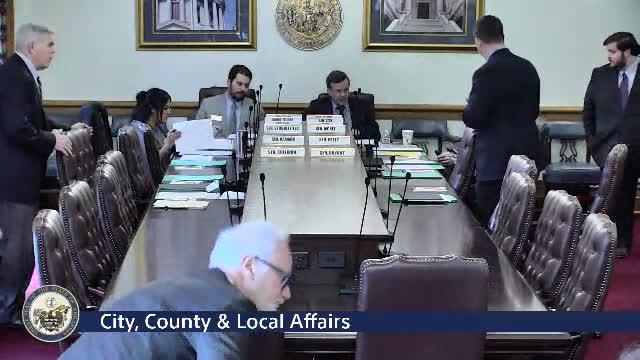
The Senate City, County & Local Affairs Committee on Monday approved a measure asking the U.S. Department of Housing and Urban Development to allow work requirements for able‑bodied, working‑age adults who receive public housing assistance.
Senator Ben Gilmore, Senate District 1, the bill’s senate sponsor, told the committee the proposal is aimed at encouraging work. "Work is honorable, and those who can work should work," Gilmore said when introducing House Bill 1196, which would ask the state to petition HUD to permit a work requirement for certain public‑housing recipients.
Representative Ken Underwood, co‑sponsor, said the committee’s version limits the requirement to part‑time activity. "If you meet the work requirement... it's only a part time requirement," Underwood said, describing the standard as 20 hours a week of paid work, 20 hours of volunteer service, or participation in a work program.
The bill includes exemptions the sponsors said they adjusted during committee preparation; Gilmore described an amendment changing an original child‑care exemption to cover a dependent child up to age 5.
Opponents urged caution. Bruno Showers, senior policy analyst for Arkansas Advocates for Children and Families, testified that prior experiments with work requirements produced little sustained improvement. "The results are not impressive at all," Showers said, summarizing national welfare‑to‑work research and Arkansas’s Medicaid work‑requirement efforts, and said such rules can create administrative burdens, redundant screening, and wrongful program exits.
During questioning, committee members asked for documentation supporting organizational testimony; Showers said a board committee authorizes his testimony and agreed to provide documentation to staff if requested.
In closing, Gilmore said the state petition follows recent executive actions on Medicaid and cited examples from other states where sponsors say work requirements have encouraged participation. He told the committee the state would reapply to HUD every 24 months if permission were denied.
A motion to advance the bill was made and seconded (mover recorded as Senator McKee; second recorded as Senator Bridal), the committee voted with vocal "aye" responses, and the chair announced the bill passed the committee.
Senator Ben Gilmore, Senate District 1, the bill’s senate sponsor, told the committee the proposal is aimed at encouraging work. "Work is honorable, and those who can work should work," Gilmore said when introducing House Bill 1196, which would ask the state to petition HUD to permit a work requirement for certain public‑housing recipients.
Representative Ken Underwood, co‑sponsor, said the committee’s version limits the requirement to part‑time activity. "If you meet the work requirement... it's only a part time requirement," Underwood said, describing the standard as 20 hours a week of paid work, 20 hours of volunteer service, or participation in a work program.
The bill includes exemptions the sponsors said they adjusted during committee preparation; Gilmore described an amendment changing an original child‑care exemption to cover a dependent child up to age 5.
Opponents urged caution. Bruno Showers, senior policy analyst for Arkansas Advocates for Children and Families, testified that prior experiments with work requirements produced little sustained improvement. "The results are not impressive at all," Showers said, summarizing national welfare‑to‑work research and Arkansas’s Medicaid work‑requirement efforts, and said such rules can create administrative burdens, redundant screening, and wrongful program exits.
During questioning, committee members asked for documentation supporting organizational testimony; Showers said a board committee authorizes his testimony and agreed to provide documentation to staff if requested.
In closing, Gilmore said the state petition follows recent executive actions on Medicaid and cited examples from other states where sponsors say work requirements have encouraged participation. He told the committee the state would reapply to HUD every 24 months if permission were denied.
A motion to advance the bill was made and seconded (mover recorded as Senator McKee; second recorded as Senator Bridal), the committee voted with vocal "aye" responses, and the chair announced the bill passed the committee.
Don't Miss a Word: See the Full Meeting!
Go beyond summaries. Unlock every video, transcript, and key insight with a Founder Membership.
✓
Get instant access to full meeting videos
✓
Search and clip any phrase from complete transcripts
✓
Receive AI-powered summaries & custom alerts
✓
Enjoy lifetime, unrestricted access to government data
30-day money-back guarantee
