Senate committee passes amended bills to curb crypto-mining: 0% foreign-ownership, standing for nearby property owners, penalties and rulemaking under Oil and G
April 18, 2024 | CITY, COUNTY & LOCAL AFFAIRS COMMITTEE - SENATE, Senate, Committees, Legislative, Arkansas
This article was created by AI summarizing key points discussed. AI makes mistakes, so for full details and context, please refer to the video of the full meeting. Please report any errors so we can fix them. Report an error »
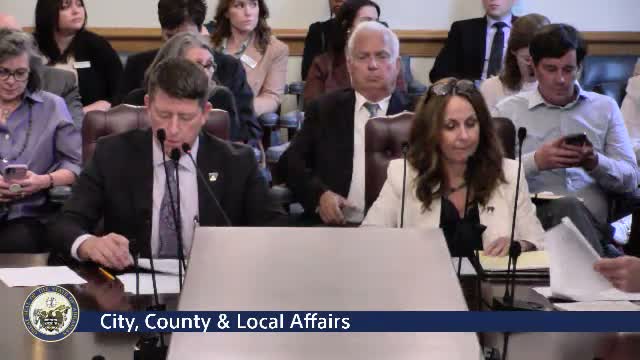
A Senate committee on Friday passed amended measures aimed at regulating digital asset (crypto) mining across Arkansas, imposing a 0% foreign-ownership prohibition, giving nearby property owners the right to sue for noise noncompliance and directing administrative rulemaking through the Oil and Gas Commission.
Senators voted to adopt the sponsors' amendments and then passed Senate Bill 78 as amended. Senator Bryant, who explained much of the amendment language, said the bills merge overlapping provisions to avoid conflict and to return local control where appropriate. "We are at 0% foreign ownership with heavy penalties," Bryant said, describing penalties of "$1,000,000 or 25% of fair market value" and an allocation of proceeds split "50% to the attorney general and 50% to the oil and gas commission".
The measures create standing for any property owner within 2,000 feet of a facility to bring suit in circuit court if facilities fail to comply with noise or other provisions. Sponsors said existing operations are given a limited compliance window: 90 days for noise provisions and 365 days to divest foreign ownership before enforcement action by the Attorney General's office.
Senator Irvin, a co-sponsor, described the bills as a package that provides a state regulatory framework while preserving local authority. "The state regulatory system and oversight provides great legal standing for our citizens," Irvin said, noting the bills include legislative intent language about cybersecurity and resource use and that the Oil and Gas Commission would promulgate rules under the Administrative Procedure Act.
Committee members pressed sponsors on enforcement and technical details. Senators asked whether investigations would be proactive or complaint-driven; sponsors answered that Oil and Gas investigations would be initiated upon complaint while foreign-ownership inquiries could begin with information received by the Attorney General.
Entergy Arkansas testified on how utilities would manage new customers. John Bethel, Entergy's director of public affairs, described an "interruptible" rate designed for crypto customers: the utility would give 30-minute or one-hour notice to interrupt service, interruptions could last up to four hours, and customers who fail to interrupt more than twice in a 12-month period would lose access to interruptible pricing and face financial penalties. "It's an interruptible rate, so that we can, upon, there are 2 notice periods in the rate schedule," Bethel said.
Public testimony highlighted local concerns. Kenneth Graves, chairman of the Arkansas Rice Growers Association and a DeWitt school board member, told the committee: "We don't want crypto in the state," citing noise, internet capacity near schools, water disposal and community impacts. Jerry Lee Bogard, a landowner, said the bills address risks to agricultural irrigation and the Sparta aquifer and praised the measures as initial protections for rural infrastructure.
The committee approved the amendments on voice votes (motions and second recorded in committee proceedings) and passed SB78 as amended. Sponsors said they are willing to reconvene for additional public comment if needed and that, because the measures include emergency clauses, administrative rulemaking could begin promptly after enactment.
The bills now move forward to the full Senate; sponsors and staff said the Oil and Gas Commission would develop specific rules and that the Legislative Council/Administrative Law Committee would review those rules under normal procedures.
Senators voted to adopt the sponsors' amendments and then passed Senate Bill 78 as amended. Senator Bryant, who explained much of the amendment language, said the bills merge overlapping provisions to avoid conflict and to return local control where appropriate. "We are at 0% foreign ownership with heavy penalties," Bryant said, describing penalties of "$1,000,000 or 25% of fair market value" and an allocation of proceeds split "50% to the attorney general and 50% to the oil and gas commission".
The measures create standing for any property owner within 2,000 feet of a facility to bring suit in circuit court if facilities fail to comply with noise or other provisions. Sponsors said existing operations are given a limited compliance window: 90 days for noise provisions and 365 days to divest foreign ownership before enforcement action by the Attorney General's office.
Senator Irvin, a co-sponsor, described the bills as a package that provides a state regulatory framework while preserving local authority. "The state regulatory system and oversight provides great legal standing for our citizens," Irvin said, noting the bills include legislative intent language about cybersecurity and resource use and that the Oil and Gas Commission would promulgate rules under the Administrative Procedure Act.
Committee members pressed sponsors on enforcement and technical details. Senators asked whether investigations would be proactive or complaint-driven; sponsors answered that Oil and Gas investigations would be initiated upon complaint while foreign-ownership inquiries could begin with information received by the Attorney General.
Entergy Arkansas testified on how utilities would manage new customers. John Bethel, Entergy's director of public affairs, described an "interruptible" rate designed for crypto customers: the utility would give 30-minute or one-hour notice to interrupt service, interruptions could last up to four hours, and customers who fail to interrupt more than twice in a 12-month period would lose access to interruptible pricing and face financial penalties. "It's an interruptible rate, so that we can, upon, there are 2 notice periods in the rate schedule," Bethel said.
Public testimony highlighted local concerns. Kenneth Graves, chairman of the Arkansas Rice Growers Association and a DeWitt school board member, told the committee: "We don't want crypto in the state," citing noise, internet capacity near schools, water disposal and community impacts. Jerry Lee Bogard, a landowner, said the bills address risks to agricultural irrigation and the Sparta aquifer and praised the measures as initial protections for rural infrastructure.
The committee approved the amendments on voice votes (motions and second recorded in committee proceedings) and passed SB78 as amended. Sponsors said they are willing to reconvene for additional public comment if needed and that, because the measures include emergency clauses, administrative rulemaking could begin promptly after enactment.
The bills now move forward to the full Senate; sponsors and staff said the Oil and Gas Commission would develop specific rules and that the Legislative Council/Administrative Law Committee would review those rules under normal procedures.
View the Full Meeting & All Its Details
This article offers just a summary. Unlock complete video, transcripts, and insights as a Founder Member.
✓
Watch full, unedited meeting videos
✓
Search every word spoken in unlimited transcripts
✓
AI summaries & real-time alerts (all government levels)
✓
Permanent access to expanding government content
30-day money-back guarantee
