Senate committee hears DCFS annual report showing foster‑care rise and staffing shortfalls
November 15, 2021 | CHILDREN AND YOUTH COMMITTEE - SENATE, Senate, Committees, Legislative, Arkansas
This article was created by AI summarizing key points discussed. AI makes mistakes, so for full details and context, please refer to the video of the full meeting. Please report any errors so we can fix them. Report an error »
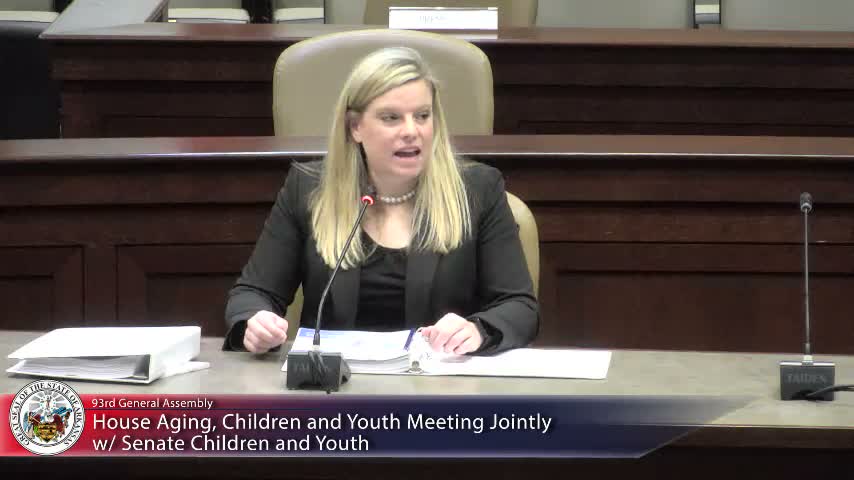
Director Misha Martin, director of the Division of Children and Family Services, told the Senate Children and Youth Committee that Arkansas saw measurable increases in foster‑care caseloads during state fiscal year 2021 and is responding with prevention programs and workforce changes.
"The child abuse hotline received 30,935 or accepted 30,935 reports," Martin said, adding that DCFS investigated 21,049 reports and served 4,029 families via differential response. She noted investigations with true findings rose slightly to 29% and that the state recorded 53 maltreatment investigations involving a child fatality in SFY2021.
Martin said initiation and completion timeliness remained close to prior years — initiation for priority 1 and 2 investigations at about 85% and completion timeliness at 81% (investigations completed within 45 days). She highlighted that recurrence of maltreatment within 12 months stood at 7%, below the 9.1% national standard.
The agency also reported a roughly 11% increase in the number of children in foster care over the previous year, driven in part by declining discharges from care. "We do not see a substantial increase in entries; discharges are one of the leading reasons that we continue to see an increase in the number of children in foster care," Martin said. She added that neglect remains the primary reason for entry into care.
Martin described placement and permanency data: at the end of SFY2021, 37% of children were placed with relatives (she said more recent counts exceed 40%), 54% of children had a permanency goal of reunification, and 93% of children exiting care achieved permanency through return home, placement with relatives, adoption, or another permanent arrangement.
On health and services, Martin said monthly documented contact with a family service worker was recorded for 82% of children and that comprehensive health assessments declined during COVID but were returning toward timeliness goals. She warned that placement stability remains a concern (placement moves per 1,000 days measured above the national standard).
Martin outlined prevention investments under the federal Family First Prevention Services Act and related state efforts, saying evidence‑based intensive in‑home programs implemented in 37 counties correlated with reductions in entries to foster care in those counties. She said the department will seek additional funding in the SFY2023 budget to expand successful programs.
The committee took no formal vote on program authorizations during the hearing; Martin and staff were asked to provide additional county‑level breakdowns in follow‑up materials.
"The child abuse hotline received 30,935 or accepted 30,935 reports," Martin said, adding that DCFS investigated 21,049 reports and served 4,029 families via differential response. She noted investigations with true findings rose slightly to 29% and that the state recorded 53 maltreatment investigations involving a child fatality in SFY2021.
Martin said initiation and completion timeliness remained close to prior years — initiation for priority 1 and 2 investigations at about 85% and completion timeliness at 81% (investigations completed within 45 days). She highlighted that recurrence of maltreatment within 12 months stood at 7%, below the 9.1% national standard.
The agency also reported a roughly 11% increase in the number of children in foster care over the previous year, driven in part by declining discharges from care. "We do not see a substantial increase in entries; discharges are one of the leading reasons that we continue to see an increase in the number of children in foster care," Martin said. She added that neglect remains the primary reason for entry into care.
Martin described placement and permanency data: at the end of SFY2021, 37% of children were placed with relatives (she said more recent counts exceed 40%), 54% of children had a permanency goal of reunification, and 93% of children exiting care achieved permanency through return home, placement with relatives, adoption, or another permanent arrangement.
On health and services, Martin said monthly documented contact with a family service worker was recorded for 82% of children and that comprehensive health assessments declined during COVID but were returning toward timeliness goals. She warned that placement stability remains a concern (placement moves per 1,000 days measured above the national standard).
Martin outlined prevention investments under the federal Family First Prevention Services Act and related state efforts, saying evidence‑based intensive in‑home programs implemented in 37 counties correlated with reductions in entries to foster care in those counties. She said the department will seek additional funding in the SFY2023 budget to expand successful programs.
The committee took no formal vote on program authorizations during the hearing; Martin and staff were asked to provide additional county‑level breakdowns in follow‑up materials.
Don't Miss a Word: See the Full Meeting!
Go beyond summaries. Unlock every video, transcript, and key insight with a Founder Membership.
✓
Get instant access to full meeting videos
✓
Search and clip any phrase from complete transcripts
✓
Receive AI-powered summaries & custom alerts
✓
Enjoy lifetime, unrestricted access to government data
30-day money-back guarantee
