Crimes Against Children Division reports hotline volume, case filings and staffing status
June 21, 2022 | CHILDREN AND YOUTH COMMITTEE - SENATE, Senate, Committees, Legislative, Arkansas
This article was created by AI summarizing key points discussed. AI makes mistakes, so for full details and context, please refer to the video of the full meeting. Please report any errors so we can fix them. Report an error »
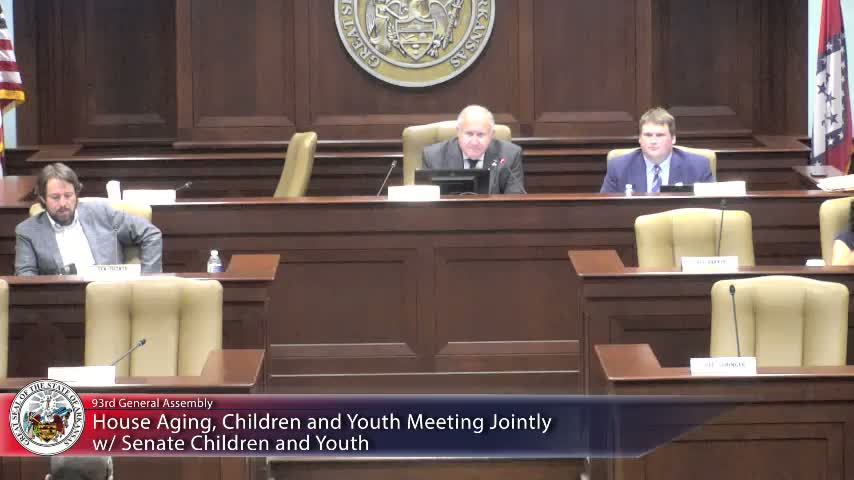
Major Jeff Drew, speaking for the Arkansas State Police Crimes Against Children Division (CACD), presented the division’s January–March quarterly report to the Senate Children and Youth Committee, summarizing hotline activity, case assignments and prosecutorial outcomes.
Drew said the statewide hotline received 14,737 calls during the quarter and 8,574 of those calls were accepted for further action; CACD handled 1,647 of the accepted cases while DCFS handled 5,472 and 1,455 were routed to differential response. "Presently, 2,523 cases are still active," he said, and noted 172 of those had been open longer than the statutory 45‑day target for completion.
CACD reported a substantiation rate of 34 percent for the cases assigned to the division in the period. Drew also walked through county‑level prosecutorial submission data: the report shows how many investigative referrals were sent to prosecuting attorneys, how many were filed and how many were declined; he said filing rates vary by district and that prosecutorial discretion and capacity affect filing patterns.
In response to a question about staffing, Drew said investigators were largely filled (only about four vacancies out of 73 investigative positions) but the hotline operator pool remained below full strength (about 21 of 35 operators staffed), which the division sees as a constraint on call processing and response times.
Committee members thanked CACD for the report and pressed on disparities in filing rates across judicial districts. Drew described that variation as a function of prosecutorial aggressiveness and case acceptance standards rather than a single statewide prosecutorial policy.
The presentation did not result in immediate committee action; members requested the data be monitored and available for follow‑up discussion with local prosecutors where filing patterns appear anomalous.
Drew said the statewide hotline received 14,737 calls during the quarter and 8,574 of those calls were accepted for further action; CACD handled 1,647 of the accepted cases while DCFS handled 5,472 and 1,455 were routed to differential response. "Presently, 2,523 cases are still active," he said, and noted 172 of those had been open longer than the statutory 45‑day target for completion.
CACD reported a substantiation rate of 34 percent for the cases assigned to the division in the period. Drew also walked through county‑level prosecutorial submission data: the report shows how many investigative referrals were sent to prosecuting attorneys, how many were filed and how many were declined; he said filing rates vary by district and that prosecutorial discretion and capacity affect filing patterns.
In response to a question about staffing, Drew said investigators were largely filled (only about four vacancies out of 73 investigative positions) but the hotline operator pool remained below full strength (about 21 of 35 operators staffed), which the division sees as a constraint on call processing and response times.
Committee members thanked CACD for the report and pressed on disparities in filing rates across judicial districts. Drew described that variation as a function of prosecutorial aggressiveness and case acceptance standards rather than a single statewide prosecutorial policy.
The presentation did not result in immediate committee action; members requested the data be monitored and available for follow‑up discussion with local prosecutors where filing patterns appear anomalous.
View the Full Meeting & All Its Details
This article offers just a summary. Unlock complete video, transcripts, and insights as a Founder Member.
✓
Watch full, unedited meeting videos
✓
Search every word spoken in unlimited transcripts
✓
AI summaries & real-time alerts (all government levels)
✓
Permanent access to expanding government content
30-day money-back guarantee
