Arkansas National Guard outlines missions, funding and programs to Senate children and youth panel
November 14, 2022 | CHILDREN AND YOUTH COMMITTEE - SENATE, Senate, Committees, Legislative, Arkansas
This article was created by AI summarizing key points discussed. AI makes mistakes, so for full details and context, please refer to the video of the full meeting. Please report any errors so we can fix them. Report an error »
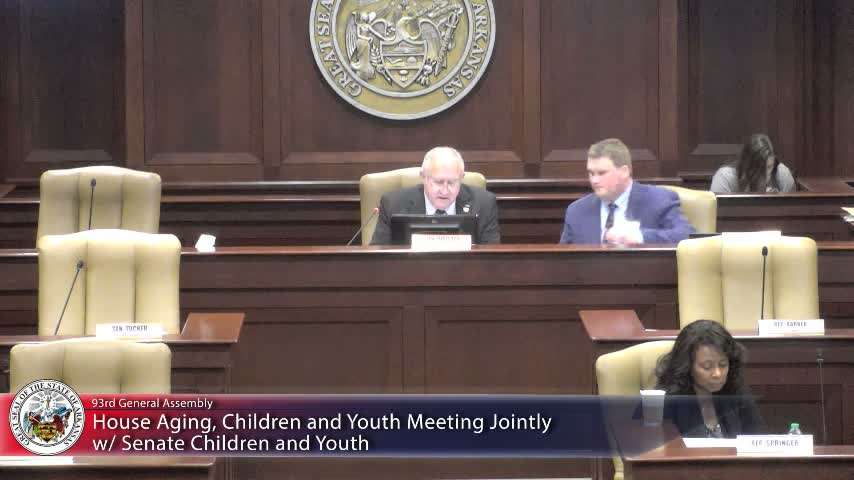
The Senate Children and Youth Committee heard a briefing from the Arkansas National Guard on the Guard's structure, missions and programs, and asked officials about local impacts and personnel policies.
Adjutant General Penn and staff told members the Guard operates under a dual state and federal mission, with the governor able to call forces into state active duty and federal authorities leading Title 10 activations. Lieutenant Colonel Will Phillips said Arkansas is "community based" with units and personnel spread across the state to respond quickly when directed by civil authorities.
The briefing gave detailed force numbers and facilities: roughly 6,500 Army Guardsmen, about 22% Air National Guard personnel, major training sites at Camp Robinson, Fort Chaffee and Ebbing Air National Guard Base, and specialized units including aviation brigades, field artillery brigades and the 180th Airlift Wing, which will host expanded C-130 training.
Officials highlighted economic and operational impacts. Phillips said roughly $783,000,000 in annual economic activity is tied to the Guard's presence; General Penn emphasized federal investment in state readiness and cited about $454,000,000 in federal equipment, facilities and manpower in-state. State funding for state active-duty missions was described as roughly $2,000,000 annually.
Committee members questioned program expansion and personnel policy. Representative Bentley praised the Youth Challenge program and asked whether the program could be expanded; Guard staff said they are trying to maximize class loads at Camp Robinson and would seek additional national funds after demonstrating local capacity. On vaccine policy, members asked whether religious exemptions for Guard members could be recommended. General Penn replied that exemption decisions rest with the service secretary but said his office reviews requests and that, "I have made my recommendation not to approve any" exemptions when they would impair unit readiness because personnel granted exemptions would be unable to deploy to federal missions.
Members also raised facility maintenance needs: committee members asked how many armories exist and whether they receive adequate funding. Penn said the state has 52 armories and that 12 still lack women's restrooms; he said a maintenance request to address backlogs, including latrine upgrades, was included in the governor's budget submission.
The committee did not take formal action on Guard policy during the session but recorded the briefing for further legislative follow-up and budgeting discussions.
Ending: The committee thanked the Guard presenters and moved on to other docket items.
Adjutant General Penn and staff told members the Guard operates under a dual state and federal mission, with the governor able to call forces into state active duty and federal authorities leading Title 10 activations. Lieutenant Colonel Will Phillips said Arkansas is "community based" with units and personnel spread across the state to respond quickly when directed by civil authorities.
The briefing gave detailed force numbers and facilities: roughly 6,500 Army Guardsmen, about 22% Air National Guard personnel, major training sites at Camp Robinson, Fort Chaffee and Ebbing Air National Guard Base, and specialized units including aviation brigades, field artillery brigades and the 180th Airlift Wing, which will host expanded C-130 training.
Officials highlighted economic and operational impacts. Phillips said roughly $783,000,000 in annual economic activity is tied to the Guard's presence; General Penn emphasized federal investment in state readiness and cited about $454,000,000 in federal equipment, facilities and manpower in-state. State funding for state active-duty missions was described as roughly $2,000,000 annually.
Committee members questioned program expansion and personnel policy. Representative Bentley praised the Youth Challenge program and asked whether the program could be expanded; Guard staff said they are trying to maximize class loads at Camp Robinson and would seek additional national funds after demonstrating local capacity. On vaccine policy, members asked whether religious exemptions for Guard members could be recommended. General Penn replied that exemption decisions rest with the service secretary but said his office reviews requests and that, "I have made my recommendation not to approve any" exemptions when they would impair unit readiness because personnel granted exemptions would be unable to deploy to federal missions.
Members also raised facility maintenance needs: committee members asked how many armories exist and whether they receive adequate funding. Penn said the state has 52 armories and that 12 still lack women's restrooms; he said a maintenance request to address backlogs, including latrine upgrades, was included in the governor's budget submission.
The committee did not take formal action on Guard policy during the session but recorded the briefing for further legislative follow-up and budgeting discussions.
Ending: The committee thanked the Guard presenters and moved on to other docket items.
View the Full Meeting & All Its Details
This article offers just a summary. Unlock complete video, transcripts, and insights as a Founder Member.
✓
Watch full, unedited meeting videos
✓
Search every word spoken in unlimited transcripts
✓
AI summaries & real-time alerts (all government levels)
✓
Permanent access to expanding government content
30-day money-back guarantee
