Arkansas deaf advocates ask legislature for funding to establish statewide Deaf Services Center
September 20, 2022 | CHILDREN AND YOUTH COMMITTEE - SENATE, Senate, Committees, Legislative, Arkansas
This article was created by AI summarizing key points discussed. AI makes mistakes, so for full details and context, please refer to the video of the full meeting. Please report any errors so we can fix them. Report an error »
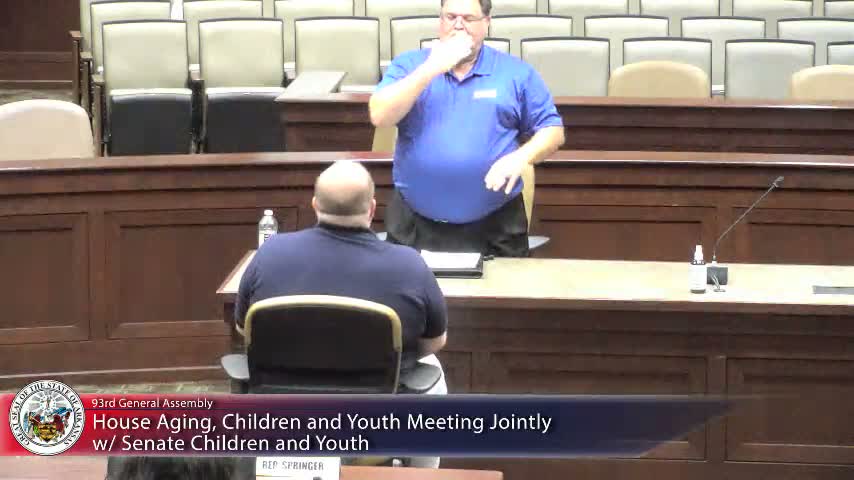
Jeff Prael, representing the Arkansas Association of the Deaf, told the Senate Children and Youth Committee that people who are deaf in Arkansas face gaps in access to mental-health care and other state services and proposed creating a statewide Deaf Services Center led by deaf staff.
Prael recounted a case of a deaf man with severe mental illness who “remains homeless” because shelters and mental-health facilities lacked interpreter services or staff fluent in sign language, and said the state “failed him” and that he “became a statistic.” He also described a separate case in which a deaf mother of two repeatedly requested interpreters from the Department of Children and Family Services and, Prael said, was labeled “an unfit mother” because she could not communicate effectively with DCFS staff. “The state did not comply with ADA Title 2,” Prael said.
Prael asked the committee to support two funding paths to establish the center: a one-time request to the governor for $1,500,000 from surplus or “rainy day” funds and an annual appropriation of $350,000–$500,000 to operate the center with four staff. He said the group plans to meet with the governor’s office and had briefed the governor’s liaison, Jay, at a recent town hall. Prael also told members the National Association of the Deaf had recently recognized Arkansas as the top state for providing accessible COVID-19 information, and he said the state should sustain that reputation.
Committee members pressed Prael on timing and next steps. Representative Springer asked whether the request to the governor had already been made; Prael said a town hall with the governor’s liaison had taken place and that he expected to pass a request to the governor’s office after a planned meeting with Jordan. When asked whether there is a deadline, Prael said “time is of the essence” and that he had been told the governor could make funding decisions before his term expired.
Michelle Martin, director of the Division of Children and Family Services, said she was not familiar with the specific cases Prael described and offered to follow up after the hearing. Martin told the committee DCFS maintains a statewide contract with Communications Plus for interpreter services and that she would coordinate with Medicaid and the Division of Aging and Adult Behavioral Health to clarify what happened in the cited cases. “I definitely need to look into it and figure out what happened,” Martin said.
The committee did not take a formal vote on the funding request; members asked DHS staff to follow up and to return with information at the next committee meeting so the committee could better understand where communication breakdowns occurred and what state resources are available.
What happens next: Prael and advocacy group representatives said they plan to meet with the governor’s office and to seek a budget appropriation. DHS and DCFS staff committed to investigate the specific cases Prael raised and to report back to the committee.
Prael recounted a case of a deaf man with severe mental illness who “remains homeless” because shelters and mental-health facilities lacked interpreter services or staff fluent in sign language, and said the state “failed him” and that he “became a statistic.” He also described a separate case in which a deaf mother of two repeatedly requested interpreters from the Department of Children and Family Services and, Prael said, was labeled “an unfit mother” because she could not communicate effectively with DCFS staff. “The state did not comply with ADA Title 2,” Prael said.
Prael asked the committee to support two funding paths to establish the center: a one-time request to the governor for $1,500,000 from surplus or “rainy day” funds and an annual appropriation of $350,000–$500,000 to operate the center with four staff. He said the group plans to meet with the governor’s office and had briefed the governor’s liaison, Jay, at a recent town hall. Prael also told members the National Association of the Deaf had recently recognized Arkansas as the top state for providing accessible COVID-19 information, and he said the state should sustain that reputation.
Committee members pressed Prael on timing and next steps. Representative Springer asked whether the request to the governor had already been made; Prael said a town hall with the governor’s liaison had taken place and that he expected to pass a request to the governor’s office after a planned meeting with Jordan. When asked whether there is a deadline, Prael said “time is of the essence” and that he had been told the governor could make funding decisions before his term expired.
Michelle Martin, director of the Division of Children and Family Services, said she was not familiar with the specific cases Prael described and offered to follow up after the hearing. Martin told the committee DCFS maintains a statewide contract with Communications Plus for interpreter services and that she would coordinate with Medicaid and the Division of Aging and Adult Behavioral Health to clarify what happened in the cited cases. “I definitely need to look into it and figure out what happened,” Martin said.
The committee did not take a formal vote on the funding request; members asked DHS staff to follow up and to return with information at the next committee meeting so the committee could better understand where communication breakdowns occurred and what state resources are available.
What happens next: Prael and advocacy group representatives said they plan to meet with the governor’s office and to seek a budget appropriation. DHS and DCFS staff committed to investigate the specific cases Prael raised and to report back to the committee.
Don't Miss a Word: See the Full Meeting!
Go beyond summaries. Unlock every video, transcript, and key insight with a Founder Membership.
✓
Get instant access to full meeting videos
✓
Search and clip any phrase from complete transcripts
✓
Receive AI-powered summaries & custom alerts
✓
Enjoy lifetime, unrestricted access to government data
30-day money-back guarantee
