Senate committee hears banking officials on AI risks and rising elder financial fraud
January 29, 2024 | CHILDREN AND YOUTH COMMITTEE - SENATE, Senate, Committees, Legislative, Arkansas
This article was created by AI summarizing key points discussed. AI makes mistakes, so for full details and context, please refer to the video of the full meeting. Please report any errors so we can fix them. Report an error »
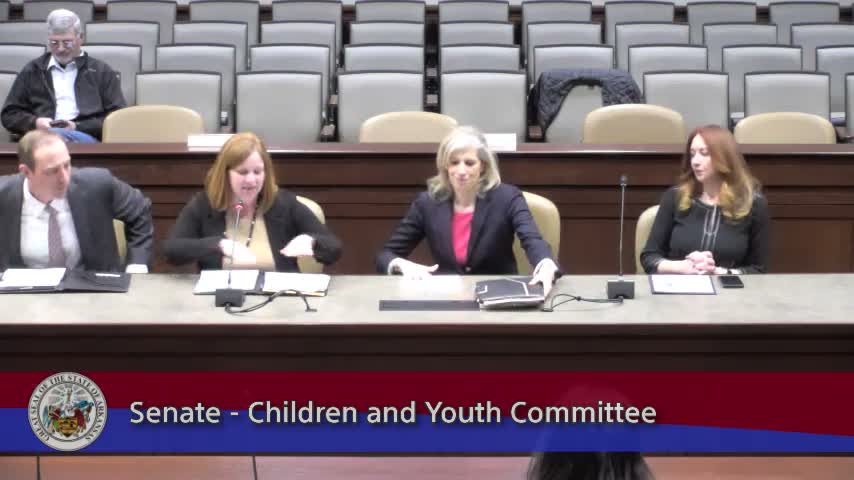
Susanna Marshall, Arkansas bank commissioner and Arkansas securities commissioner, told the Senate Children and Youth Committee that artificial intelligence already touches everyday banking products and will grow in use for cost savings, fraud detection and faster delivery of services. "We want to encourage that, and we want them to do it in a safe and sound manner," Marshall said, adding that institutions should build strong risk‑management frameworks and prioritize cybersecurity and consumer protections.
Campbell McLaren, deputy commissioner of the Arkansas Securities Department, said the division is tracking two rising threats: elder financial abuse and technology‑enabled frauds. Citing a report from the FBI’s Internet Crime Complaint Center, McLaren said "in 2022 there were 650 victims over age 60 in Arkansas and $24,000,000 in losses." He described enforcement, investor education and a grants program (funded from enforcement receipts) as the department’s primary responses.
Karen Tierney, director of consumer services and legislative affairs for the securities department, outlined how money‑services businesses and fintechs are adopting AI, machine learning and blockchain for payments and customer service while creating new areas of vulnerability. She noted existing federal and state compliance frameworks — including the Gramm‑Leach‑Bliley Act, fair‑lending rules and HMDA — remain relevant and cited the National Institute of Standards and Technology’s AI Risk Management Framework as a tool for institutions.
Lori Trogdon, president and CEO of the Arkansas Bankers Association, gave concrete fraud examples and said banks combine AI detection tools with trained frontline staff to stop scams. Trogdon emphasized consumer education programs and urged customers to use fraud controls the banks offer. She summarized simple steps under an acronym she called FAR — flip the card and call the number printed on it, protect account information, and report suspected fraud — and pointed legislators to the "Banks Never Ask That" campaign.
Committee members asked whether state law needs to be changed to address AI or fraud. Marshall said she did not see an immediate state‑law gap for FDIC‑insured banks because those institutions are also subject to federal regulators. Panelists recommended partnering with federal regulators and law enforcement while emphasizing state outreach, prevention and consumer education.
Panelists and lawmakers warned that many fraud perpetrators operate outside state borders, complicating detection and prosecution, and that some elder frauds go unreported. McLaren and colleagues said the department’s most effective tools are early detection, public education (presentations at civic groups and retirement centers) and coordination with law enforcement. The meeting ended with the chair asking staff to distribute the panels’ resources to committee members and signaling the committee will keep the topic under review.
Campbell McLaren, deputy commissioner of the Arkansas Securities Department, said the division is tracking two rising threats: elder financial abuse and technology‑enabled frauds. Citing a report from the FBI’s Internet Crime Complaint Center, McLaren said "in 2022 there were 650 victims over age 60 in Arkansas and $24,000,000 in losses." He described enforcement, investor education and a grants program (funded from enforcement receipts) as the department’s primary responses.
Karen Tierney, director of consumer services and legislative affairs for the securities department, outlined how money‑services businesses and fintechs are adopting AI, machine learning and blockchain for payments and customer service while creating new areas of vulnerability. She noted existing federal and state compliance frameworks — including the Gramm‑Leach‑Bliley Act, fair‑lending rules and HMDA — remain relevant and cited the National Institute of Standards and Technology’s AI Risk Management Framework as a tool for institutions.
Lori Trogdon, president and CEO of the Arkansas Bankers Association, gave concrete fraud examples and said banks combine AI detection tools with trained frontline staff to stop scams. Trogdon emphasized consumer education programs and urged customers to use fraud controls the banks offer. She summarized simple steps under an acronym she called FAR — flip the card and call the number printed on it, protect account information, and report suspected fraud — and pointed legislators to the "Banks Never Ask That" campaign.
Committee members asked whether state law needs to be changed to address AI or fraud. Marshall said she did not see an immediate state‑law gap for FDIC‑insured banks because those institutions are also subject to federal regulators. Panelists recommended partnering with federal regulators and law enforcement while emphasizing state outreach, prevention and consumer education.
Panelists and lawmakers warned that many fraud perpetrators operate outside state borders, complicating detection and prosecution, and that some elder frauds go unreported. McLaren and colleagues said the department’s most effective tools are early detection, public education (presentations at civic groups and retirement centers) and coordination with law enforcement. The meeting ended with the chair asking staff to distribute the panels’ resources to committee members and signaling the committee will keep the topic under review.
Don't Miss a Word: See the Full Meeting!
Go beyond summaries. Unlock every video, transcript, and key insight with a Founder Membership.
✓
Get instant access to full meeting videos
✓
Search and clip any phrase from complete transcripts
✓
Receive AI-powered summaries & custom alerts
✓
Enjoy lifetime, unrestricted access to government data
30-day money-back guarantee
